U.S. Peace Movement to Send Delegation to Venezuela

U.S. Peace Movement to Send Delegation to Venezuela

Yesterday, February 27, 2019, a press conference was held at the United Nations press room in New York City to announce that leaders of the U.S. peace movement will be going to Venezuela to speak with government and civic groups about what is really happening in that country and how we can add our voices to stop any coup attempts or moves towards war. A number of United National Antiwar Coalition (UNAC) people will be on the trip, which has been organized by UNAC affiliate, the U.S. Peace Council.

Four members of the 13 person peace delegation spoke at the UN press conference including:

  • Joe Lombardo, Co-Coordinator of the United National Antiwar Coalition

  • Ajamu Baraka, National Organizer, Black Alliance for Peace

  • Bahman Azad, Organizational Secretary of the U.S. Peace Council

  • Sara Flounders, Co-Director of the International Action Center

Besides speaking about their trip, the participants urged support for the national rally in Washington, D.C., on March 30 when NATO will be coming to the US Capital to celebrate their 70th anniversary. The newest NATO partner and the first in Latin America is the country of Colombia, which has been acting as a U.S. proxy in the region to intervene into the affairs of Venezuela. Information on the March 30 action can be found here: http://no2nato2019.org.

If you would like to help finance the trip to Venezuela, please make a donation to the United National Antiwar Coalition here: https://www.unacpeace.org/donate.html. All money that is donated to UNAC between now and March 9, when the delegation leaves for Venezuela, will go to support the delegation.

Statement released by UNAC

Cuban Statement on U.S. Intervention in Venezuela

Cuban Statement on U.S. Intervention in Venezuela

The Revolutionary Government of the Republic of Cuba condemns the escalation of pressures and actions by the U.S. government in preparation for a military adventure under the guise of a “humanitarian intervention” in the Bolivarian Republic of Venezuela, and calls on the international community to mobilize in order to prevent its consummation.

Between February 6 and 10 of 2019, several military transport aircraft have flown to the Rafael Miranda Airport in Puerto Rico, the San Isidro Air Base in the Dominican Republic, and other strategically located Caribbean Islands, most certainly without the knowledge of the governments of those nations. These flights took off from U.S. military facilities where Special Operation Troops and U.S. Marine Corps units operate. These units have been used for covert operations, even against leaders of other countries.

Media and political circles—including within the U.S.—have revealed that extremist figures of the government with a long history of actions and slander aimed at causing or instigating wars, such as John Bolton, U.S. National Security Advisor; and Mauricio Claver-Carone, Director of the National Security Council’s Office of Western Hemisphere Affairs, counting on the connivance of Marco Rubio, Senator of the anti-Cuban mafia in Florida, designed, directly and thoroughly organized, and funded, from their posts in Washington, the attempted coup d’etat in Venezuela by means of the illegal self-proclamation of a President.

They are the same individuals who, either personally or through the State Department, have been exerting brutal pressures on numerous governments to force them to support the arbitrary call for new Presidential elections in Venezuela, while promoting recognition for the usurper who barely won 97,000 votes as a parliamentarian, against the more than 6 million Venezuelans who elected Constitutional President Nicolás Maduro Moros last May.

After the resistance mounted by the Bolivarian and Chavista people against the coup, evidenced by the mass demonstrations in support of President Maduro, and the loyalty of the National Bolivarian Armed Forces, the U.S. government has intensified its international political and media campaign, and strengthened unilateral economic coercive measures against Venezuela, among them the freezing of Venezuelan funds in third countries banks, worth billions of dollars, and the theft of this sister nation’s oil revenue, causing serious humanitarian damage and harsh deprivation to its people.

In addition to this cruel and unjustifiable plunder, the U.S. intends to fabricate a humanitarian pretext in order to launch a military attack on Venezuela and, by resorting to intimidation, pressure, and force, is seeking to introduce into this sovereign nation’s territory alleged humanitarian aid—which is one thousand times inferior as compared to the economic damages provoked by the siege imposed by Washington.

The usurper and self-proclaimed “President” shamelessly announced his disposition to call for a U.S. military intervention under the pretext of receiving the aforementioned humanitarian aid, and has described the sovereign and honorable rejection of that maneuver as a crime against humanity.

High-ranking U.S. officials have been arrogantly and blatantly reminding us all, day after day, that when it comes to Venezuela, “all options are on the table, including military action.”

In the process of fabricating pretexts, the U.S .government has resorted to deception and slanders, presenting a draft resolution at the UN Security Council which, cynically and hypocritically expresses deep concern for the human rights and humanitarian situation, the recent attempts to block the delivery of humanitarian aid, the millions of Venezuelan refugees and migrants, the excessive use of force against peaceful protesters, the breakdown of regional peace and security in Venezuela, and calls for taking the necessary steps.

It is obvious that the United States is paving the way to forcibly establish a humanitarian corridor under international supervision, invoke the obligation to protect civilians and take all necessary steps.

It is worth recalling that similar behaviors and pretexts were used to by the U.S. during the prelude to wars it launched against Yugoslavia, Iraq, and Libya, which resulted in tremendous human losses and caused enormous suffering.

The U.S. government attempts to remove the biggest obstacle—the Bolivarian and Chavista Revolution—to imperialist domination of Our America and deprive the Venezuelan people of the largest certified oil reserves on the planet and numerous strategic natural resources.

It is impossible to forget the sad and painful history of U.S. military interventions perpetrated more than once in Mexico, Nicaragua, the Dominican Republic, Haiti, Cuba, Honduras, and most recently Grenada and Panama.

As was warned by Army General Raúl Castro Ruz on July 14, 2017, “The aggression and coup violence against Venezuela harm all of Our America and only benefit the interests of those set on dividing us in order to exercise their control over our peoples, unconcerned about causing conflicts of incalculable consequences in this region, like those we are seeing in different parts of the world.”

History will severely judge a new imperialist military intervention in the region and the complicity of those who might irresponsibly support it.

What is at stake today in Venezuela is the sovereignty and dignity of Latin America and the Caribbean and the peoples of the South. Equally at stake is the survival of the rule of International Law and the UN Charter. What is being defined today is whether the legitimacy of a government emanates from the express and sovereign will of its people, or from the recognition of foreign powers.

The Revolutionary Government calls for an international mobilization in defense of peace in Venezuela and the region, based on the principles established in the Proclamation of Latin America and the Caribbean as a Zone of Peace, which was adopted by heads of state and government of CELAC in 2014.

It likewise welcomes and supports the Montevideo Mechanism, an initiative promoted by Mexico, Uruguay, the Caribbean Commonwealth (CARICOM), and Bolivia, which seeks to preserve peace in Venezuela based on the principles of non-interference in the internal affairs of states, legal equality of states, and the peaceful resolution of conflicts, as stated in its recent declaration.

It welcomes the positive consideration given to this initiative by President Maduro Moros and the international community, and expresses its concern given the U.S. government’s categorical rejection of the dialogue initiatives promoted by several countries, including this one.

The Revolutionary Government reiterates its firm and unwavering solidarity with Constitutional President Nicolás Maduro Moros, the Bolivarian Chavista Revolution and the civic and military unity of its people, and calls upon all peoples and governments of the world to defend peace and mount a joint opposition, over and above political or ideological differences, to a new imperialist military intervention in Latin America and the Caribbean, which will damage the independence, sovereignty and interests of all peoples from the Rio Bravo to Patagonia.

Havana, February 12, 2019

Photo credit: Carlos Garcia Rawlins/Reuters

Nicolás Maduro: An Open Letter to the People of the United States

Nicolás Maduro: An Open Letter to the People of the United States

By Nicolás Maduro

February 7, 2019 

If I know anything, it is about peoples, such as you, I am a man of the people. I was born and raised in a poor neighborhood of Caracas. I forged myself in the heat of popular and union struggles in a Venezuela submerged in exclusion and inequality. I am not a tycoon, I am a worker of reason and heart, today I have the great privilege of presiding over the new Venezuela, rooted in a model of inclusive development and social equality, which was forged by Commander Hugo Chávez since 1998 inspired by the Bolivarian legacy.

We live today a historical trance. There are days that will define the future of our countries between war and peace. Your national representatives of Washington want to bring to their borders the same hatred that they planted in Vietnam. They want to invade and intervene in Venezuela - they say, as they said then - in the name of democracy and freedom. But it's not like that. The history of the usurpation of power in Venezuela is as false as the weapons of mass destruction in Iraq. It is a false case, but it can have dramatic consequences for our entire region.

Venezuela is a country that, by virtue of its 1999 Constitution, has broadly expanded the participatory and protagonist democracy of the people, and that is unprecedented today, as one of the countries with the largest number of electoral processes in its last 20 years. You might not like our ideology or our appearance, but we exist and we are millions.

I address these words to the people of the United States of America to warn of the gravity and danger that intend some sectors in the White House to invade Venezuela with unpredictable consequences for my country and for the entire American region. President Donald Trump also intends to disturb noble dialogue initiatives promoted by Uruguay and Mexico with the support of CARICOM for a peaceful solution and dialogue in favor of Venezuela. We know that for the good of Venezuela we have to sit down and talk because to refuse to dialogue is to choose strength as a way. Keep in mind the words of John F. Kennedy: "Let us never negotiate out of fear. But let us never fear to negotiate". Are those who do not want to dialogue afraid of the truth?

The political intolerance towards the Venezuelan Bolivarian model and the desires for our immense oil resources, minerals, and other great riches, has prompted an international coalition headed by the US government to commit the serious insanity of militarily attacking Venezuela under the false excuse of a non-existent humanitarian crisis.

The people of Venezuela have suffered painfully social wounds caused by a criminal commercial and financial blockade, which has been aggravated by the dispossession and robbery of our financial resources and assets in countries aligned with this demented onslaught.

And yet, thanks to a new system of social protection, of direct attention to the most vulnerable sectors, we proudly continue to be a country with high human development index and lower inequality in the Americas.

The American people must know that this complex multiform aggression is carried out with total impunity and in clear violation of the Charter of the United Nations, which expressly outlaws the threat or use of force, among other principles and purposes for the sake of peace and the friendly relations between the Nations.

We want to continue being business partners of the people of the United States, as we have been throughout our history. Their politicians in Washington, on the other hand, are willing to send their sons and daughters to die in an absurd war, instead of respecting the sacred right of the Venezuelan people to self-determination and safeguarding their sovereignty.

Like you, people of the United States, we Venezuelans are patriots. And we shall defend our homeland with all the pieces of our soul. Today Venezuela is united in a single clamor: we demand the cessation of the aggression that seeks to suffocate our economy and socially suffocate our people, as well as the cessation of the serious and dangerous threats of military intervention against Venezuela. We appeal to the good soul of the American society, a victim of its own leaders, to join our call for peace, let us be all one people against warmongering and war.

Long live the peoples of America!

Nicolás Maduro
President of the Bolivarian Republic of Venezuela

Photo credit: AFP

U.S. Peace Council Rejects Intervention into Venezuela

U.S. Peace Council Rejects Intervention into Venezuela

Reject Interference and Threats Against the Re-elected Government of Venezuela!

Socorro Gomes
President of the World Peace Council
January 8, 2019

The democratic and progressive forces follow and denounce the endless sequence of statements, sanctions and other offensive measures against the Bolivarian Republic of Venezuela. This time, in line with the imperialist agenda dictated by the United States for Latin America and the Caribbean, with the exception of Mexico under a new government, the countries that make up the Lima Group have again charged against Venezuela and, consequently, against its people, its sovereignty and democracy, declaring that they will not recognize the legitimacy of the government of the reelected President Nicolás Maduro, to be inaugurated on January 10.

In its contempt for the democratic and legitimate electoral process, as recognized by international observers, the Lima Group, in its statement of January 4, dared to demand the President re-elected by the Venezuelan people not to begin his new term. Such arrogance is unacceptable, especially in a region that has long suffered from the direct foreign interference commanded by the USA, where people have always had to fight hard for democracy.

Regime change operations, in various forms, are nothing more than coups d’état that trample over the citizens’ civil and political rights and the nations’ sovereignty, preventing regional stability and relations of respect, cooperation and friendship that will consolidate a just and sovereign peace. Even more outrageous is that they are promoted precisely under the pretext of protecting democracy. The Bolivarian government has a history of popular consultation practices that confirm its legitimacy and are unprecedented in those countries whose governments pretend to be the police of democracy in the continent – starting with the governments of Colombia, Peru and Brazil after the 2016 coup d’état.

The World Peace Council has reiterated its solidarity with the Venezuelan people in confronting foreign interference conducted whether through the Lima Group or the Organization of American States, but always coordinated by the bosses of the reactionary and putschist forces, the United States. The defense of Venezuela’s sovereignty is essential to ensuring peace on the continent and strengthening the bonds of respect and friendship among its peoples.

We join all peace-loving and freedom-loving forces in the irreducible support for the Venezuelan people’s struggle for their democracy and for overcoming sovereignly the serious political and economic crisis, which is inflated through a heavy media, economic and political war, causing instability, seeking to instigate polarization in the country. We are certain that the resistant Venezuelan people will overcome this threat, but we remain vigilant, mobilized in denunciation and in solidarity with their struggle!

All respect for the sovereignty of the Bolivarian Republic of Venezuela!

No to the interference of the Lima Group!

In defense of Peace among the Latin American and Caribbean nations!

Photo credit: Reuters

First Conference Against U.S./NATO Military Bases

First Conference Against U.S./NATO Military Bases

Press Communiqué of the First International Conference Against U.S./NATO Military Bases

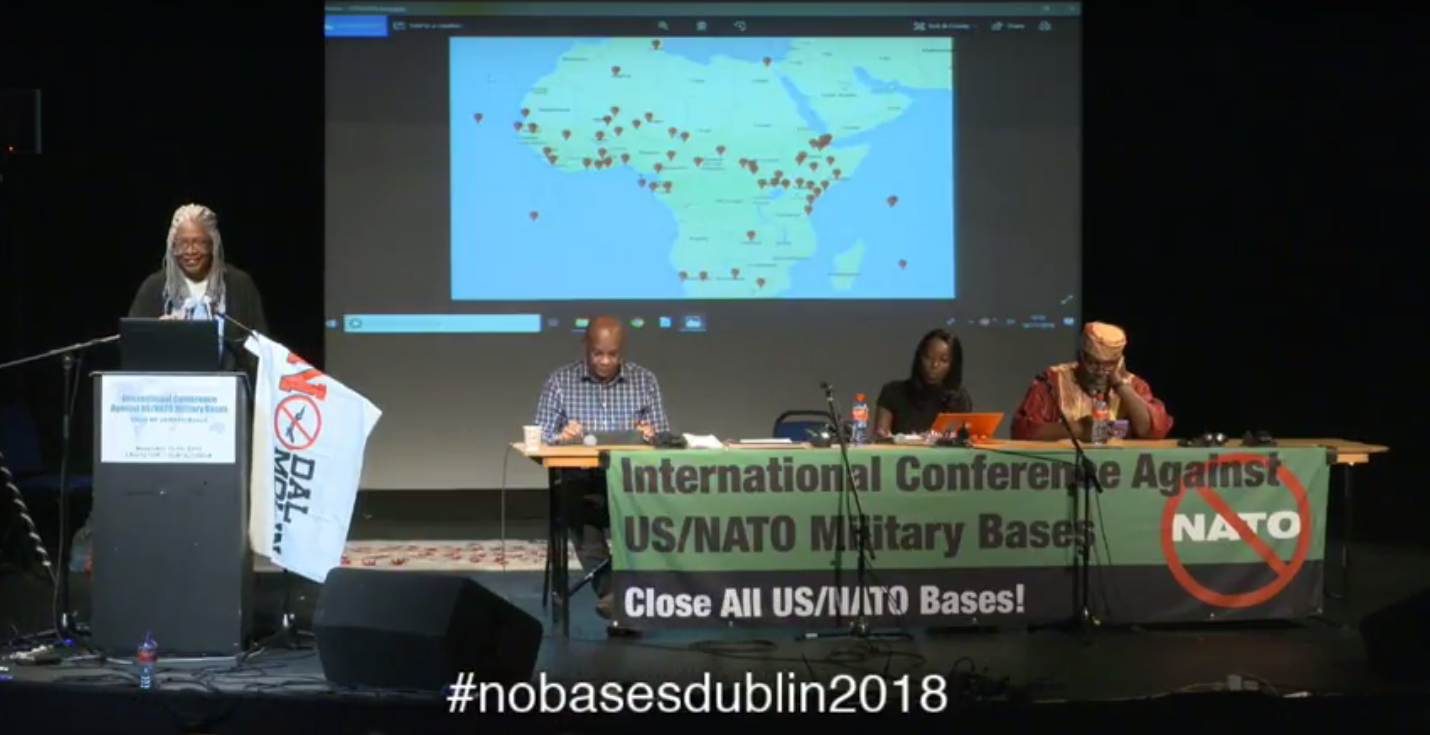
The First International Conference Against U.S./NATO Military Bases was held on November 16-18, at the Liberty Hall in Dublin, Ireland. The conference was attended by close to 300 participants from over thirty-five countries from around the world. Speakers representing countries from all continents, including Cuba, Argentina, Brazil, Colombia, United States, Italy, Germany, Portugal, Greece, Cyprus, Turkey, Poland, United Kingdom, Ireland, Czech Republic, Israel, Palestine, Kenya, D.R. Congo, Japan and Australia, made presentations at the conference.

This conference was the first organized effort by the newly formed Global Campaign Against U.S./NATO Military Bases, created by over 35 peace, justice and environmental organizations and endorsed by over 700 other organizations and activists from around the world. What brought all of us together in this International Conference was our agreement with the principles outlined in the Global Campaign’s Unity Statement, which was endorsed by the Conference participants.

The participants in the Conference heard from and shared with representatives of organizations and movements struggling for the abolition of foreign military bases from around the world about the aggressions, interventions, death, destruction, and the health and environmental damages that the military bases have been causing for the whole humanity along with the threats and violation to the sovereignty of the “host” countries.

The participants and organizers of the conference agreed as a matter of principle that while they oppose all foreign military bases, they consider the close to 1,000 US/NATO military bases established throughout the world, which constitute the main pillars of global imperialist domination by U.S., NATO and EU states, as the main threat to peace and humanity, and must all be closed. The NATO states’ military bases are the military expression of imperialist intervention in the lives of sovereign countries on behalf of the dominant, financial, political, and military interests, for the control of energy resources, transport roads, markets and spheres of influence, in clear violation of international law and the United Nations Charter.

The participants in theConference call upon the organizations and movements who agree on the above to work closely with each other in a coordinated manner as a part of the Global Campaign to organize and mobilize the public around the world against U.S./NATO military bases.

While we call for the closure of all U.S./NATO military bases, we consider the closure of bases and military installations in certain countries and areas as needing special attention by the international movement. These, for example, include the Guantanamo US base in Cuba, the US bases in Okinawa and South Korea, the U.S. Base in Rammstein/Germany, Serbia, the old and new U.S./NATO bases in Greece and Cyprus, the establishment of the new U.S. African Command (AFRICOM) with its affiliated military bases in Africa, the numerous NATO bases in Italy and Scandinavia, the Shannon Airport in Ireland, which is being used as a military base by the U.S. and NATO, and the newly established bases by the United States, France and their allies on and around the Syrian soil. 

In order to continue our joint Global Campaign in solidarity with the just causes of the peoples in their struggle against foreign military aggression, occupation and interference in their internal affairs, and the devastating environmental and health impacts of these bases the participants agreed to recommend and to support coordinated actions and initiatives in the coming year (2019) which shall strengthen the global movement to expand the actions and cooperation while moving forward. 

As a step toward this goal, the conference supports the global mass mobilizations against NATO’s 70th Anniversary Summit in Washington D.C., on April 4, 2019 and respective protests in the NATO member states and worldwide.

We declare our solidarity with the Cuban people’s decades-long efforts to take back their Guantanamo territory, illegally occupied by the United States, and declare our support for the Sixth International Seminar for Peace and the Abolition of Foreign Military Bases, organized by MOVPAZ for May 4-6, 2019, in Guantanamo, Cuba.

The participants express their most sincere thanks and gratitude to the Peace and Neutrality Alliance (PANA) Ireland, for their generous hospitality and support in hosting this historic Conference.  

Adopted by the participants at the

First International Conference Against U.S./NATO Military Bases

November 18, 2018

Dublin, Ireland


Watch videos from all three days of the First Conference Against U.S./NATO Military Bases, which was held in Dublin, Ireland, November 16-18. BAP National Organizer Ajamu Baraka and BAP Coordinating Committee member Margaret Kimberley serve on the Executive Committee of the U.S.-based Coalition Against U.S. Foreign Military Bases, of which BAP is a founding member. Ajamu chaired a panel on Day 2 and Margaret chaired the AFRICOM panel on Day 3.

Movement News: Final Declaration of the Continental Meeting of the World Peace Council for the Americas and Caribbean

Movement News: Final Declaration of the Continental Meeting of the World Peace Council for the Americas and Caribbean

FINAL DECLARATION

WPC CONTINENTAL MEETING FOR THE AMERICAS AND THE CARIBBEAN
 
Moca, Dominican Republic – September 12-13, 2018
 

The Continental Meeting of Peace Organizations attached to the World Peace Council (WPC) in the region of the Americas and the Caribbean was held in Moca, Dominican Republic, on September 12 and 13 of 2018, under the presidency of Socorro Gomez, WPC President, and Regional Coordinator Silvio Platero with the participation of representatives of peace organizations from 10 countries of  the continent.
 
This important biennial meeting was attended by peace leaders and fighters from the Dominican Union of Journalists for Peace (UDPP, the Spanish acronym), host organization of the meeting; the Canadian Peace Congress (CPC); the Movement for Peace, Solidarity and Sovereignty of Argentina (MOPASSOL); the Peace Council of Brazil (Cebrapaz); the Cuban Movement for Peace and Sovereignty of the Peoples (Movpaz); the Peace Council of the United States (USPC); the Mexican Movement for Peace and Development (MOMPADE) and  the Peace Council of Guyana. It was also recognized the presence of delegates from Chile and  Puerto Rico.
 
The meeting approved the Report presented by the Regional Coordinator summarizing the work in promotion of peace in the continent since the last meeting, held in Toronto, Canada, in July 2016. It was appreciated that multiple and diverse actions and initiatives of denounce and social mobilization were carried out by the organizations in these two years of hard fight against the strategies of imperialism and its NATO allies that stubbornly try to impose their geopolitical and economic order in the world and particularly in this continent.
 
Each one of the peace organizations attending the meeting presented its Report on the work displayed during this period and informed in detail its actions in favor of peace in its own country and the continent as a whole.
 
The relevance of the WPC Meeting held in Sao Luis, state of Maranhao, Brazil, in November 2016 for the coordination of the struggle for peace at world and continental levels was also highlighted. Said meeting had an ample representation of organizations from several world regions that reiterated their condemnation of imperialism and its NATO allies and the imperialist aggressions in several parts of the planet.
 
That continental meeting approved with satisfaction the celebration of the Fourth Trilateral Conference of the peace organizations of North America attached to the WPC, which drew a fruitful balance of the actions undertaken since the past meeting, held in Toronto, Canada, in July, 2016.
 
In this context, the Canadian Congress for Peace, the Peace Council of the United States, and the Mexican Movement for Peace and Development again elaborated and approved the guidelines of their actions and mobilizing initiatives against the war and imperialism in a region of high geo-strategic importance for the destinies of humankind.
 
The participants in the continental meeting confirmed the complex international situation faced by the world because of the permanence and development of elements opposed to peace and global political stability. In the first place is the growing imperialist aggressiveness, today strengthened by an ultra-conservative Administration in Washington that persists in imposing its world dominion by means of strengthened intervention policies and meddling in other nations’ affairs. This new economic and commercial protectionism threatens with the outburst of a commercial war with China, and with aggravated chauvinism aims at increasing the hegemonic thought among U.S. citizens.
 
It was agreed that the existent model for economic development has either failed or proven ineffective and what it is needed is a scientific, realistic people centered development strategy based on sustainable economic development, equity, social and economic justice.  
     
They likewise expressed their rejection to the growing and unceasing increase of the military budget of the United States and NATO, which are in search of military superiority, threaten to extend to the cyberspace, and insist on the proliferation and modernization of the nuclear arsenal.
 
In this context, the reorganization and opening of new foreign military bases and installations in several world regions is an essential element of the imperialist global strategy of dominion and violation of the sovereignty of the countries where they are located.
 
From that perspective, the permanent threat and imposition of sanctions against Russia and Iran is part of those aggressive policies that continue driving the world to the edge of a new world war.
 
The meeting showed sympathy and total endorsement to the creation of a Global Campaign against Foreign Military Bases and the WPC declaration of the World Day against Foreign Military Bases every February 23.
 
The first International Conference against US/NATO Military Bases sponsored by the WPC to be held in Dublin, next November will be a very significant moment for the global peace movement to wage a global struggle against the core foundation of the US/NATO imperialist domination and an important opportunity to mobilize the Global Campaign against these bases.
 
The participants likewise reiterated the demand to shut down NATO.
 
They also reiterated their strongest rejection to the imperialist policies in the Middle East aimed at the creation of a new geopolitical area in that territory in accordance with their interests to favor Israel and not propitiate the creation of a Palestine state with East Jerusalem as its capital, as well as to achieve the disarticulation of Syria and the Islamic revolution in Iran.
 
The leaders and peace fighters present at the meeting also stated their great concern regarding the extension and strengthening of the imperialist and oligarchic siege in Latin America and the Caribbean against the progressive political processes that for more than one decade have brought immeasurable social progress to their peoples and produced the notorious advancement of a favorable process of regional integration in solidarity without the participation of the United States.
 
The use of open or disguised methods of political, economic and media war, as well as the coarse political manipulation of justice are ever more present in the imperial intentions to disarticulate and revert those processes, including military threat and even the attempt of assassination of national leaders. The strengthening of the South Command capacity with its network of military bases, as well as the reactivation of the Fourth Fleet is part and parcel of this strategy.
 
The utmost solidarity was conveyed in this regard with the peoples of Argentina, Brazil, Nicaragua and Venezuela that are currently facing the aggressive policies of imperialism and the national oligarchies temporarily heading the governments of several of those countries.
 
Particularly strong was the delegates’ demand for the release from prison of the leader of the Workers’ Party of Brazil, Luis Inacio Lula da Silva, and their endorsement of support for his right to freely participate in the national elections next October.
 
They likewise demanded the cessation of aggressions against the Bolivarian nation and expressed their strongest rejection of the attempt to assassinate of the democratically elected President Nicolás Maduro Moros.
 
They also expressed their firm solidarity with the people and government of Nicaragua, and defended their right to peace and free determination without any foreign meddling.
 
The coming to power of a new conservative government in Colombia creates expectations as to the future of the peace agreements signed by the previous government and the FARC-EP at the time, in accordance with the declarations of the new ruler during the election campaign that took him to the presidency of the Republic. In this regard, the meeting issued a call to the new Colombian authorities to respect the achieved agreements, included Ethnic Agreement, and to stop brutal assassinations of community´s social leaders and former guerrilla members, as well as, strongly demanded the freedom of Jesus Santrich and to continue ahead with the negotiating process with the ELN in order to conclude with the establishment a definitive and lasting peace in that nation.
 
With regard to Cuba, the participants in the meeting reaffirmed the global dedmand for the cessation of the economic, commercial and financial blockade imposed by the United States against the Cuban people for more than 50 years, and once more demanded the return of the illegally occupied territory of Guantánamo to Cuba.
 
The regional meeting expressed solidarity with the people of Argentina in its legitimate right of sovereignty over the Falkland (Malvinas), South Georgias and South Sandwich Islands, and condemned the increased British military presence in that zone.
 
The representatives of the peace organizations at the meeting congratulated the Mexican people and showed their satisfaction with the victory obtained by the progressive political force MORENA headed by Andrés Manuel López Obrador, elected President of the Aztec nation, which creates genuine hopes of social changes in favor of the large masses of that country.
 
It was also reiterated the denounce against the permanence of a colonial situation in the Caribbean sub-region and particularly in Puerto Rico, which continues to be submitted to a relation of subjection by the United States. At the same time they expressed their widest solidarity with the struggle of the Puerto Rican people to obtain their independence and sovereignty.
 
The dismantling of all foreign bases and military installations in the region was likewise demanded.
 
In its effort to preserve peace and security in the continent, the meeting called for the continuation of the celebration and deepening of the ongoing bilateral and multilateral negotiations about territorial and migratory differences existing in the region.
 
In the present situation of conservative restoration in Latin America and the Caribbean that imposes great risks for peace and political stability in the area, the participants reiterated the full validity of the Proclamation of Latin America and the Caribbean as Zone of Peace approved by all the Heads of State and Government of the region at the 2nd Summit of the Community of Latin American and Caribbean States (CELAC) in January, 2014. The principles of respect for the identity, independence and sovereignty of all nations, agreed upon at that meeting, continue to exist as essential political bastion for the defense and preservation of peace in our continent.
 
The meeting noted the upcoming celebration in Cuba of two international events of great importance for peace in the region in the present political context of confrontation with the new strategy of imperialist domination: the Second International Seminar “Realities and Challenges of the Proclamation of Latin America and the Caribbean as Zone of Peace”, to be held in Havana on September 19th- 21st, 2018, and the 6th International Seminar for Peace and the Abolition of Foreign Military Bases, to take place in Guantánamo on May 4-6, 2019.
 
The participants in this peace meeting in the American continent received with satisfaction the intention expressed by the Mexican Movement for Peace and Solidarity to consider the possibility to host the next Continental Meeting in 2020 in Mexico what it will be conveniently confirmed to WPC, to the WPC Continental Coordinator and to WPC Organization.
 
At the end of the meeting, the representatives of the peace organizations of the continent expressed their acknowledgment and thankfulness to the Dominican Union of Journalists for Peace for its effective role as host of the meeting and the excellent facilities and courtesies that, together with the authorities and the people of Moca, were granted to the participants.
 

Moca, Dominican Republic, September 13, 2018


Movement News: Final Declaration of Trilateral Peace Conference

Movement News: Final Declaration of Trilateral Peace Conference

Fourth Canada – United States – Mexico
Trilateral Peace Conference


September 13, 2018 – Moca, Dominican Republic

Final Declaration

The Canadian Peace Congress (CPCon), the U.S. Peace Council (USPC) and the Mexican Movement for Peace and Development (MOMPADE) held their fourth Trilateral Meeting on September 13, 2018 in Moca, Dominican Republic in conjunction with the Hemispheric Peace Conference of the World Peace Council and its affiliates on this continent. Upon the conclusion of their meeting, the delegations of the three organizations issued the following statement:

Our Trilateral Meeting takes place at a time of a serious deterioration of the international
situation, marked by the increasingly aggressive actions of U.S. imperialism, with the active
support of Canada and its other NATO allies, to interfere in the domestic affairs of other states,
to use economic blackmail and threats of aggression, to conspire with regional actors and local
oligarchies to carry out ‘regime change’ operations against governments unwilling to submit to
imperialist demands, and in some cases to resort to direct military intervention. This aggressive
behavior comes together with, and is closely related to, the deepening systemic crisis of
capitalism and the ever-worsening effects of climate change and the general degradation of the global environment.

The participants express grave concern that the accelerated drive to militarization, aggression and war threatens the very future of humanity, and call for urgent measures to stop and reverse the arms race, to sharply reduce bloated military budgets and to redirect these funds to peaceful and socially useful purposes to raise wages and living standards, improve social programs and protect our environment. Urgent efforts are required to prevent the modernization of nuclear arsenals, to ban the militarization of outer space, and to move in the direction of general and comprehensive disarmament, including the ratification of the Treaty on the Prohibition of Nuclear Weapons.

Our organizations condemn the further expansion of NATO, including the recent addition of Colombia as a “global partner” and its intention to recruit other states in our hemisphere to the NATO camp, which is totally controlled by U.S. imperialism and serves its economic and
political interests. The cause of peace can only be advanced through the dissolution of this
aggressive military alliance, not through its expansion.

The Trilateral Meeting agrees that the firm foundations of peace must be based on the principles of non-intervention and full respect for the sovereignty, territorial integrity, self-determination and independence of all states, as stipulated in the UN Charter and covenants of international law enacted since the end the World War II.

The participants note that the web of U.S. foreign military bases around the world – including an archipelago of almost 80 foreign bases throughout the Americas – is a direct threat to world peace and undermines the sovereignty of individual states, and we call for the closure of these bases. Our three organizations commit to helping build the Global Campaign Against US/NATO
Military Bases, and pledge to help mobilize the largest possible contingents of peace forces from our countries to participate in the International Conference Against US/NATO Military Bases to be held in Dublin, Ireland on November 16-18, 2018.

Our organizations pledge to strengthen our solidarity with the Bolivarian Revolution in Venezuela and the Sandinista government in Nicaragua, both of which are under sharp attack by U.S. imperialism, and with Socialist Cuba which continues to endure and advance despite a
revitalized blockade by the United States. These are not isolated issues or events, but rather part of a coordinated campaign to undermine progressive governments and movements throughout Latin America, particularly those striving to resist imperialist hegemony, and to defend their national sovereignty and independent path of development. This subversive campaign increasingly relies on judicial and parliamentary maneuvers to remove elected leaders and oust progressive governments from power.

In this regard, our Meeting welcomes the progressive changes in Mexico arising from the recent election results, but warns that the new government could well become the next target of such anti-democratic attacks by imperialism and domestic reactionary forces.

The participants note that the re-negotiation of the North American Free Trade Agreement (NAFTA) between our three countries has reached a critical stage as the Trump Administration,
acting in the interests of U.S. finance capital, seeks to extract concessions from both its northern and southern neighbors. Our organizations consider that the economic relations between our neighboring countries – and related treaties and agreements – must be mutually beneficial for the peoples and economies of our three countries, must serve to improve the wages, working conditions and overall living standards of our peoples, and must protect and enhance our shared natural environment.

Our organizations also express alarm at the rapid growth of racist, anti-immigration tendencies and state policies in our countries, especially marked by the plans of the Trump Administration to step up the deportation of undocumented workers and the completion of a wall along the entire U.S./Mexican frontier. In our view such positions and policies pander to and help to promote the further rise of xenophobia, national chauvinism, racism and fascism in our societies, backward and dangerous trends which are antithetical and hostile to the cause of peace. We should be building bridges to unite us, not walls to divide us.

While working on all of these related issues over the coming period, our Meeting proposes that our organizations consider three specific campaign initiatives flowing out of this trilateral session:
1. Against Arms Production, the Arms Trade and the Militarization of our Societies – this
to include opposition to the military-industrial complexes in our three countries, the export
of weapons and military-related goods internationally (including the illicit cross-border
traffic of weapons), and the hypocritical “War on Drugs” and militarization of police
forces domestically, all of which serve to breed a poisonous ‘cult of militarism’ in our
societies. No to Wars at Home or Abroad!
2. Against the Reactionary Wave of Intolerance, Xenophobia and Anti-Immigrant Ideas
and State Policies which criminalizes migrant workers, national minorities and racialized communities, and promotes the spread of racism and fascism in our societies. Instead, we
must build unity and solidarity among all those who stand for the protection and
enhancement of the economic, social and political rights of the people, including the
fundamental and inherent rights of the indigenous peoples of our countries.
3. Against Imperialist Interventionism and ‘Regime Change’ and in solidarity with all
those peoples and States which are victimized by, or targeted for such imperialist
interference and aggression within our hemisphere and around the world.
Finally, the Trilateral Meeting agrees to establish a permanent “continuation” committee,
composed of one representative from each of our three organizations, to develop concrete
proposals with regard to the three campaign initiatives (outlined above), and to maintain ongoing lines of communication and dialogue among our organizations on all matters of mutual concern and interest.

Photo credit: AFP/M. Kulbis

Movement News: Ferguson Activist Says "We Need More Than Change, We Need Revolution”

Movement News: Ferguson Activist Says "We Need More Than Change, We Need Revolution”

By Lamont Lilly, member of BAP's Coordinating Committee

Originally published in Truthout

“When the cameras left, everybody forgot,” says Missouri-based Black radical organizer Tory Russell, talking about how quickly national attention turned away from Ferguson following the murder of Michael Brown by a police officer four years ago. But, he adds, activists in St. Louis and Ferguson “sure as hell haven’t forgotten” and have continued to push for justice and accountability since the murder.

In this exclusive interview, Russell, co-founder of the St. Louis-based grassroots organization Hands Up United and co-creator of its community service initiative Books and Breakfast, offers an update on the ongoing efforts of Michael Brown’s family and other racial justice activists in the Ferguson/St. Louis area. As one of the activists who helped organize the initial protests at the Ferguson Police Department on the night of August 9, 2014, Russell was one of the key strategists of the 2014 Ferguson uprising, following the death of Michael Brown. In 2016, he served as a Black Lives Matter representative at the International Pan-African Conference in Zambia, Africa. He is also one of the noted activists in the 2017 documentary, Whose Streets?

Lamont Lilly: Tory, thank you for your time and sharing some thoughts with me. August 9, 2018, marked four years since the fatal shooting of 18-year-old Michael Brown by a Ferguson police officer. You’ve been working with the Brown family — and more specifically, with his father — for the last four years. How is the Brown family doing? What has that work looked like for you?

Working with Mike Brown Sr. has been extremely humbling. He’s a father who lost his son and had to watch people speculate every day for the last four years about how his son died, and without any justice, by the way. The Brown family has watched, in other cases, officers be fired and prosecuted—[there are] other families who have received millions [of dollars], resources and continued support.

Folks may not realize this, but the Brown family hasn’t received much of anything in those terms. I mean, while we speak, we’re finishing up our fourth anniversary week together and not one major nonprofit or national organization put any effort or resources toward this.

That’s a lot to hold, especially with very little support. Your son becomes the face of a movement because he was murdered by the police. Then you’re thrown into the national spotlight to answer questions and talk about it and mourn in front of the whole world. But when the cameras left, everybody forgot. Four years later, and even more people have forgotten. For the people who live here, we sure as hell haven’t forgotten. We never will.

Tory Russell speaks with Ferguson Voices.

Courtesy of Mark Katzman and FergusonVoices.com

A few months ago, I read that Mike Brown’s mother, Lezley McSpadden, was considering a campaign run for a Ferguson City Council seat this year. Is there an update on that?

I haven’t been involved in that process … so I honestly wouldn’t know what to tell you about that. I can say this: It would really be something if Mike Brown’s mother was on the city council. It would definitely make for some interesting council meetings. Sister Lezley has certainly earned her “seat at the table,” that’s for sure.

Speaking of seats and public office, three former protesters of the 2014 Ferguson uprising have now transitioned into local politics. Bruce Franks Jr. is now a Missouri state representative. Rasheen Aldridge was elected Democratic committeeman at 22 years old. John Collins-Muhammad now serves on the St. Louis Board of Aldermen. So, how have local organizers there leveraged these positions in their pursuit of justice and providing for the community’s needs?

There are some who ran here and won here, and many who did not win. And I’m not quite sure what it would take to shift the “balance of power” through the current political system, particularly with only a few people in a few key seats.

If we’re looking for Black liberation through a ballot box or through city hall, then we’re kidding ourselves.

On the state level, there’s not much there, considering that in the state of Missouri, the Republicans have a supermajority here. If we’re being honest with ourselves, all you can really do on that level is help to better broker a bad deal, and maybe advocate for a few extra crumbs, but nothing structural ever changes.

But I was always taught you heat the pot from the bottom up, though. On the local level, here in the city, we can do some major things. When John [Collins-Muhammad] ran for state representative, he lost. But we used that to run for alderman because our main goal was controlling the resources that directly affect the people in our community. Right now, we’re fixing up recreational centers, getting into the schools and creating community-based service programs for the elders, mothers and youth—everything from the development of community food pantries to community gardens and revised African-centered curriculums in our local schools. We’re also planning around how to get poor and working-class families into decent homes. The leverage is in “the people.” The positions are just the vehicle.

Do let me be clear about something, though: If we’re looking for Black liberation through a ballot box or through city hall, then we’re kidding ourselves. All that can do is create the conditions for us to get free. But it’s the community, the people, the organizers who have to take that entry point and push it forward—whether it’s reparations or the redistribution of stolen land. But that’s another conversation.

You kind of just touched on this, Tory, but in addition to state violence and police terror, what are some of the other local issues that folks are organizing around?

Here in the St. Louis/Ferguson area, it’s the same as anywhere else for Black people, worldwide. Food, housing, health care, economic development and environmental injustice are certainly key issues that we have continued to grapple with here.

I think what people fail to realize is that on a mass level, we don’t control any of the mechanisms to get or ensure those things. We’re depending on the same people and government that enslaved and colonized us, to in turn, now give us the things that we need to be whole and healthy, and most importantly, a free people.

We wanted the spirit of Ferguson to move throughout activist communities nationwide, so people could be prepared for when a Mike Brown incident happened in their own city.

It all boils down to the historical and systematic racism that we were subjected to, and are still subjected to. The same holds true for police terror, because when white supremacists continue to run the country, it will continue to show up in all facets of your life, especially for Black people. All of these issues can be deadly, but some are just more direct.

You’ve been instrumental in the formation of several grassroots initiatives in the St. Louis area, from Hands Up United, to “Ferguson October,” to the Books and Breakfast Program. How did these initiatives come together?

All of those initiatives were created out of the political necessity of the people, just like the Ferguson rebellion was. The Ferguson uprising was what was needed at that time. I think the difference here was that we didn’t listen to the appointed leaders and we just went outside and got it cracking.

Mike Brown was murdered in August. We realized that the narrative of resistance needed to be shared nationally. Two months later, we organized Ferguson October. We wanted the spirit of Ferguson to move throughout activist communities nationwide, so people could be prepared for when a Mike Brown incident happened in their own city.

Like anything that you organize—that is, if its main purpose is to counter what the US government accepts as “justice” and “humane” for Black folk—organizers should be doing the things that prepare themselves and our service programs for the long haul. We must.

The first way that we wanted to do that was through revamping the Black Panther’s Free Breakfast Program by creating Books and Breakfast. It was an ode to the Black Panther’s breakfast program, but we remixed it by giving out free revolutionary books to the community. At its height, the Books and Breakfast Program, which came directly out of St. Louis, was in 40-plus cities around the country. It’s still going on today, but not on the same large scale.

I honestly thought that we were prepared for these things back in the fall and winter of 2014, but we weren’t. I for one, certainly wasn’t prepared. My greatest example of this was the formation of Hands Up United. We created that out of the rebellion as a means to train and activate Black and Brown youth to become grassroots radical organizers in their own communities. It was great in theory, but not in practice. You see, radical readings are great, and so are mass protests and demonstrations; they’re very needed, actually. But organizing for liberation has to become a lifestyle, a practice. It’s nice to hear people quote Assata Shakur, and yes, Fred Hampton, we love that! But we have to live like Fred Hampton and Assata Shakur. Everyday! You know what I mean? We’re not just activists and radical intellectuals. We have to be revolutionaries. And that requires daily practice, and principles by which we live.

You know, even within the movement, some folks want to be “change agents,” but not revolutionaries. But we had change and Mr. “Yes We Can” for eight years. Yet, look at what’s happening in the Black community. Look at what’s happening to our families, our children, our culture.

Chicago is just four hours north of here. Per capita, the same murder rate is happening right here in St. Louis, even worse. We obviously need more than just a little change, because you can’t buy anything with “change” nowadays. We need some revolution!

I owe this community to show up because I am this community, and this community is me.

The lesson I learned most from all of these initiatives is the importance of surrounding yourself with liberation-minded folks and people who are prepared to truly struggle for the long haul and meet our people where they are. That’s not always going to be easy. Most of the time, that’s never going to be easy!

Several leading activists from the 2014 Ferguson uprising have since come under some serious repression from the state. Joshua Williams is still incarcerated. Darren Seals, Edward Crawford and DeAndre Joshua are all dead now. Tory, knowing the FBI and COINTELPRO, I’m quite sure you’ve been targeted. How in the hell have you survived there? How do you live with this kind of threat, yet still do the work?

I often think the same thing … How in the hell am I still alive? Maybe they’re taking a different approach to me than just a bullet. I don’t know … but I do know that, ultimately, I’m still here. And there’s still work to be done.

In all honestly, I think what they’re trying to do here in St. Louis is starve me out. These people and their systems will keep you from being employed or being able to get a job. If you’re too radical and too loud, they’ll exile you, they’ll ostracize you. They’ll tie you up in court and keep you in “barely surviving mode”…. If they can’t stop you, they’ll slow you down. And they’ll use the press to spread lies and rumors about you—to invalidate you.… If they invalidate the organizers, they can invalidate the entire movement. Here in Ferguson, we had to learn this the hard way. But these kinds of tactics are nothing new. This was happening 50 years ago to the Black Panther Party.

You know, they’ll also hit you with fame, which can be very enticing. If fame doesn’t work, they’ll toss some money at you. If the money doesn’t work, they’ll just ruin your personal life.

For Darren Seals and Joshua Williams, as soon as they were emerging as leaders who could organize everyday Black people, [the state] got rid of them. There’s not a day that goes by that I don’t think about them … or the many faces who made the sacrifices for what they believed in.

Their loved ones are still paying the price for that decision. You know what, we’re still standing, though. And we’re going to keep on standing!

For varying reasons—one being the repression you just clearly illustrated—several of the leading youth organizers of the 2014 uprising are actually no longer living in the Ferguson/St. Louis area. Some left for employment and educational opportunities. Some left for the safety of their own lives. But you decided to stay and keeping organizing, right there in Ferguson. Why?

You know, I don’t think anything can physically run me away from this place. I owe this community to show up because I am this community, and this community is me. Even if I wasn’t here, I would still be helping to organize or bring light to what’s going on here. I was still connected to Ferguson and St. Louis even when I was abroad in Africa and Australia. I also think that for some people, Ferguson was simply a resume-builder, rather than “that place” where the resistance started.

As Black people, there are no safe spaces for us—only places of limited intellectual and physical refuge.

It’s a physical and mental grind here just navigating within the system itself. Each little police department is its own unique land mine. But we’re still out here, man. I’m just saying, if you’re going to organize in the Ferguson/St. Louis area, you have to be more than just an “event planner.” We don’t do pundits here … Jesse Jackson got ran out of Ferguson.

I also think the difference comes down to simple fear. Sure, some left for fair reasons. Others left because they simply weren’t built for Ferguson. Ferguson is one of the hardest places to organize in the world, to me. Yes, the world. Because if you’re not ready for the repression and surveillance, Ferguson ain’t the place for you. I haven’t even mentioned the dozens of municipalities and various ordinances.

This also ain’t the academy. In Ferguson, you have to come through the hood if you really want to move the people, but the hood might not use “activist” or academic language. I don’t think some people were comfortable with that. But that’s what Ferguson was in the beginning. That’s where Mike Brown was murdered—in Canfield, the hood of Ferguson. So that’s where the organizing had to start.

I also think that some folks just haven’t figured out yet, that as Black people, there are no safe spaces for us—only places of limited intellectual and physical refuge.

Former Ferguson police officer Darren Wilson was never been held accountable for Mike Brown’s death because, ultimately, his actions were legally upheld in a US court of law. How does that make you feel about “the law” in this country, particularly as a Black man? I’m asking because even when these atrocities are captured on live video — such as the case with Aiyana Stanley-Jones, Eric Garner, Tamir Rice or Philando Castile — all we as Black folk are ever left with is this constant state of visual trauma, but no justice. But this is “the law” though, right? Well, whose laws are these? Who are these laws and “law enforcers” really serving?

It’s 2018, man. If you don’t know by now that this is the white man’s country, then you’re beyond sleep. The “laws” in this country have a duality to them—written one way and applied another way, depending on who’s in front of the judge. When it’s us, oh, they follow the rule of law down to the letter — hell, down to the comma. But for white people in this country, rape ain’t rape, theft ain’t theft and murder ain’t murder; it’s only a consequence of their mere existence—survival of the fittest, you know what I mean?

A few Black faces in high places does not create justice. Symbolism is not liberation.

In reference to the Mike Brown case, and I do believe for all of the names that you just mentioned, the fact that these cases all took place under a Black US president and a Black attorney general should have told us something. A few Black faces in high places does not create justice. Symbolism is not liberation. Personally, I think it’s time to show the world that either the United Nations is the international center for global accountability, or just a global think tank being used by our colonizers for global domination. Either way, we still have lots of work to do.

We as a people, really need to even stop advocating in these courtrooms and just go to the United Nations, in a real way, without compromising. That means concessions won’t do.

Maybe one day, we can create our own court systems—a justice system made for the people and by the people. Truth is, our oppressors are not going to give us any justice. And they’re certainly not going to give us any Black Liberation, land or political autonomy. We’re going to have to either take or create those things for ourselves. Until that’s done, we’ll have to keep organizing, from Ferguson and beyond.

This interview has been lightly edited for clarity and length.oo

Lamont Lilly is an independent journalist, Black radical activist and community organizer based in Durham, North Carolina. In 2016, he was the Workers World Party US vice-presidential candidate. Follow him on Twitter @LamontLilly.


Copyright, Truthout.org. Reprinted with permission.
 

Photo credit: Danny Wicentowski and the Riverfront Times
Movement News: Was Patrice Lumumba's Assassination the Most Important of the Last Century?

Movement News: Was Patrice Lumumba's Assassination the Most Important of the Last Century?

By Maurice Carney, of BAP member organization Friends of the Congo

The assassination was a disaster not only for the Democratic Republic of Congo, but for the entire African continent. More than half a century later, its shockwaves still reverberate.

The assassination of Congo's first democratically elected prime minister, Patrice Emery Lumumba on January 17, 1961 has been famously termed “the most important assassination of the 20th century”, and that is arguably true - especially for the African continent.

Should one assess the devastation and havoc wreaked on the Congo since Lumumba’s overthrow and subsequent assassination, it is unmatched anywhere else in the world.

After enduring over three decades of a US-installed and maintained dictatorship under Joseph Desire Mobutu, the Congolese people became the victims of the deadliest conflict since World War II with an estimated six million lives lost due to conflict and conflict-related causes from 1996 to 2007.

The US overthrow of Patrice Lumumba is in line with a number of other noteworthy undermining of democratically elected leaders in the 20th century, such as Iran’s Mohammad Mosaddegh in 1953; Guatemala’s Jacobo Arbenz in 1954; and Chile’s  Salvador Allende in 1973.

The United States through its Central Intelligence Agency (CIA) in cahoots with the United Nations, Belgium and local Congolese elites, did not merely overthrow a democratically elected government in the Congo; it laid the foundation for the assassination of Lumumba, his youth minister, Maurice Mpolo, and the first vice president of the Senate Joseph Okito. These actions violently uprooted and systematically dismantled any hopes for a democratic culture in the Congo.

American covert action in the Congo led by the CIA, was ranked as the largest in the agency's history at the time. Congo was the first post-independence African country in which the US intervened.

Henry Jackson in his seminal work From Congo to Soweto: US Foreign Policy Toward Africa Since 1960, noted that the United States heeded Chairman Mao’s assertion about the Congo – “If we can take the Congo: We can hold the whole of Africa.”

Congo was also the centerpiece for Kwame Nkrumah's—the man who led Ghana to independence—Pan-African project of the United States of Africa. Due to its strategic location in the heart of Africa and its spectacular wealth, it was to serve as the industrial engine to power the development of the African continent.

Frantz Fanon captured the strategic importance of Congo when he noted that Africa has the shape of a pistol and Congo is its trigger. Ludo De Witte, author of The Assassination of Lumumba rightly notes that the dismantling of the Lumumba government has had “disastrous consequences throughout Africa as a whole.” 

Africa’s and Congo’s loss has been a gain for Belgium, the United States and other Western nations.


The West’s outstanding debt

Both Belgium and the United States are morally indebted to the Congo. 

In a just world, the Congolese people would get reparations for the damage done to them by both countries. However, instead of reparations, Belgium apologised in 2002 for its role in the assassination of Lumumba and a few months ago, built a statue to commemorate Lumumba in Brussels.

As for the United States, the US Congress produced the Church Committee Reports which investigated the abuses of US intelligences services among which was the CIA’s role in the assassination of Patrice Lumumba.

Nations act based on their interests, not moral imperatives. For both the US and Belgium, keeping Congo weak, dependent and impoverished best serves their strategic interests, which includes access to precious and strategic minerals in order to fuel their military, aerospace, technology, electronics and automobile industries. 

It would be folly for the Congolese people to expect anything constructive and beneficial from the US or Belgium.

Both countries’ current pronouncements on democracy and economic development contradict their history of plunder and the stifling of democracy in the Congo. Joseph Kabila, the current strongman and authoritarian figure presiding over a tyrannical regime in the Congo could not have ascended to head of state and remain in power for the past seventeen years without the backing of the US and other Western nations.

One could quip as Malcolm X did in 1963 that the current hysteria in the United States about alleged Russian interference in US elections is a case of the chickens coming home to roost, but the comparisons are hardly equivalent.

The US intervention in the Congo that overthrew Congo's first democratically elected prime minister reverberates to this day. Stephen Weissman’s summary of US declassified documents on the CIA’s covert action in the Congo observed that its legacy of clients and techniques contributed to a long-running spiral of decline, which was characterized by corruption, political turmoil and dependence on western military intervention.

The media often report that there has not been a peaceful transition of power in the Congo. However, they often neglect to point out that it was since the CIA orchestrated the overthrow of the democratically elected Prime Minister in 1960, that there has not been a peaceful transfer of power.

Although the Belgians attempted to erase all memory of Lumumba by chopping up his corpse and dissolving the butchered pieces in acid, they have failed to extinguish his vision for a free and liberated Congo and Africa.

Lumumba’s ideas and teachings continue to have an indelible imprint on Congolese youth. The youth have perpetuated Lumumba’s legacy through art, music and activism. An entire generation of university students and young scholars are studying and learning about Lumumba as they benefit from the Lumumba Scholarship Initiative.  An increasing number of Congolese youth are striving to fulfill Lumumba’s words when he said in his last letter to his wife Pauline that the future of the Congo is beautiful and that the people will defend its independence and its liberty.

Long Live Congo! Long Live Africa!


Original article: https://www.trtworld.com/opinion/was-patrice-lumumba-s-assassination-the-most-important-of-the-last-century--19397

Movement News: NATO Is a Public Protection Racket

Movement News: NATO Is a Public Protection Racket

By Ann Garrison

Originally published on blackagendareport.com

I wish I could say I’d written that headline all by myself, but, giving credit where it’s due, I swiped it from Hungarian scholar George Szamuely’s remarks on the most recent YouTube vigil for political prisoner Julian Assange:

NATO is really kind of a public protection racket. I mean there’s no enemy that NATO’s supposedly defending anybody against. So what is it actually doing? It has to create its own crises to justify its existence. So it triggers crises and then claims to be the solution. As it moves eastward, the Russians get very upset. So then we’ve got the various Baltic states, Poland—they start getting very agitated and saying. 'Oh no no, we need more NATO, we need more NATO protection.'

“It has to create its own crises to justify its existence.”

"NATO then comes up and says, 'Well, yes, we have to move in. We’ve got this huge dangerous Russian threat looming. We need more resources for NATO.' So it becomes like a protection racket: “Well, nice place you’ve got here. Shame if anything were to happen to it.

This is how NATO operates. So now NATO’s much much bigger than it ever was in the days of the Soviet Union, and what is its purpose? What is it supposedly doing? And under Trump, who supposedly campaigned against NATO, it’s now getting even more resources. And it’s clearly creating these zones of instability.”

Szamuely says that he relies heavily on the US diplomatic cables released by Wikileaks for his research into the origins of the New Cold War. He calls them a “gold mine of information” that tell the story of what really happened, quite unlike the tale of Russian aggression told by obedient Western officialdom, think tanks, academics and media.

The New Cold War began almost immediately after the end of the First Cold War, he says, after the reunification of Germany in 1990, then the dissolution of the Warsaw Pact in 1991. Russia signed off on both and, in exchange, the Western powers reneged on everything they’d promised in return. NATO advanced eastward to Russia’s borders after reassuring Gorbachev that it wouldn’t unilaterally exploit the country’s moment of vulnerability.

“Putin undertook the defense of Syria against the US and the jihadi terrorists that the US funds.”

At the end of 1991, the US installed Boris Yeltsin as the Russian president, then ravaged the country in a neoliberal free-for-all that enriched Western oligarchs and created Russian oligarchs. Nine years later, Putin enraged the West by putting the brakes on that, refusing to let the looting continue and refusing to let the new Russian oligarchs run the country.

In recent years, Russia reacted to the way that NATO had pushed it into a corner, surrounded by US military bases and missile installations, by installing troops and missiles on its own borders, and asserting that it’s a sovereign nation, not a subject of US empire and military hegemony.

Then, in September 2015, Putin undertook the defense of Syria against the US and the jihadi terrorists that the US funds. He drew the line in eastern Ukraine and Crimea, where the populations are predominantly Russian speakers, and defended Russia’s only warm water port, Sevastopol, on Crimea’s Black Sea coast. The US reacted as though Russia had placed missiles on its Mexican borders, and again, Wikileaks was an invaluable source on what really happened.

Wikileaks and Africa

George Szamuely said he’s joined the campaign to free Julian Assange because he owes him a debt of gratitude for so much of the primary source material he’s relying on in his research into the origins of the New Cold War. There’s also a wealth of primary source material about Africa and every other corner of the world as seen through the eye of the empire and its vassals and opponents. A 2008 Wikileak diplomatic cable from an unnamed US official in Kigali, Rwanda was the basis of my last piece for the BAR: Wikileaks: Rwandan Reconciliation Is a Lie. In Rwanda: Starvation in the Shadow of a Star, I cited one of the leaked Podesta emails regarding two Rwandan districts, Kayonza and Kirehe, which the Clinton Development Initiative (CDI) boasts of helping in its publication “Anchor Farm Project: Rwanda.” They’re two of the country’s three famine stricken districts that Rwandans are fleeing to Uganda.

I’ll have more to say about that Clinton Development Initiative in Rwanda, especially in light of the 2014 Bill, Hillary, and Chelsea Clinton Foundation tax return which reveals that the foundation took in $177, 804,612.00, and made grants to charity totaling $5,160,385.00—3% of revenue. In 2005, the Clinton Foundation announced its partnership with the Hunter Foundation in the Clinton Hunter Development Initiative Commitment in Rwanda , whose value they estimated at $100 million -- $20 million a year for a five year period. How could this initiative in Rwanda be valued at $100 million, nearly 20 times the Clinton Foundation’s total grants to charity four years later? Worth $100 million to whom? I didn’t find the Clinton Foundation tax return on Wikileaks. That’s on the website of the National Center for Charitable Statistics, but Wikileaks releases contain abundant information on the African Great Lakes Region.

Wikileaks provides a wealth of primary source material about Africa and every other corner of the world as seen through the eye of the empire and its vassals and opponents.”

Speaking by Skype to editors in Tadjikistan, regarding the diplomatic cables on Central Asia, Assange said, “The most important thing to do is to read all of it. If you go searching for particular things, you will bring your prejudice to the material and you will only find what you already know. Now the other is to understand the situation in which these documents are made. That is that they are made by US diplomats, political officers, and economic officers at the US Embassies and they are reports on their own activities back to Washington.”

I haven’t yet found anything in the diplomatic cables that reversed my convictions or prejudice regarding Rwanda, Uganda, Burundi, or the Democratic Republic of the Congo, although, as Assange urged, I remain open to that possibility. I have learned a lot that I didn’t know, found a lot more detail about what I did know, and often found that US complicity in the region’s catastrophic violence and exploitation is even worse than I thought.

We’ve seen no more than the tip of the iceberg of what Wikileaks has released, but there is far more there than the DNC and Podesta emails that sent the Democratic Party on a rampage.

What are the real goals of the Democratic Party rampage?

Last week, via Twitter, the Democratic Party served Wikileaks with a lawsuit alleging that the organization collaborated with Russian spies to obtain and publish the DNC and Podesta emails during the 2016 presidential campaigns that worked out so poorly for Hillary Clinton. Wikileaks’ only terrestrial address is a post office box at Australia’s University of Melbourne, which it rents to maintain its non-profit status. The Democratic Party will have to argue that the service was legal because they’d tried and failed to serve Wikileaks at the p.o. box and that Wikileaks is demonstrably active on Twitter. There’s no doubt about that, but does the Democratic Party really want to face Wikileaks in court any more than Mueller wants to face 13 Russian spies? The Russian spies will never be tried because they’ll never be extradited to the US, so the indictment has served as a propaganda tool. US media cite it as proof even though it’s just an indictment, a list of allegations, and as Ray McGovern said, “You can indict a ham sandwich.”

Wikileaks Vault 7 release reveals that the CIA has tools that can falsify the identity of a hacker, and the CIA has never denied that. Indeed, Wikileaks has never had to retract a story and never busted a source. So the Democratic Party’s legal complaint can’t be proven any more than Mueller’s indictment. However, if Wikileaks introduces the diplomatic cables in court, they could prove that, as George Szamuely says, NATO is a public protection racket.

Ann Garrison is an independent journalist based in the San Francisco Bay Area. In 2014, she received the Victoire Ingabire Umuhoza Democracy and Peace Prize for her reporting on conflict in the African Great Lakes region. She can be reached at ann@anngarrison.com.