AFRICOM WATCH BULLETIN #60
In May, anti-imperialist organizations such as the Communist Party Marxist - Kenya held the counter-summit “Pan-Africanism Summit Against Imperialism” (PASAI) against the France-Africa summit held in Nairobi. As we reflect on these actions of anti-imperialist resistance, we are reminded of the historical struggle against British settler colonialism in Kenya. To help us understand the connections between Kenya’s historical anticolonial struggle and the ongoing struggle against neo-colonialism, the AFRICOM Watch Bulletin spoke with Dr. Edward Muchene.
U.S. Out of Africa: Voices from the Struggle
Dr. Edward Muchene was born in 1952 in Central Kenya, a member of the Kikuyu Nation. It was about this time when the Kenyan Land and Freedom Army began its armed struggle aimed at dislodging British colonization. While it is more commonly known as “Mau Mau” according to Dr. Jemima Pierre that term was applied by the British Propaganda machine in an attempt to depict these African Freedom fighters as a primitive and anti-white tribal cult. Dr. Muchene’s father and all of his uncles were sent to detention camps, without any semblance of due process, by the British until 1959. He grew up in that era. Dr, Muchene came to the United States in 1976 to pursue further education and after college ended up settling in Maryland. He is currently a disability support counselor at Montgomery College in Maryland. He travels back to Kenya and other African countries twice a year and plans to settle back in Kenya in about three years to retire. Here is Dr. Muchene, discussing his experience, the history of the movement and where things stand today in Kenya.
AFRICOM Watch Bulletin (AWB): I know this is an impossible thing to do in this timeframe, but can you just give a brief overview of British settler colonialism in Kenya and the Mau Mau Rebellion, and how does that legacy of the Mau Mau Rebellion live on in the current anti-imperialist struggles in Kenya?
Dr. Muchene: Well, I think the most important thing to remember here is that after World War I, Britain had all these soldiers who had returned from the war, these young men, and they didn't have enough jobs or resources. So in about 1920, these young men want to go and, you know, find a new way of life, new opportunities. So that's how they ended up in Kenya, and at that time they were called the British settlers. So when they first came in, according to my father, [Kenyans] welcomed them as wageni. Wageni is the Swahili world for visitors or guests, so they were welcomed. And the Kikuyu didn't see any ulterior motives. These are people here coming, maybe, you know, this is a good thing.
But then after that, they started relocating people and started taking the good land. And so we were saying like, “Wait a minute.” And then they started charging the Hut Tax, you know, charging me for my house? This is unheard of. So the Kikuyu started organizing the Mau Mau. And what started as guerilla tactics, basically [to show] you cannot come in here and take our land. That was the main thing with the Kikuyus – you can't take the land. The land is the most important thing to us, so we'll fight you. And so they started the Mau Mau.
I did a little research to figure out, what does the Mau Mau mean? The interpretation is, when these Kikuyus were caught, they would be asked by the British people or soldiers, “What are you discussing? What are all these things you are trying to do, what is the deal?” And they would say “Mau, mau,” [which] in Kikuyu means, “Oh, [just] those things.” The Kikuyu are very [clever] people. They don't tell you, they just say “Mau, mau.” So the British said, “Oh, they're talking about Mau Mau.” But then you can interpret that in Swahili, and it means all the [words], “Mzungu Aaende Ulaya, Mwafrika Apate Uhuru.” The white man has to leave Africa, so that the African can receive independence. So the word “mau mau” was able to be interpreted to mean that, but it originally started because the Kikuyus seemed to be discussing specifics to these soldiers. But then when they were interrogated, they would say, “Oh, mau mau,” meaning, as I said, “Those things, you don't mention what they are.” So the British say, “Oh yeah, this is about Mau Mau.” So they, that's how the Mau Mau started.
Moving on, as the Mau Mau fighting continued, they picked up all these Kikuyus. Every Kikuyu, most of the Kikuyus that were young people, everyone in my family was picked up. But for those who agreed to be home guards, meaning they joined the British to be guards, they were let go and they stayed. But most of my family, they ate the soil and they said, take me. So those guys were detained without trial. About 50,000. And I remember like my father, they didn't show up until like 1959.
AWB: So that was about seven years.
Dr. Muchene: Yes. And then when they came in, they had to go through a transition camp, so we're able to see them. When they came in, they were all lined up and in a very, very bad situation. So it was, it was very tragic. So it still continues to be a serious generational trauma. A lot of people who were relocated, they lost their land. And then their parents were removed. I mean, for families, they just picked and there they went. So when they came back, it was very difficult for families. There are still, even today, people who have continued to struggle. I'm doing a study on that to see how intergenerational trauma has affected the communities, especially in central Kenya.
AWB: Do you have any thoughts on how that's influenced the anti-imperial struggles today in Kenya? Particularly with the young people?
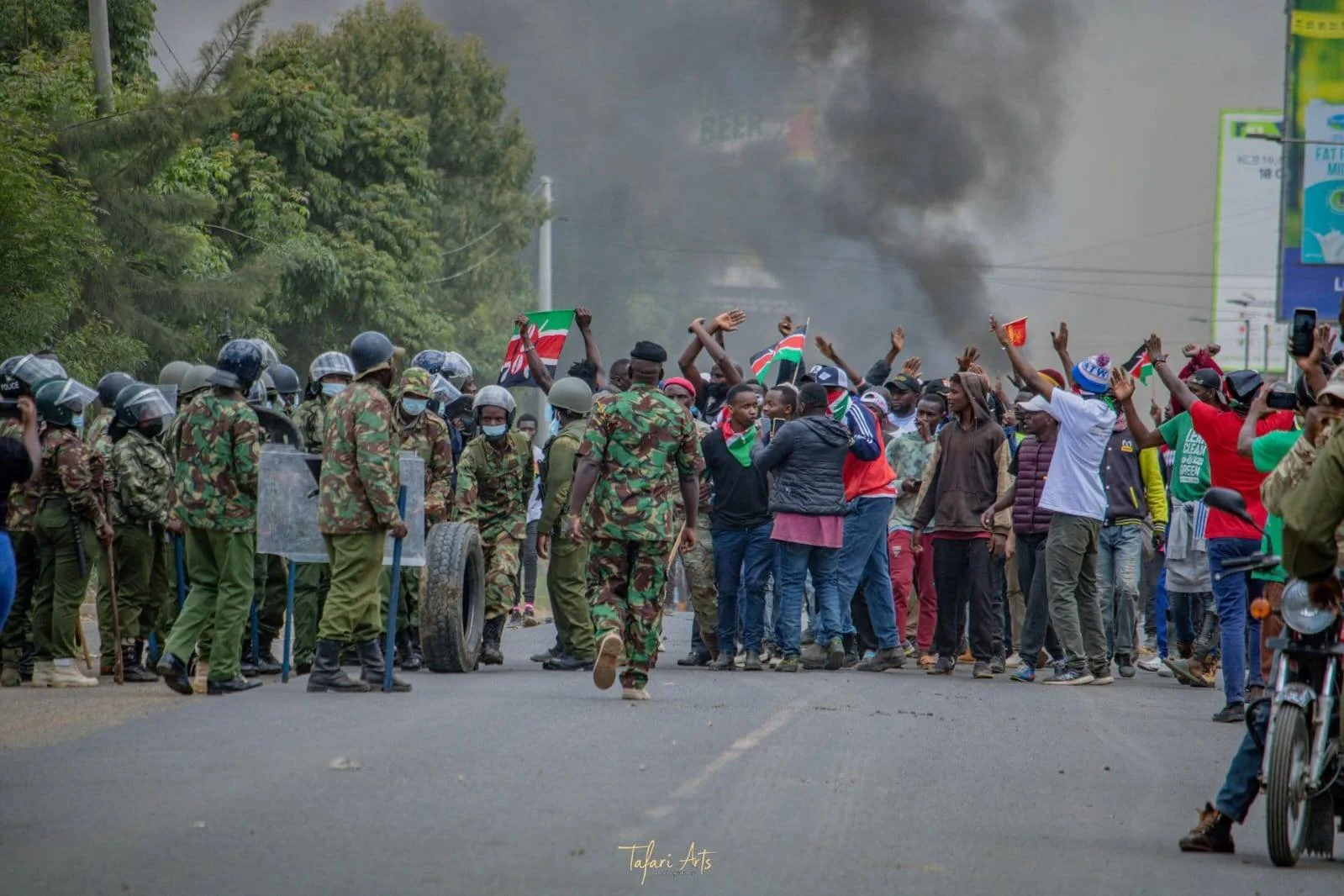
Dr. Muchene: Well, I think the young people of today are totally, totally different. With the Kikuyu, [the uprising] was about the land, specifically the land. And with the youth today, it is because they don't have jobs. And remember, with the Mau Mau mostly was Kikuyus. But with today's youth, there's [participation by] everyone throughout the country.
These are educated young people. In fact, last year, they were trying to come up with a finance bill. And the finance bill was going to be affecting the livelihoods of people so much; that is what started the uprising in a major force. So you look at what has happened with the uprising of the youth today and it's across the country, and they are against their own government because of what the government has done. The problem with these African governments is they are a very small group of people who are elite in the sense that they have taken over. So in essence, like I know in my government, they bribe members of parliament to vote for these bills. And it is done in such a way that they can come in and, for example, they put a housing levy to build new houses. But who is getting those new houses? The youth are not going to get them because they have no money. They have no jobs.
So the difference between the youth of today and of the Mau Mau is that [historically] it basically was one tribe about the land, but today it is everyone – including Ruto tribe’s, the youth from that group, because they also don't have jobs. And again, it's their policies.
AWB: So it's broader today.
Dr. Muchene: Yes, it is broad. Okay. And the Kikuyus’ [rebellion] was just segregated. Because the Kikuyus are the ones who really, even today, if you don't have a piece of land as a young man, it's not good for you. Even I continue to buy land myself, even today, and I'm old, you know.
AWB: Do you see any similarities between the militant element of youth today and the Mau Mau youth then? You mentioned the distinction in terms of the land versus the jobs, but other than that, do you see any similarities?
Dr. Muchene: Yes. I think what has happened is that the needs are different from those of the Mau Mau time. Because again, the growth in western needs and kind of life. So their approach is different, but they are militant. They went and burned the parliament. You know?
The Kikuyus during the Mau Mau would invade British camps and steal their guns. So the Kikuyus, the youth at that time, were willing to die. And these ones, there have actually been several hundreds of them who got killed when they entered the parliament trying to take over the country. So, I think the same mentality is there in terms of, we have to get what is rightfully ours. In this case, decisions by the government to increase employment. But since the government doesn't listen, the same [way] the British didn’t listen, they're using force.
In Kenya, force seems to have worked, in the past and now. Because a lot of members of parliament are not going back. They're not going to be voted in. Even Ruto, I don't think he is, and it’s the youth that is going to do it. The same way the youth got rid of the British. So yeah. There are those similarities, although the needs are different.
AWB: Today we see an active increase in imperialist aggression from France and the US through AFRICOM toward Kenya. How do we tie together the history of settler colonialism in Kenya and the recent actions of these neo-colonial forces?
Dr. Muchene: Well, this time it's so interesting because it is done in a very, very different way. I would say today, a lot of these African governments are the ones that are really promoting those imperialist ideas. They are supporting them. I can give you an example. In my country, I know we just signed a big memorandum of understanding for mineral exploitation with the American government. If you look at the mentality, the exploitation ideology is the same.
They're just using, what is the word I'm looking for? They're going directly to the source. It's easier to penetrate because you can offer these guys bribes. So that is one way of doing it. But again, with Africa, it's the way the military is being used. If you look at, for example, the Americans, they're using their military in places like the DRC. They're also using it in Kenya. There is no question about it.
If you go to places like Laikipia where they're planning on getting the Ebola facility, that was done through bribing. They paid them, and they're using the military there to get the soldiers who are guarding the mining in Congo. The ones who are going to be infected with Ebola, they’re going to be brought by the military to the military camp in Laikipiai. The same thing goes with the Manda camp, the military camp in Lamu. It's a very strategic position Kenya is in, especially in that Indian Ocean corridor location. It is very strategic with the Al-Shabab in Somalia… The whole thing about the military is to protect the way exploitation is going to happen.
AWB: So it's not primarily about anti-terrorism.
Dr. Muchene: No, no, no, no, no, no. You see, what has happened is, the Europeans are very afraid of the Chinese. The Chinese are very smart people. They came up with a different strategy. You go to Kenya today, at the airport you’d say, these roads, these highways are [made in] conjunction with the government of the people of China. You know, they “gave” them this road. Why are they going to give? They’re not going to give you the road, they're exploiting you. But they do it in a nice way. So the Chinese are getting [so] ahead of the Europeans and the Americans. So the Americans decided, we’ll use the military. And the way we are going to come in here is [by saying] we are going to protect you or we are going to help in development. It’s all wrapped up in a very well-orchestrated exploitation kind of mechanism.
AWB: You took me to my next question. In terms of resource extraction, what in your opinion are the future plans of the French? Is it just typical exploitation, or how will the French presence be different or similar from the other colonial powers in Kenya?
Dr. Muchene: Oh, it’s the same. The main goal is exploitation. But what they're doing now…I happened to be talking to somebody over the weekend who is in the military, and they were telling me the majority of their military there is to help their governments exploit commercially. They help the companies. If you look at what is happening in Congo, for example, the military contractors are there to protect the mining.
So the same thing in Kenya, if you look at Manda [Bay] in Lamu. It is to make sure they are able to supply support across East Africa and Central Africa in terms of helping their companies’ [interests]. If you look, for example, they just found in Rwanda, they have the largest deposits of uranium. And even in Kenya, they are not saying what they have found, but in order to get that, they need to be protected, so they're going to bring their own military. They don't believe the African militaries are going to be able to protect them, but this is because for commercial [interests], there is nothing else but to make sure they are getting those minerals out safely with protection.
AWB: So can you speak to the recent activity around AFRICOM’s moves to expand the Manda Bay base? Um, what has been the response of the people of Kenya to this move? With the presence of the Massachusetts National Guard through the State Partnership Program and AFRICOM’s presence in general, what's the general response of the working class Kenyan folks on that?
Dr. Muchene: That's very interesting because I got firsthand information. I'm going to be moving, where I'm going to be settling in Kenya is in Malindi, which is two hours from Lamu. So I was talking to some of my friends there and I asked them, "What do you think about the airbase in Manda?" They said, “Oh, yeah, we like it.” Hmm, I say, “Why?”
“Because they are going to protect us from Al-Shabaab.” The Somali mission. Because if you look at the border of Kenya, you know, here is Lamu and here is Somalia. So the bordering forest, that's where [Al-Shabaab] hides, so the Manda is not too far from there. So the locals, of course, they are misguided. They're naive saying, “Oh yeah, these people are here to protect us.” But no, that is not the main point. The point is that they're enlarging that port to begin with.
So they kind of transport planes. In fact I asked one of my sons, who is in the military, to send me unclassified documents. You know, I just wanted to read [about] what it is, so I was able to see some of the materials that are not classified. You know, they are enlarging the airports so they can use that too for the logistics. But of course, it's very strategic in East Africa.
AWB: So what would you say can be done going forward to support the anti-imperialist, anti-colonial struggles in Africa, both in Kenya and from the diaspora, particularly here in the United States? Or, as some would say, within the belly of the beast?
Dr. Muchene: Well, I think what has really helped is media. Freedom of speech, especially in my country. People are educated, so what media has done, especially now with the telephones and smartphones, people are able to put things on TikTok and YouTube, and so people in the diaspora are able to see all this. And you know, a lot of these countries are receiving money from the diaspora. We send a lot of money. In fact, Kenya's foreign exchange is mainly supported by diaspora money from America and Europe. So there is actually diaspora representation in the Ministry of Foreign Affairs. So, by understanding what is happening locally, politically, the people in the diaspora are able to really pressure the governments. So I think even in South Africa and all these other places, I think if that continues to happen, the media continues to happen, freedom of speech and media is going to be the main [way] in getting these messages across.
If you look, for example, at what happened in Kenya a few weeks ago when Rubio announced that Americans suspected of having Ebola are not going to be let in the United States, [that] they're all going to Kenya, there is a facility in Kenya. So after he announced this, in America everybody in the diaspora [made] telephone calls to members of the parliament back in Kenya saying, “Hey, what's happening?” And Ruto was able to confirm, “Yes, I did make an agreement with them.” So the people were like, “What? Without even letting us know?”
So moving forward, I think media is going to be the key. The exploitation will continue and these closed door decisions will be made. But I think once they find out and make noise, I think moving forward in campaigns, people will be able to use that to elect new people. That's what I think.
AWB: Anything you want to add that I didn't ask in terms of the current situation in Kenya and perspectives that we didn't talk about?
Dr. Muchene: Yeah, I think people don't really understand how much the African leaders today are agreeing to all these exploitation ideas. Because I think these governments now know they don't have to fight the Americans, the French. For example, if you look at the G7 meeting, who was invited? Ruto was invited by, I think, Macron. And it was so paternalistic. They were praising him, blah, blah, blah, all this, and Ruto was representing the whole of Africa. And guess what? Behind closed doors they are just laughing at this moron.
So, I believe that what is going to happen down the road, is this will continue because the majority of the leaders are going to be the small group of elite. Except for in places like Burkina Faso.
AWB: Ahh, the Sahel states.
Dr. Muchene: Yep, mm-hmm. So when these guys visit these countries like America, they'll have closed doors. Just like how they made the Ebola deal. And they'll be paid off, they’ll come back, and nobody knows until it explodes. This is so different from colonialism. The neocolonialism, the way it works, is so well-orchestrated. And they're not coming there and fighting the people. They're going directly to [the leaders]. They have understood, we [should] just go to these guys. We go to the leaders of these countries and let them allow us and give them a few million dollars [to] commit the whole country.
AWB: Yeah.
Dr. Muchene: So I think that is the danger we are facing right now. And moving forward, it is not going to be easy to conquer this because you have a small group of elite. If you look at my country, most of the people who have been in power are the same people. You know, even in other African countries, it is the same people. They have so much power that it'll even be very difficult for the youth to really do it. So that's where we are. To me, I think it'll continue to happen.
AWB: That's unfortunate. Hopefully, we can push something forward to make some improvement. Because frankly, there are variations in different places, but I think the primary contradictions of capitalism, imperialism, colonialism, those things are the same.
Dr. Muchene: Oh, yeah, exactly. They're the same. They're the same. And it is like a friend of mine was telling me, these guys have created funds called facilitating funds. Meaning the money they used to bribe these African leaders. So it's a part of the cost of whatever mining minerals [operations] they're going to be getting. Even the companies that are interested in doing business there, they understand going through the vehicle of the government. Trump is doing so much business with these people, it's unbelievable how the bilateral communication opens the way on behalf of the companies. Basically, that's what's happening in Africa.
News and Analysis
Kenya is Not America’s Quarantine Zone
By Beverley Waithaka for Black Agenda Report | June 24, 2026
Africa-France Summit and the people’s counter-summit
By Gathanga Ndung’u for Review of African Political Economy | May 14, 2026
Kenyan government offers Red carpet for colonizers and a bloody nose for Anti-Imperialists
By Black Alliance for Peace Africa Team | May 12, 2026
Massachusetts Guard Leaders Join Kenyan Partners at African Land Forces Summit
By the Massachusetts National Guard | March 31, 2026
Justified Accord 2026 begins in Kenya, Tanzania, Djibouti
By U.S. SOUTHCOM | February 23, 2026
US begins $70m expansion of Kenya military base to counter Al-Shabaab
By The Africa Report | January 30, 2026
Kenyan Police Attack Youth-led Demonstrations Against Brutality
By Abayomi Azikiwe for Black Agenda Report | July 9, 2025
AFRICOM, Kenya, Kickoff 2025 African Chief of Defense Conference
By U.S. AFRICOM | May 28, 2025
ESSAY: Behind the Mau Mau: George Padmore, 1953
Edited by the Black Agenda Review for Black Agenda Report | September 14, 2022
By Jemima Pierre for Black Agenda Report | May 18, 2011