A-APRP Condemns Invasion of PAIGC Central Committee Meeting by Para-Military

A-APRP Condemns Invasion of PAIGC Central Committee Meeting by Para-Military

All eyes on Guinea Bissau!

The All-African People’s Revolutionary Party stands in uncompromising support of our sister Party; the PAIGC

We condemn, in the strongest possible terms, the flagrant denial of the PAIGC’s right to conduct its affairs and pursue the People’s mandate in open fair and transparent elections. We call on all progressive, peace loving and justice minded People around the world to denounce the terrorist actions taking place.

The party of Amilcar Cabral; the African Party of Independence of Guinea and Cape Verde (PAIGC) is once again under attack by the illegitimate anti-constitutional government of self-proclaimed president Embalo Sissoco installed in 2019.

Yesterday, March 18th, 2022, a para-military force invaded the PAIGC National Headquarters firing tear gas (from zionist Israel) into meeting room where the PAIGC Central Committee was meeting, to approve final documents for its 10th Party Congress. The entirety of the Central Committee was forced out of the building resulting in injuries.

Some PAIGC Members were beaten; some C.C. Members were injured, while others’ phones were confiscated.

The Regional Secretary of the Amilcar Cabral African Youth (JAAC) was kidnapped by a personal security staff of Embalo Sissoco, taken to an isolated area and beaten.

Dr. Sana Conte, a lawyer activist, was kidnapped by another personal security staff of Embalo Sissoco who was in a Ford Ranger with license plate number 63-18 CG, which belongs to the Chief of Security named Tcherninho. Dr. Sana Conte has not been seen since..

There are constant threats to the physical integrity of PAIGC President, Engineer Domingos Simões Pereira.

The objective is to prevent the PAIGC from holding its mandated Congress so that they cannot contest legislative elections.

These are the same tactics that were used to disrupt the 9th PAIGC Congress in 2018. After the paramilitary invasion and beatings of PAIGC Members, the Congress was held and the PAIGC won the Legislative Elections of March 2019. Less than one year later, Sissoco Embalo self-proclaimed himself as president in a hotel and carried out a coup that dislodged the PAIGC led Government in an attempt to install a dictatorship.

It logically follows that arrests, beatings, threats and intimidation will continue.

The All- African People’s Revolutionary Party stands in uncompromising support of our sister Party; the PAIGC. We condemn, in the strongest possible terms, this flagrant denial of PAIGC the right to conduct its affairs and pursue the People’s mandate in open fair and transparent elections. We call on all progressive, peace loving and justice minded people around the world to denounce the , Sissoco Embalo self-proclaimed dictatorship.

All eyes on Guinea Bissau!

All support for the PAIGC.

Forward to One unified Socialist Africa!

(Banner Photo: Headquarters of African Party for the Independence of Guinea and Cape Verde in capital and port city Bissau. / Wikiwand)

Event: Political Prisoners and Colonized Peoples: The Solidarity Imperative

Event: Political Prisoners and Colonized Peoples: The Solidarity Imperative

Register here.

Join us in solidarity as we examine Human Rights in an international context as it relates to political prisoners and colonized peoples.

About this event

Despite decades of calls for an end to all colonialism, many peoples on every continent still struggle for sovereignty and liberation. From well-recognized occupied territories like Western Sahara and Palestine, to contested lands like Puerto Rico, which officially are understood to be “non-self-governing,” freedom movements have shifted strategies over the past five years, with open dialogues about nonviolent resistance, armed struggle, and new methods appropriate to 21st century dynamics. Through it all, one thing seems clear: solidarity for the political prisoners of the rising civil resistance movements needs to become a stronger focus and much better coordinated.

This webinar, co-sponsored by a coalition of several groups, will look directly at this key organizing challenge, with updates from front line organizers and analysis from long-time activists. It will then conclude with an open exchange on potential areas for future work together.

This webinar has been organized as a collaboration of the new Occupied Peoples Forum, which brings together representatives of eight still-colonized peoples, Solidarity 2020 and Beyond, Waging Nonviolence, Resistance Studies Initiative, the International Peace Research Initiative, and the U.S.-based, Black-led, Spirit of Mandela coalition.

It is an outgrowth of the Spirit of Mandela's successful October 2021 International Tribunal on U.S. Human Rights Abuses Against Black, Brown, and Indigenous Peoples. The Tribunal examined questions of human rights in an international context and found the U.S. guilty of five counts of genocide. This online seminar continues those efforts, providing an overview of resistance campaigns focused on solidarity work with political prisoners and their freedom campaigns.

Featuring:

Sahar Francis, Palestinian Executive Director, Addemeer Prisoner Support and Human Rights Association

Luis Rosa Perez, Puerto Rican former political prisoner; human rights activist with Casa Corretjer

Enguia Mohamed, President, NOVA Western Sahara civil resistance association

Jalil Muntaqim, Black Panther former political prisoner; Spirit of Mandela Coordinating Committee member

Moderated by:

Rosa Moiwend, West Papuan organizer and peace educator

Matt Meyer, Secretary General, International Peace Research Association; Spirit of Mandela Coordinating Committee member

Sponsored by:

Spirit of Mandela Coalition, Occupied Peoples Forum, Solidarity 2020 and BeyondWaging NonviolenceResistance Studies Initiative, and the International Peace Research Association

Register here.

Democracy Scores Another Victory Over the U.S. in Honduras

Democracy Scores Another Victory Over the U.S. in Honduras

Democracy Scores Another Victory Over the U.S. in Honduras

Black Alliance for Peace Statement on Honduran Elections

The anti-colonial, pro-human rights members of the Black Alliance for Peace (BAP) welcome the resounding victory of the people of Honduras. “Again, the people of our region have registered their unwavering commitment to authentic democracy and the right to national self-determination with the victory of President-elect Xiomara Castro in Honduras,” states Jemima Pierre, coordinator of BAP’s Haiti/Americas committee. 

The people of our region and the world remember the criminal assault on democracy that took place in Honduras in 2009 as one of the first acts of the newly elected Obama/Biden Administration. But with the election of Xiomara Castro, it is clear the coup stalled but did not reverse the momentum in Honduras for national independence, despite the death and systematic repression unleased on the population by the U.S. backed fascist regime.  

“Just over the last two months, from Nicaragua to Venezuela and now Honduras, it is clear that the dogs of war and repression represented by the gringos from the North are unable to squash the spirit of the peoples of our region for People(s)-Centered Human Rights and national liberation. When we free Haiti and remove the illegal and immoral blockade against Cuba, the momentum for finally ejecting the U.S. and its antiquated fantasies of continued domination of our region and peoples will be unstoppable,” according to Ajamu Baraka, Black Alliance for Peace National Organizer. 

BAP salutes the people of Honduras for this incredible victory and pledges to fight with them to protect their hard-won victory, a victory that is really a triumph for all of us. 

No compromise, no retreat!

"The Democratic Party wants war with Russia, the Trump administration wants war with China, so it's up to the people to demand and struggle for peace against both pro-imperialist war parties."

- Ajamu Baraka, National Organizer

(Banner Photo: Supporters of Free Party presidential candidate Xiomara Castro cheer before she speaks after general elections, in Tegucigalpa, Honduras, Nov. 28, 2021. / Associated Press)


Guinea and the Military Coup Incubator, AFRICOM

Guinea and the Military Coup Incubator, AFRICOM

Originally published in Black Agenda Report by Netfa Freeman, who represents BAP member organization Pan-African Community Action (PACA) on BAP’s Coordinating Committee, September 8, 2021

The recent coup in Guinea exemplifies the damage done by European colonizers and the U.S. Africa Command.

West Africa has just experienced its fourth attempted coup in just over a year, and seven coups over the last 13 years were carried out by African troops trained by the U.S. Africa Command (AFRICOM). One was directly carried out by AFRICOM forces - Operation Odyssey Dawn against Libya in 2011, its first major military operation. 

On Sunday, September 5, 2021 soldiers detained Guinean President Alpha Condé and claimed control of the government. They suspended the constitution and closed all of the country’s borders. In a video recorded in the capital Conakry, Colonel Mamady Doumbouya of the Guinean Armed Forces (GAF) announced that the National Assembly had been dissolved.

Doumbouya, deemed the primary leader of the coup, was trained by the French military in France and, before turning against him, was called in 2018 by Condé to head a new Special Force Unit. Doumbouya and many others in the Guinean’s military also had AFRICOM training in Operation Flintlock 19. Operation Flintlock 19 occurred in early 2019 and, with participation from 34 African and other partner nations, was the largest annual exercise hosted by AFRICOM.

There should be no doubt that an indoctrination about the inherent goodness of the US-European role in Africa accompanies this military training with blindspots about the true legacy of colonialism. It is highly unlikely that a soldier could get through such brainwashing today and still have an anti-imperialist mindset intact.

Reminiscent of the coup in Mali that took place in May of this year, Guinea seems to validate AFRICOM as an incubator of military coups in Africa. Rather than embark on an agenda that addresses mass poverty and abolished austerity, comprador leadership seeks protection from the people through neo-colonial relationships with the Pan-European, capitalist patriarchy. Then their youthful and neo-colonial trained military personnel get it into their heads that, rather than serve an aged and widely unpopular dictator, they will take control themselves.

In Guinea, “the TV address featured nine unnamed soldiers, several draped in the red, gold and green national flag, who said they had taken over because of rampant corruption, mismanagement and poverty,” Yahoo News reported. Similar claims were made in Mali by Colonel turned Mali president, Assimi Goïta.

In and of itself a coup does not necessarily indicate that the action is against the people’s interest, whether the nature of the incoming government is revolutionary or neo-colonialist. Thomas Sankara, “The Upright Man ” and revolutionary leader of Burkina Faso, came to power through a coup. Hugo Chavez’s first attempt to power in Venezuela was via coup. The case of the Arab Pan-Africanist of the Libyan Jamahiriya, Muammar Gaddafi was the same.

A hugely significant factor with these leaders and those who followed them was that they were imbued with an anti-imperialist imperative. They understood that the primary contradiction was not the particular comprador leadership who held state offices. The primary contradiction is the capitalist, European imperialist global order. They knew that the only solution for the people of the Global South was to embark on a bottom up process of control over their land, resources, or economic systems.

The coup in Guinea has been widely condemned by the US, the UN, the AU, ECOWAS, and others. In contrast, news of the coup sparked celebrations in some parts of the capital, where hundreds of people applauded the soldiers.

African people face such dire circumstances at the hands of neocolonialism and neoliberalism that they welcome the remotest possibility of change. The outward faces of their oppression are the Black faces that only appear to be in charge. Too many African presidents don’t actually preside over their countries. They kowtow. 

An indication that AFRICOM incubated coups will likely not result in any fundamental change is that those leading the coups do not even make mention of the principles they are for, or that they are even against foreign domination. They make no attempts to create participatory programs of transformation that redistribute land, nationalize natural resources, or establish universal health care and education.

In our March 2021 article, Movements Not Saviors: Lessons from Bobi Wine’s Tweet for Juan Guaido, co-author Jemima Pierre and I explained that:

“The goals of African people must be more advanced than simply replacing a dictator. Imperialism is a global system that requires enforcement of certain conditions everywhere. This is precisely why autocratic leaders are supported by imperialism. These governments are the neocolonial political cover for the West’s control of the land, labor and markets of the colonized. A return to the oppressive conditions for the people will be inevitable if a dictator is removed but not the West’s ultimate control.”

A upgraded, popular Pan-Africanist movement must be rebuilt to demilitarize and depose imperialism from Africa. This will require constructing a mass based geostrategic vision that intensifies in Africa opposition to AFRICOM and other European military projects.

Netfa Freeman is an organizer in Pan-African Community Action (PACA) and on the Coordinating Committee of the Black Alliance for Peace. Netfa is also co-host/producer of the WPFW radio show and podcast Voices With Vision.

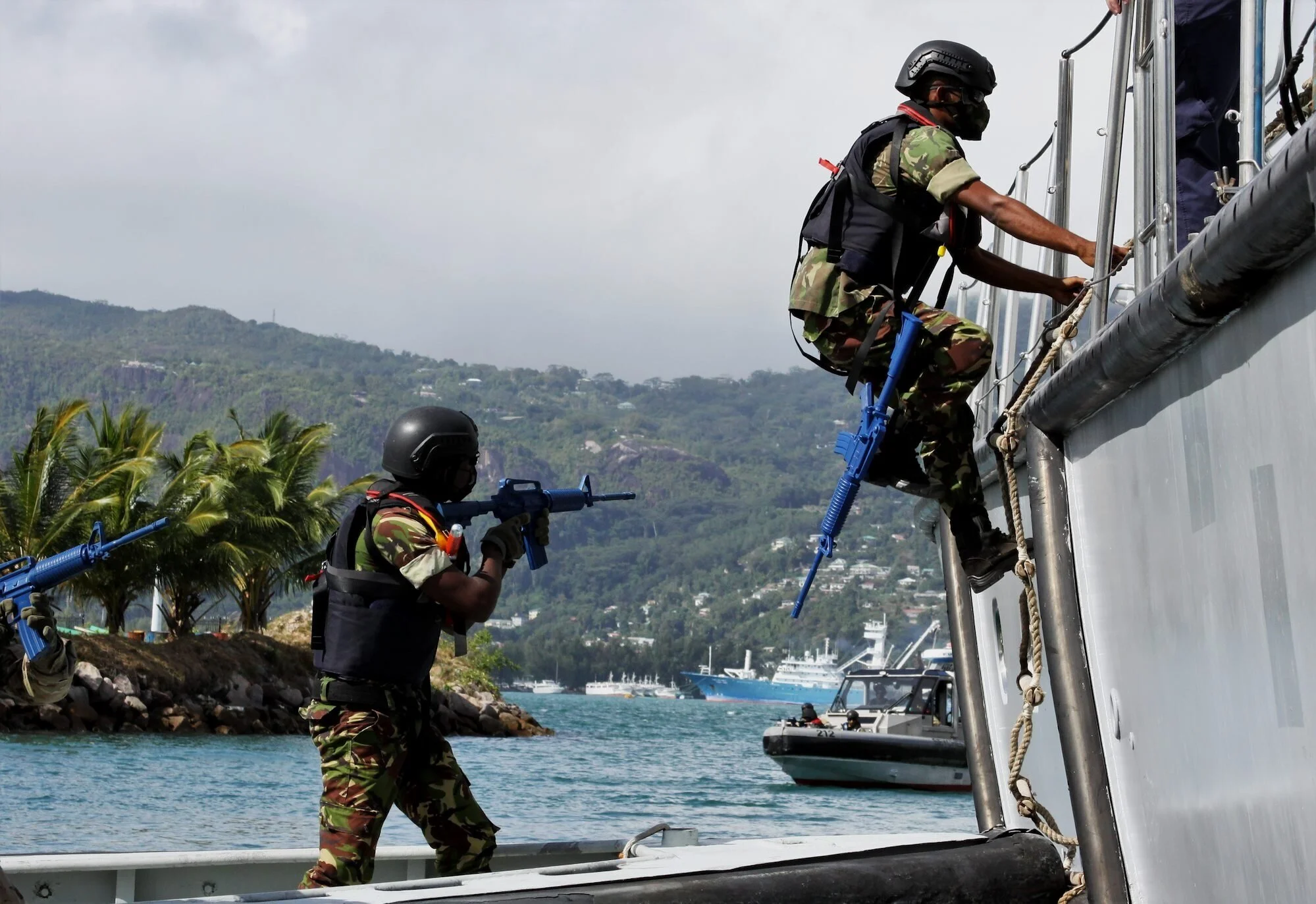
Banner photo: Members of the Seychellois Coast Guard board a patrol boat during training in Victoria, Seychelles on August 3, 2021. (Yeoman 1st Class Ann Geiman/AFRICOM)

Haiti: On Interventions and Occupations

Haiti: On Interventions and Occupations

Originally published in Black Agenda Report by BAP member Dr. Peter James Hudson and BAP Haiti/Americas Coordinator Dr. Jemima Pierre, August 4, 2021

U.S. and other foreign interventions are the cause of Haiti's ongoing crises.

The first calls for foreign intervention into Haiti came soon after the assassination of Haitian President Jovenel Moïse in Port-au-Prince on July 7th. Intervention was  justified by the claim that Moïse’s death had created a vacuum of political leadership and authority that would push Haiti into a maelstrom of chaos and anarchy -- into what the Guardian announced as a “violent new era.” Only intervention, led by the US and supported by its international partners, could save the troubled republic from an inevitable crisis.

By all accounts, the press projections of Haiti falling to barbarism after the assassination has not happened. But the calls for foreign intervention have continued. These calls have ignored two important and consequential facts. First, previous foreign interventions have been unmitigated disasters. They have led to long-term military occupations that destroyed the Haitian state and marginalized civil society while leaving tens of thousands of Haitians displaced or dead. Second, and most importantly, Haiti is already under occupation. Calls for “intervention” are not only disingenuous, but actually redundant.

The first US intervention and occupation of Haiti officially began with an echo of the present. In 1915, Haitian president Theodore Guillame Sam was murdered – dragged out of the French legation and killed in the streets – after he had imprisoned and then killed a number of his political opponents. Fearing political chaos, and with a desire to protect US interests, persons, and property, the US landed three hundred troops on July 28th, 1915, initiating a military occupation that lasted nineteen years, until 1934.

But the calls for intervention and the strategies for occupation had long preceded Sam’s murder. In the years leading up to the landing of US marines in 1915, the National City Bank of New York was becoming increasingly involved in Haiti’s financial affairs. They pushed for control of Haiti’s railroads, ports, the national bank, and the sovereign debt – and they were encouraged by the US State Department, who had adopted the well-known policy of “dollar diplomacy” throughout the Caribbean region . Bank managers served as shadow representatives of the State Department in Haiti.

CIty Bank officials had already called for US military intervention to protect their Haitian investments before 1914. In 1914, bank vice president Roger Leslie Farnham wrote a memorandum outlining a strategy for occupation, saturated with racial paternalism and ideas of Haitian inferiority, for US secretary of state William Jennings Bryan. The same year, City Bank officials sent a request for US Marines to land in Haiti to move the $500,000 gold reserve from the Banque National d’Haiti in Port-au-Prince to a Wall Street vault. They asserted the action was taken to protect their investments. Haiti’s politicians viewed it as theft, and a deliberate attack on the Republic’s sovereignty.

When intervention and occupation did occur in 1915, the bank consolidated its near-monopoly control of Haiti’s finances, banking, and industry. During the first occupation, the US rewrote the Haitian constitution and installed a puppet president, imposed press censorship and martial law, and brought Jim Crow policies and forced labor to the island. It also initiated a “pacification” campaign against those Haitian militants engaged in armed struggle to protect the republic’s sovereignty. The US military dropped bombs and burned villages, tortured and murdered peasants, and hunted rebel “bandits” for sport.

Of the stated aims of the occupation – building infrastructure, expanding education, and providing internal and regional stability – little was achieved. The longstanding result of the US occupation was the establishment and training of a local police force, the Gendarmerie d'Haïti. Years after the occupation, this police force was used to terrorize the Haitian people.

US troops withdrew in 1934 after a sustained period of protest, begun in 1929 by Haitian students and eventually joined by all classes of Haitians and Haitian allies in the international community.

The US would continue to intervene Haitian affairs, first supporting the brutal dictatorship of Francois “Papa Doc” Duvalier and Jean-Claude “Baby Doc” Duvalier, and then again in 1991 as the CIA bankrolled a coup d’etat against the country’s first democratically elect president, Jean-Bertrand Aristide. The coup was not consolidated because of continuous resistance from the Haitian people. By 1994, US president Bill Clinton’s administration was forced to bring Aristide back to Haiti after 3 years in exile, with 20,000 troops brought in to quell Haitian resistance. But Aristide was now a hostage to US neoliberal policy. The US troops remained until 1999.

The second occupation of Haiti began in 2004 and was initiated after a coup d'etat sponsored by the U.S., France, and Canada that dethroned elected Haitian president Jean-Bertrand Aristide. Aristide was kidnapped by US marines and sent to the Central African Republic. US President George W. Bush announced afterwards that he was sending US forces to Haiti to “help stabilize the country.” It is clear, as Glen Ford and Peter Gamble remind us, “George Bush didn’t invent U.S. aggression against Haiti; that’s been U.S. policy since 1804.”

The 2004 illegal coup d’état was both enforced and cleaned up with the sanction of the UN. The UN took over from US forces and established the United Nations Stabilization Mission in Haiti (or MINUSTAH) for the tasks of military occupation under the guise of establishing peace and security.

A multi-billion dollar operation, MINUSTAH had, at any given time, between 6000 and 12,000 military troops and police stationed in Haiti alongside thousands of civilian personnel. Like the first US occupation, the UN occupation under MINUSTAH was marked by its  brutality towards Haitian people. Civilians were brutally attacked and assassinated. “Peace-keepers” committed sexual crimes. UN soldiers dumped human waste into rivers used for drinking water, unleashing a cholera epidemic that killed between 10,000 and 50,000 people.

The Core Group -- an international coalition of self-proclaimed non-Black “friends” of Haiti -- emerged through the MINUSTAH occupation in 2004. Its stated goal was to oversee Haiti’s governance. Meanwhile, as with the first occupation, the US and MINUSTAH trained Haitian police forces, reintegrating many of the rogue members into these forces. The US, in collusion with MINUSTAH and the Core Group, also over-rode Haitian democracy, installing both neo-Duvalierist Michel Martelly and his PHTK party, alongside Martelly’s protege and successor, Jovenel Moïse. Moreover, it was under occupation that Haiti was devastated by the 2010 earthquake; all the pledges of humanitarian aid and assistance and the promises to “build back better” have amounted to nothing, the funds grifted by the Haitian oligarchy and comprador bourgeoisie, as well the international community.

While it is claimed that this occupation officially ended in 2017, with the dissolution of MINUSTAH, the UN has remained in Haiti through a new acronym: BINUH, the United Nations Integrated Office in Haiti. BINUH has had an outsized role in Haitian internal political affairs. For example, soon after Moïse was killed, its representative, Helen La Lime, asserted that Claude Joseph would be installed as Haiti’s leader. Later on, the “Core Group” switched gears and demanded that Ariel Henry should be president. And this is exactly what happened when a “new” Haitian government was announced on July 20, 2021, with Henry as leader. This without any say from the Haitian people.

It would seem that the goal, and perhaps success, of this occupation has been to not only permanently quell the last vestiges of the mass movement that emerged through the fall of the Duvalier dictatorship and culminated in the 1990 election of Jean Bertrand Aristide. The objective was to also completely and fatally destroy the Haitian state. And with that, the turning of Haiti into a permanent vassal state. In this, the self-hating comprador bourgeoisie, the poodles for white supremacy, have played a significant role. It is noteworthy that, in the wake of Moïse’s assassination, the comprador bourgeois lapdogs (such as Claude Joseph, Joseph Lambert, Ariel Henry) as well as the nonBlack oligarchs (such as Reginal Boulos) rushed first to get the blessings of their white overlords, representatives of the UN occupation force, the Core Group and the U.S. State Department.

For Haiti, both the first occupation, in 1915, and the second, in 2004, were unmitigated disasters. Both were premised on the idea that not only was Haiti falling into chaos and anarchy, but with the deeply racist notion that Haitians are unable to govern themselves. Be it under watch of US Marines, a multinational UN force, or an international cohort of technocratic experts in security and democracy, it seems likely that the ongoing second occupation will be intensified by a formal foreign military intervention.

The occupation will only end with the complete withdrawal of the imperial powers from Haiti.

Peter James Hudson is a writer, editor, and historian who teaches Black Studies at UCLA. He is the author of Bankers and Empire: How Wall Street Colonized the Caribbean.

Jemima Pierre is a contributor to Black Agenda Report, the Haiti/Americas Coordinator for the Black Alliance for Peace, and a Black Studies and anthropology professor at UCLA.

Banner photo: UN troops in Haiti. (Swoan Parker/Reuters)

BAP-Philly Member's Statement at July 26 Rally Commemorating Cuban Revolution

BAP-Philly Member's Statement at July 26 Rally Commemorating Cuban Revolution

BAP-Philly member Deandra Jefferson read aloud the following statement at a July 26, 2021, rally held in Philadelphia to commemorate the start of the Cuban revolution on July 26, 1953.

 
BAP-Philly member Deandra Jefferson reading the following statement at the U.S. Hands off Cuba rally at Philadelphia City Hall. (Joe Piette/Workers World Party)

BAP-Philly member Deandra Jefferson reading the following statement at the U.S. Hands off Cuba rally at Philadelphia City Hall. (Joe Piette/Workers World Party)


Good afternoon, my name is Deandra, and I am a member of the Philadelphia chapter of Black Alliance for Peace. We are a Black led African diaspora wide organization dedicated to advancing the anti imperial struggle throughout the world. BAP is here today standing in solidarity with the people of Cuba and the continued project of the Cuban Revolution. We demand that the U.S. end the embargo against Cuba immediately.

Cubans have made it clear; they are perfectly capable of deciding their own fate, with no intervention necessary from false friends such as the United States. The U.S. has a vested interest in seeing the Cuban Revolution fail, and has since the very beginning. Cuba continues to show the world, in spite of the embargo, that the struggle against capitalism is possible. The U.S. knows that given more resources, there would be no question to people around the world that capitalism is not viable, but socialism is. This is why they do their best through the embargo to keep these resources away, so they can continue to engineer scarcity and call it a failure of a socialist state, rather than a creation of capitalism fighting to preserve itself.

Just as the U.S. fights to suppress self determination in Cuba, they do the same in other majority Black islands in the Caribbean. Another nation that the U.S. has relentlessly tormented is the island nation of Haiti. Haiti has faced repression from imperialist forces since their successful slave revolt. The United States has been a major part of that repression throughout history. Because of the abuse of the U.S. and other colonial powers, Haiti has long had issues of scarcity of resources, similar to Cuba. Most recently, the president of Haiti was assassinated by forces acting on behalf of U.S. interests, causing further turmoil within the country. But in the case of Haiti, the highlight of these issues would only serve to implicate capitalism and the intervention of the U.S. as the culprit. The times when the U.S. has turned their attention to the issues in Haiti, they have only done so to solidify their stranglehold on the island and their unwarranted involvement in Haitian politics. Nonetheless, Cuba understands the importance of standing in true solidarity with Haiti. They have demonstrated their support for years. They have consistently provided medical care in times of crisis, such as the earthquake of 2010, and even during the current pandemic. Cuba understands the power of help with no strings attached, and putting people before profit and conquest. We must answer that call for Haiti and for Cuba.

We know that when we support the self determination of the Caribbean and the Global South, we chip away at the stranglehold of colonialism and continue to gain ground in the fight against capitalism. In the case of Cuba, the Cuban people have been asking folks in the U.S. to stand in solidarity by ending the embargo. It is the very least we can do.

Today is the anniversary of the beginning of the Cuban Revolution. Folks are out here today because we know that revolution is still alive and strong. We also know that the continued success of that revolution is crucial to the freedom and safety of those on the island, as well as the project to end capitalism and colonialism worldwide. Therefore, just as Cuba stands in solidarity with other nations facing the failings and exploitation of colonialism, we stand with them now. Viva Fidel, Viva La Revolucion!


Banner photo: Protesters gathered in solidarity with Cuba and commemorating the Cuban Revolution in front of City Hall in Philadelphia on July 26. (Joe Piette/Workers World Party)

Statement of the International Delegation to Nicaragua, July 18-25 2021

Statement of the International Delegation to Nicaragua, July 18-25 2021

Netfa Freeman, who represents BAP member organization Pan-African Community Action (PACA) on BAP’s Coordinating Committee, represented BAP and PACA on an international delegation to Nicaragua July 18-25, 2021. Below is a statement the delegation released to the Nicaraguan press on July 23. Video of the press conference can be viewed here.

Below is English, español, français and portuguens.

The international delegation to Nicaragua at a press conference on July 23, 2021. Netfa Freeman, who represented the Black Alliance for Peace and Pan-African Community Action, is seated, third from left. (courtesy: TN8)

The international delegation to Nicaragua at a press conference on July 23, 2021. Netfa Freeman, who represented the Black Alliance for Peace and Pan-African Community Action, is seated, third from left. (courtesy: TN8)

Statement of the International Delegation to Nicaragua, July 18-25 2021

We have come to Nicaragua this week to see for ourselves the lived reality of the Nicaraguan people. We are here from the United States, Brazil, Canada, and Mexico. From July 18 to July 25 our delegation, organized by the Nicaragua Network, had the opportunity to visit Managua, Granada, Estelí and Masaya. We have seen the beauty of this country and its people—a people struggling mightily to live in peace and prosperity despite constant U.S. aggression and brutal sanctions.

We heard from health care providers, teachers and vocational instructors in Estelí who are working to make sure that working class people and campesinos have access to medical attention and education—in addition to access to housing, employment and income promotion programs also offered by the Sandinista government. As one teacher explained, the current system under Sandinista leadership is one of “inclusion” as opposed to the policies of “exclusion” of the neoliberal governments of 1991 to 2007.

In contrast to the countries of the global north, Nicaragua has managed to contain one of the most serious pandemics of the last decades with a free universal public health system, with personalized attention and follow-up for infected patients, and with a model that seeks to adjust to the particular characteristics of each region, including the needs of indigenous and Afro-Indigenous communities.

In Masaya, we heard from those who lived during the U.S.-backed terror of the coup attempt of 2018. We heard from city security forces who were kidnapped and tortured by opposition forces who took over the city. The U.S. mass media - aligned with U.S. political, economic and military interests—led the false, unsubstantiated narrative of a repressive government. We heard direct testimonies of victims of the 2018 violence and saw massive destruction of
infrastructure that the city has yet to fully recover from.

One individual lost his arm during the torture he suffered. The burning of the mayor’s offices; the destruction of the city works building along with sanitation and street-paving trucks; and the burning down of the historic Masaya market, was proof to us that the instigators engaged in outright terrorism. At the same time, we saw the heroic efforts of the security workers and government and people of Masaya to rebuild and to continue providing vital services to the
citizenry.

In Granada, we heard similar testimonies, including of the opposition’s torching of the centuries-old municipal building which William Walker did not manage to destroy during his burning down of that city in the 1850s. We also heard how the historic combatants who defeated Somoza came out during the 2018 coup attempt to confront the opposition violence and, along with the police, to restore order and peace.

What’s more, we witnessed the daily lives of the Nicaraguan people who get up early every morning to take a bus or walk long distances to work. These are the vast majority of the Nicaraguan people, and it is they, as we witnessed for ourselves, who came to the Plaza de Fe in huge numbers on July 19 to celebrate the Sandinista victory over the U.S.-backed dictator Somoza. The scenes we saw in the Plaza—of working class families regaling in their red and black of the FSLN—were not covered by the U.S. press, for they resoundingly contradict the U.S. narrative of a people being repressed by a tyrannical government.

The tyrannical government—that of Anastasio Somoza—is now gone despite the backing of the U.S., which tried to reinstall Somoza’s National Guard in the form of the Contras in the 1980’s. That the U.S. now claims to care about Nicaraguan democracy is a cruel joke.

The U.S.’s constant attempts to undermine the peace and prosperity of the Nicaraguan people; to sow divisions which exploded into violence in 2018; and to undermine the sovereignty of Nicaragua are unacceptable. We denounce these attempts as immoral and illegal, just as the International Court of Justice found these efforts to be unlawful in its 1986 decision in the case of Nicaragua versus the U.S.

We call upon the U.S. government and allied NGOs to halt their interference in and sanctions against this country and to let Nicaragua live in peace as a sovereign nation just as the UN Charter unequivocally requires. Recent polling by M&R Consulting demonstrates massive opposition to such foreign interference, 85%, amongst the Nicaraguan people.

We thank the Nicaraguan people for opening up their hearts to us during our trip to this country of lakes and volcanoes, and we stand with you against all U.S. meddling, sanctions and provocations.

In solidarity,
Nicaragua Network - Alliance for Global Justice / Answer Coalition / Black Alliance for Peace /
Jornalistas Livres / Comitê Antiimperialista General Abreu e Lima / TV Cidade Livre (TVComDF) / Jornal Brasil Popular / Observatorio de Derechos Humanos de los Pueblos / Pan-African Community Action (PACA) / Party for Socialism and Liberation (PSL) / “Voices with Vision” program of WPFW Radio

* In an effort to call on the U.S. to stop interfering in the lives and future of Nicaraguans, we invite individuals from all over the world to support the Hands Off Nicaragua sign on letter.

Declaración de la Delegación Internacional a Nicaragua, 18-25 de julio 2021

Hemos venido a Nicaragua esta semana para conocer la realidad vivida por el pueblo nicaragüense. Venimos de Estados Unidos, Brasil, Canadá y México. Del 18 al 25 de julio nuestra delegación, organizada por Nicaragua Network, ha tenido la oportunidad de visitar Managua, Granada, Estelí y Masaya. Hemos visto la belleza de este país y de su gente, un pueblo que lucha valientemente por vivir en paz y prosperidad a pesar de las constantes agresiones y brutales sanciones de los Estados Unidos.

Escuchamos a los proveedores de atención médica, profesores e instructores de formación profesional de Estelí, quienes trabajan para garantizar que la clase trabajadora y los campesinos tengan acceso a servicios de atención médica y a la educación, además del acceso a la vivienda, el empleo y los programas de promoción de ingresos también ofrecidos por el gobierno sandinista. Como explicó un profesor con el que conversamos, el sistema actual bajo el liderazgo sandinista es de "inclusión", en contraposición a las políticas de "exclusión" de los gobiernos neoliberales de 1991 a 2007.

A diferencia de los países del norte global, Nicaragua ha logrado contener una de las pandemias más graves de las últimas décadas con un sistema de salud público universal y gratuito, con atención y seguimiento personalizado a los pacientes infectados, y con un modelo que busca ajustarse a las características particulares de cada región, incluyendo las necesidades de las comunidades indígenas y afro-indígenas.

En Masaya, escuchamos a quienes vivieron el terror respaldado por los Estados Unidos durante el intento de golpe de estado de 2018. Escuchamos a agentes de las fuerzas de seguridad de la ciudad que fueron secuestrados y torturados por las fuerzas de la oposición que tomaron la ciudad. Los medios de comunicación estadounidenses -alineados con los intereses políticos, económicos y militares de Estados Unidos- dirigieron la narrativa falsa y sin fundamento de que en Nicaragua existe un gobierno represivo. Escuchamos testimonios directos de víctimas de la violencia de 2018 y vimos la destrucción masiva de infraestructuras de la que la ciudad aún no se ha recuperado del todo.

Un agente perdió su brazo como consecuencia de la tortura que sufrió. La quema de las oficinas de la alcaldía; la destrucción del edificio de obras de la ciudad junto con los camiones de saneamiento y pavimentación de calles; y la quema del histórico mercado de Masaya, fue para nosotros una prueba de que los instigadores se dedicaron al terrorismo descarado. Al mismo tiempo, vimos los heroicos esfuerzos de los trabajadores de seguridad y del gobierno y el pueblo de Masaya para reconstruir y seguir prestando servicios vitales a la ciudadanía.

En Granada escuchamos testimonios similares, incluso del incendio - por parte de la oposición - del centenario edificio municipal que William Walker no logró destruir durante su quema de esa ciudad en la década de 1850. También escuchamos cómo los combatientes históricos que derrotaron a Somoza salieron durante la intentona golpista de 2018 para enfrentar la violencia opositora y, junto con la policía desarmada, restablecer el orden y la paz.

Además, fuimos testigos de la vida cotidiana de los nicaragüenses que cada mañana se levantan temprano para tomar un autobús o caminar largas distancias para ir a trabajar. Son la inmensa mayoría del pueblo nicaragüense y son ellos, como pudimos comprobar, los que acudieron en masa a la Plaza de Fe el 19 de julio para celebrar la victoria sandinista sobre el dictador Somoza, apoyado por Estados Unidos. Las escenas que vimos en la Plaza -de las familias de la clase trabajadora que se vestían de rojo y negro con el FSLN- no fueron cubiertas por la prensa estadounidense ya que contradicen rotundamente la narrativa estadounidense de un pueblo reprimido por un gobierno tiránico.

El gobierno tiránico -el de Anastasio Somoza- ya no existe, a pesar del apoyo de Estados Unidos que intentó reinstalar la Guardia Nacional de Somoza en la forma de los Contras en la década de 1980. Que Estados Unidos diga ahora que se preocupa por la democracia nicaragüense es una broma cruel.

Los constantes intentos de Estados Unidos de socavar la paz y la prosperidad del pueblo nicaragüense; de sembrar divisiones que derivaron en violencia en 2018; y de socavar la soberanía de Nicaragua son inaceptables. Denunciamos estos intentos como inmorales e ilegales, al igual que la Corte Internacional de Justicia determinó que estos esfuerzos eran ilegales en su decisión de 1986 en el caso de Nicaragua contra los Estados Unidos. Hacemos un llamado al gobierno de Estados Unidos y a las ONGs aliadas con sus intereses para que cesen su injerencia y sanciones contra este país. Dejen que Nicaragua viva en paz comon una nación soberana, tal y como exige inequívocamente la Carta de la ONU. Recientes encuestas de M&R Consulting demuestran una oposición masiva: 85% del pueblo nicaragüense se opone a dicha injerencia.

Agradecemos al pueblo nicaragüense que nos haya abierto su corazón durante nuestro viaje a este país de lagos y volcanes, y nos posicionamos con ustedes en contra de todas las injerencias, sanciones y provocaciones de los Estados Unidos.

En solidaridad,

Nicaragua Network - Alliance for Global Justice / Answer Coalition / Black Alliance for Peace / Jornalistas Livres / Comitê Antiimperialista General Abreu e Lima / TV Cidade Livre (TVComDF) / Jornal Brasil Popular / Observatorio de Derechos Humanos de los Pueblos / Pan-African Community Action / PSL Party for socialism and liberation / Voices with vision, WPFW Radio

En un esfuerzo por pedir a Estados Unidos que deje de interferir en las vidas y el futuro de los nicaragüenses, invitamos a personas de todo el mundo a apoyar la campaña de firmas Manos Fuera de Nicaragua.

--

Déclaration de la délégation internationale au Nicaragua, 18-25 juillet 2021

Nous sommes venus au Nicaragua cette semaine pour découvrir la réalité vécue par le peuple nicaraguayen. Nous venons des États-Unis, du Brésil, du Canada, et du Mexique. Du 18 au 25 juillet, notre délégation, organisée par le réseau du Nicaragua, a eu l'occasion de visiter Managua, Granada, Esteli et Masaya. Nous avons vu la beauté de ce pays et de son peuple, un peuple qui lutte vaillamment pour vivre dans la paix et la prospérité malgré l'agression constante et les sanctions brutales des États-Unis.

Nous avons entendu des prestataires de soins de santé, des enseignants et des instructeurs de formation professionnelle à Estelí, qui s'efforcent de faire en sorte que la classe ouvrière et les paysans aient accès aux services de soins de santé et à l'éducation, en plus de l'accès aux programmes de logement, d'emploi et de promotion des revenus également proposés par le gouvernement sandiniste. Comme l'a expliqué un professeur à qui nous avons parlé, le système actuel sous la direction des Sandinistes est un système d'inclusion, par opposition aux politiques d'exclusion des gouvernements néolibéraux de 1991 à 2007.

Contrairement aux pays du Nord, le Nicaragua a réussi à contenir l'une des pandémies les plus graves de ces dernières décennies grâce à un système de santé publique universel et gratuit, à des soins et un suivi personnalisés des patients infectés, et à un modèle qui cherche à s'adapter aux caractéristiques particulières de chaque région, y compris aux besoins des communautés indigènes et afro-indigènes.

À Masaya, nous avons entendu ceux qui ont vécu la terreur soutenue par les États-Unis lors de la tentative de coup d'État de 2018. Nous avons entendu des agents des forces de sécurité de la ville qui ont été enlevés et torturés par les forces d'opposition qui ont pris le contrôle de la ville. Les médias américains - alignés sur les intérêts politiques, économiques et militaires des États-Unis - ont diffusé un récit faux et sans fondement selon lequel un gouvernement répressif existe au Nicaragua. Nous avons entendu des témoignages de première main de victimes des violences de 2018 et vu la destruction massive des infrastructures dont la ville ne s'est pas encore totalement remise.

Un officier a perdu son bras à la suite des tortures qu'il a subies. L'incendie des bureaux du maire, la destruction du bâtiment des travaux publics de la ville, ainsi que des camions d'assainissement et de pavage des rues, et l'incendie du marché historique de Masaya, ont été pour nous la preuve que les instigateurs se livraient à un terrorisme pur et simple. Dans le même temps, nous avons vu les efforts héroïques des agents de sécurité, du gouvernement et de la population de Masaya pour reconstruire et continuer à fournir des services vitaux aux citoyens.

À Grenade, nous avons entendu des témoignages similaires, notamment celui de l'incendie - par l'opposition - du bâtiment municipal centenaire que William Walker n'avait pas réussi à détruire lors de l'incendie de cette ville dans les années 1850. Nous avons également entendu comment les combattants historiques qui ont vaincu Somoza sont sortis lors de la tentative de coup d'État de 2018 pour faire face à la violence de l'opposition et, avec la police non armée, rétablir 'ordre et la paix.

En outre, nous avons été témoins de la vie quotidienne des Nicaraguayens qui se lèvent tôt chaque matin pour prendre un bus ou parcourir de longues distances à pied pour aller travailler. Ils constituent la grande majorité du peuple nicaraguayen et ce sont eux, comme nous l'avons vu, qui ont afflué sur la Plaza de Fe le 19 juillet pour célébrer la victoire des sandinistes sur le dictateur Somoza soutenu par les États-Unis. Les scènes que nous avons vues sur la Plaza - des familles de la classe ouvrière portant le rouge et le noir avec le FSLN - n'ont pas été couvertes par la presse américaine car elles contredisaient totalement le récit américain d'un peuple réprimé par un gouvernement tyrannique.

Le gouvernement tyrannique - celui d'Anastasio Somoza - n'existe plus, malgré le soutien américain qui a tenté de rétablir la garde nationale de Somoza sous la forme des Contras dans les années 1980. Le fait que les États-Unis prétendent maintenant se soucier de la démocratie nicaraguayenne est une blague cruelle. Les tentatives continues des États-Unis de saper la paix et la prospérité du peuple nicaraguayen, de semer les divisions qui ont conduit à la violence en 2018 et de porter atteinte à la souveraineté du Nicaragua sont inacceptables. Nous dénonçons ces tentatives comme immorales et illégales, tout comme la Cour internationale de justice les a jugées illégales dans sa décision de 1986 dans l'affaire Nicaragua contre États-Unis.

Nous demandons au gouvernement américain et aux ONG alliées à ses intérêts de cesser leur ingérence et leurs sanctions contre ce pays. Laissez le Nicaragua vivre en paix en tant que nation souveraine, comme l'exige sans équivoque la Charte des Nations unies. Des sondages récents réalisés par M&R Consulting montrent une opposition massive : 85% du peuple nicaraguayen s'oppose à cette ingérence.

Nous remercions le peuple nicaraguayen de nous avoir ouvert son cœur lors de notre voyage dans ce pays de lacs et de volcans, et nous sommes à vos côtés contre toutes les ingérences, sanctions et provocations des États-Unis.

En solidarité,

Nicaragua Network - Alliance for Global Justice / Answer Coalition / Black Alliance for Peace / Jornalistas Livres / Comitê Antiimperialista General Abreu e Lima / TV Cidade Livre (TVComDF) / Jornal Brasil Popular / Observatorio de Derechos Humanos de los Pueblos / Pan-African Community Action / PSL Party for socialism and liberation / Voices with vision, WPFW Radio

Afin de demander aux États-Unis de cesser de s'ingérer dans la vie et l'avenir des Nicaraguayens, nous invitons les personnes du monde entier à soutenir la campagne de signature Hands Off Nicaragua.

--

Declaração da Delegação Internacional na Nicarágua, 18 a 25 de julho de 2021

Viemos à Nicarágua esta semana para ver por nós mesmos a realidade vivida pelo povo nicaraguense. Estamos aqui vindos dos Estados Unidos, Brasil, Canadá e México. De 18 a 25 de julho nossa delegação, organizada pela Nicaragua Network, teve a oportunidade de visitar Manágua, Granada, Estelí e Masaya. Vimos a beleza deste país e de seu povo - um povo que luta fortemente para viver em paz e prosperidade, apesar das constantes agressões dos EUA e de sanções brutais.

Ouvimos profissionais de saúde, professores e instrutores vocacionais em Estelí que estão trabalhando para garantir que as pessoas da classe trabalhadora e camponeses tenham acesso a atendimento médico e educação - além do acesso a programas de moradia, emprego e promoção de renda também oferecidos pelo governo sandinista. Como explicou um professor, o sistema atual sob a liderança sandinista é de “inclusão” em oposição às políticas de “exclusão” dos governos neoliberais de 1991 a 2007.

Ao contrário dos países do norte global, a Nicarágua conseguiu conter uma das pandemias mais graves das últimas décadas com um sistema público de saúde universal gratuito, com atendimento personalizado e acompanhamento de pacientes infectados, e com um modelo que busca adequar-se às particularidades de cada região, incluindo as necessidades de comunidades indígenas e afro-indígenas.

Em Masaya, ouvimos aqueles que viveram o terror apoiado pelos EUA na tentativa de golpe de 2018. Ouvimos das forças de segurança da cidade que foram sequestradas e torturadas por forças da oposição que tomaram a cidade. Os meios de comunicação de massa dos EUA - alinhados com os interesses políticos, econômicos e militares dos EUA - lideraram a narrativa falsa e infundada de um governo repressivo. Ouvimos depoimentos diretos de vítimas da violência de 2018 e vimos a destruição massiva da infraestrutura da qual a cidade ainda não se recuperou totalmente.

Um indivíduo perdeu o braço durante a tortura que sofreu. O incêndio dos escritórios da prefeitura; a destruição do prédio e depósito de obras da cidade junto com caminhões de saneamento e pavimentação de ruas; e o incêndio do histórico mercado de Masaya é a prova de que os instigadores se envolveram em terrorismo absoluto. Ao mesmo tempo, vimos os esforços heróicos dos trabalhadores de segurança, do governo e do povo de Masaya para reconstruir e continuar a fornecer serviços vitais aos cidadãos.

Em Granada, ouvimos testemunhos semelhantes, incluindo o incêndio da oposição ao edifício municipal centenário que William Walker não conseguiu destruir durante o incêndio daquela cidade na década de 1850. Também ouvimos como os combatentes históricos que derrotaram Somoza saíram durante a tentativa de golpe de 2018 para enfrentar a violência da oposição e, junto com a polícia, restaurar a ordem e a paz.

Além disso, testemunhamos o cotidiano do povo nicaraguense que se levanta cedo todas as manhãs para pegar um ônibus ou caminhar longas distâncias para o trabalho. Esta é a grande maioria do povo nicaraguense, e foram eles, como testemunhamos por nós mesmos, que vieram à Plaza de Fe em grande número em 19 de julho para celebrar a vitória sandinista sobre o ditador Somoza, apoiado pelos EUA. As cenas que vimos na Plaza - de famílias da classe trabalhadora vestidas com o tradicional vermelho e preto do FSLN - não foram cobertas pela imprensa dos EUA, já que elas contradizem retumbantemente a narrativa dos EUA de um povo sendo reprimido por um governo tirânico.

O governo tirânico - o de Anastasio Somoza - se foi, apesar do apoio dos EUA, que tentou reinstalar a Guarda Nacional de Somoza na forma dos Contras na década de 1980. Que os EUA agora afirmem se preocupar com a democracia da Nicarágua é uma piada cruel. As constantes tentativas dos EUA de minar a paz e a prosperidade do povo da Nicarágua; para semear divisões que explodiram na violência de 2018; e minar a soberania da Nicarágua são inaceitáveis. Denunciamos essas tentativas como imorais e ilegais, assim como a Corte Internacional de Justiça considerou esses esforços como totalmente ilegais em sua decisão de 1986 no caso ‘Nicarágua versus EUA’.

Apelamos ao governo dos Estados Unidos e ONGs aliadas a interromper sua interferência e sanções contra este país e a deixar que a Nicarágua viva em paz como uma nação soberana, assim como a Carta das Nações Unidas inequivocamente exige. Uma pesquisa recente da M&R Consulting demonstra uma oposição massiva a tal interferência estrangeira, 85%, entre o povo da Nicarágua.

Agradecemos ao povo da Nicarágua por abrir o coração para nós durante nossa viagem e a este país de lagos e vulcões, e estamos com vocês contra todas as intromissões, sanções e provocações dos EUA.

Em solidariedade,

Nicaragua Network - Alliance for Global Justice / Answer Coalition / Black Alliance for Peace / Jornalistas Livres / Comitê Antiimperialista General Abreu e Lima / TV Cidade Livre (TVComDF) / Jornal Brasil Popular / Observatorio de Derechos Humanos de los Pueblos / Pan-African Community Action / PSL Party for socialism and liberation / Voices with Vision, WPFW Radio

* Em um esforço para pedir aos EUA que parem de interferir na vida e no futuro dos nicaraguenses, convidamos pessoas de todo o mundo a apoiar a carta de adesão do Hands Off Nicarágua.


Banner photo: The international delegation to Nicaragua at a press conference on July 23, 2021. (courtesy: TN8)
Report to IACHR on Human Rights Violations Against Afro-Colombians During the National Strike

Report to IACHR on Human Rights Violations Against Afro-Colombians During the National Strike

An update on Colombia from Charo Mina Rojas of BAP affiliate organization Proceso de Comunidades Negras (PCN, or Black Communities’ Process):

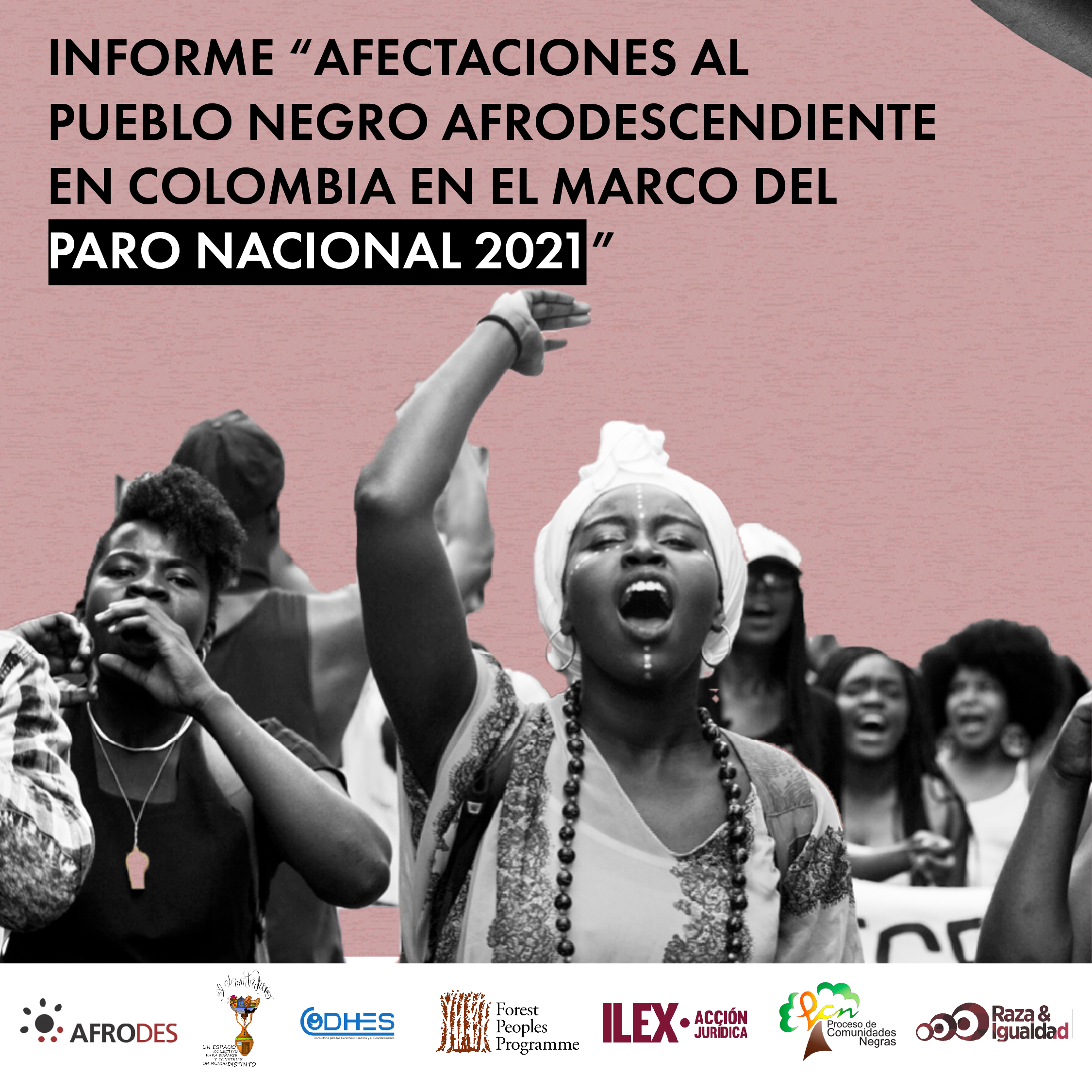
We would like to share the report presented to the Inter-American Commission on Human Rights (IACHR) delegation by several organizations during its working visit to Colombia, to collect information on the human rights abuses by state forces during the repression of the National Strike that initiated on April, 28th, 2021. Although there have been some agreements and national and international pressure brought the Commission to Colombia, repression hasn't stopped. During the delegation, police and ESMAD the anti-riot force continued attacking the demonstrators. Yesterday two other people were killed and apparently several police injured.

The immediate step to follow up the IACHR visit is to make this report to reach the UN High Commissioner for Human Rights, and encourage the Commissioner to include the information in the report she has to present to the UN HR Council in the context of the Resolución A/HRC/RES/43/1 this month. We expect to count with your support.

Thank you.


You can read the report here.

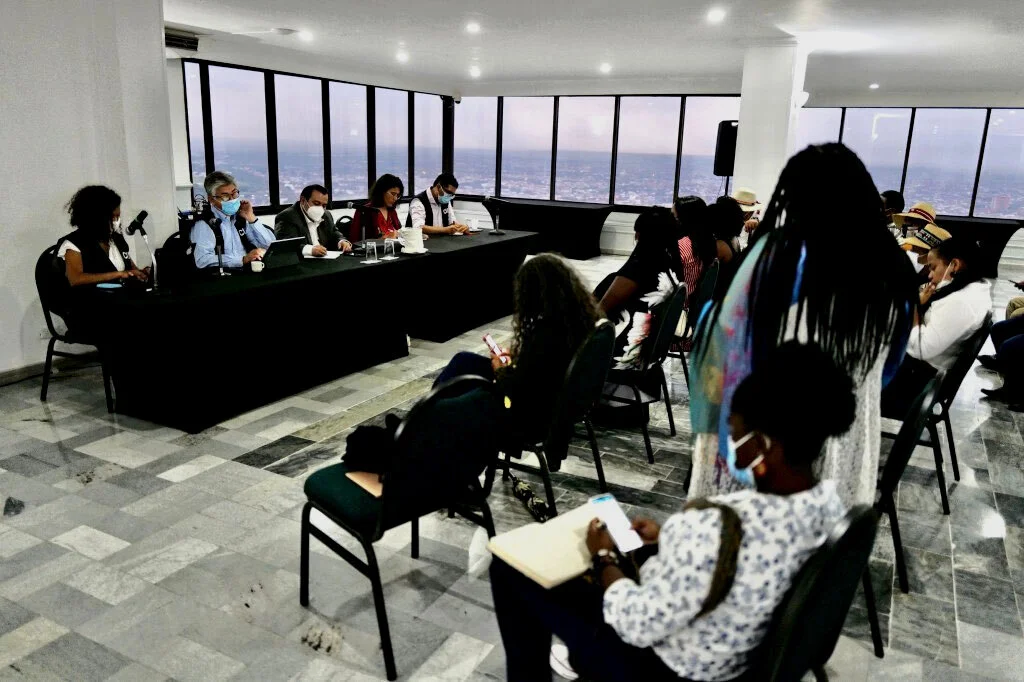
Banner photo: Afro-Colombians meeting with the Inter-American Commission on Human Rights (IACHR) delegation which arrived in Cali. Acts of gender-based violence, racism & repression by the Colombian state during the National Strike were denounced. (Proceso de Comunidades Negras - PCN, or Black Communities’ Process)

Talks to end protests and uprisings in Colombia suspended

Talks to end protests and uprisings in Colombia suspended

Originally published in Colombia Reports by Adriaan Alsema, May 31, 2021

Talks to end protests and uprisings against Colombia’s far-right president Ivan Duque were suspended on Sunday after the government backed out of previously made agreement.

The suspension of the talks further deepen the crisis and increase the risk of more violence that has killed dozens of protesters, two policemen and one prosecution official since April 28.

The National Strike Committee, which has organized peaceful protests, said the government refused to sign off on a previous draft agreement to end the violent repression of protest.

The social organizations reiterated they will continue to be available for talks to end the protests and uprisings that have expanded and become more chaotic in response to extreme police brutality.

The government said in a press release that it wanted the National Strike Committee to lift roadblocks that have been spontaneously been put up by people throughout the country without the knowledge of the social leaders.

Ahead of the talks, Duque ordered the militarization of eight Colombia’s 32 provinces where these often illegal roadblocks are seriously affecting the transport of food supplies or the free movement of ambulances.

In its statement, the social organizations demanded the withdrawal of the presidential decree ordering to expand the militarization contrary to the previously made agreement.

The National Strike Committee called for “huge peaceful demonstrations in the entire country” for Wednesday in another attempt to break the latest deadlock.

According to analyst Elizabeth Dickinson of the International Crisis Group, “nascent trust” between the protest organizers and the government was “shattered” after the breakdown of talks.

The social organizations said they agreed to resume talks on Tuesday. Contrary to evidence, the government said it “has been and will be fully motivated to sit down and seek agreements,” but didn’t confirm whether it would resume talks on Tuesday.

Instead, the government said “we hope that the community leaders accept out invitation to… talk, but without strike or blockages.”

Banner photo: Leaders of the National Strike Committee (Twitter)

Review of BAP Webinar on Afro-Colombians' Role During National Strike

Review of BAP Webinar on Afro-Colombians' Role During National Strike

Write-up by Sarah Soanirina Ohmer, Lehman Envision Anti-Racism Collective, CUNY Lehman College, Bronx, New York. 

Luchar por la vida: Voces Afro-Colombianas sobre el Paro Nacional


“Death is the only space that we are given in this country. The state defends paramilitaries, it’s very clear who has a right to live in this nation. We are fighting for a life of joy! Much more than the “reforms” proposed! This is about the blood running in our veins. This is about the joy beating in our hearts.”   

Vicenta Moreno, Casa Cultural del Chontaduro 

Event description: “Colombia is a country striving to reach peace for more than 50 years. Despite the signing of the Peace Accord with FARC-EP in 2016, during the last three years, under right-wing president Ivan Duque, hundreds of social leaders and human rights defenders have been killed, violence against women has increased 20%, massacres and armed confrontations in ancestral territories are generating new internal displacement. Social and economic disparities have exacerbated. Since April 28 Black people have mobilized in the National Strike demanding social and economic change, peace and respect for their collective rights. The Colombian government met the strike with brutal violence killing 47 people, 35 from the city of Cali, in neighborhoods that were primarily Black, poor, and working class. While the strike is not completely called off and now armed civilians supporting Duque’s government are also shooting the protesters, how is this affecting and will affect Black/Afrodescendant people?”

On Wednesday April 12 2021, 7:30pm, I logged onto Zoom to catch up and check in with comrades in Cali, Colombia. Black Communities Process in Colombia (PCN), Afroresistance, and Black Alliance for Peace. 

Colombian rap came on as we all entered the online conference room, bobbing our heads as we expressed gratitude in the chat - we were clearly grateful for the opportunity to commune, gather, touch base, virtually, as a global Black community. #elpueblonoserindecarajo, Props to BAP, and a family vibe came through the chat to everyone, as familiar faces got ready to address us from the webinar stage. 


As the second song ended, Executive Director Janvieve welcomed the community with a reminder of the importance of language justice. For Black Alliance for Peace, linguistic access to all participants of African descent is central to building international solidarity and global equity. The entire event offered live interpreting from Spanish to English, by Flor and Argelis. 

As I sit here reflecting on the event, I find that the panelists left us with three crucial points:

  1. we need to educate our Black masses quickly on the current situation in Colombia from intersectional perspectives, 

  2. in order to present facts on our siblings in Colombia, our comrades have to create their own collection of data, reframe all of the articles and reports from the perspective of Black Colombians, and hunt down missing pieces of information, since everything related to Black Colombians is either silenced, filtered through white supremacist media, or absent. 

  3. The comprehensive presentations also zoomed into the most consequential impacts of the police repression onto Black Colombians and specific needs for solidarity and international support: the brutal repression, the hundreds of disappeareds, and the absolute invisibility of the victimization of Black mothers and their resistance. 

Each speaker made it very clear that the most vital participants in the strike were young Black Colombians, and they were the hardest affected by the violence. We also learned that the violence came from police and military out of uniform, working as militia, targeting specific individuals of African descent in the peaceful protests, committing homicides and assassinations.

Before introducing the first speaker, Charo Mina Rojas spoke from the locus of enunciation of African Diasporic religions, anchoring the gathering to the spiritual activism of our ancestors, the strengths of our orixás, especially Obatalá. A moment of reflection and prayer connected us with our foremothers and forefathers, to our loved ones who have disappeared, asking our orixás for help that they return to us, and recognition to all of the young people who have been fighting in the streets for our freedoms. 165 people were in the room, plus more on Facebook live, from Canada, Colombia, Brazil, the United States, and other parts of the world, listening to the Yoruba Nigerian language of resistance and Candomblé from Bahia, communing with the orixás offering us strength so that we may continue to resist, and live, engaging so that the orí of our young brothers and sisters be protected, asking Obatalá that we may have peace and land that is ours, not a capitalist land. 

Out of 47 people who had died already, 35 were from Cali (Indepez), the majority of whom were young adults and 4 of whom were minors.

Of 1,876 acts of violence, there had been 12 cases of sexual violence, and 28 eye injuries reported by Wednesday, along with 963 arbitrary detentions, 548 forced disappearances, 7 Indigenous injured by paramilitary in Cali, and 7 Afro-Colombians killed in Cali.

Harrinson Cuero presented the context of the national strike for people of African descent in Colombia. The explosive cocktail, he explained, made it so that the streets and the government became more dangerous than the virus: structural racism and social alienation, extractivism and inequality, pandemic and death, unemployment, poverty, along with the tax reform. The order of the items on the list, with structural racism at the top, underlined the explosive contents of the cocktail from the most impactful and urgent need to address, to the least. He went on to present each ingredient in the cocktail, to offer the Black Alliance for Peace audience a clear image of the factors that have led to the social unrest of Afro-Colombians from May 5 through the current day. 


Cuero listed the facts and the statistics to counter the stigmatized disinformation in mainstream media in Colombia and international news outlets. First, the Black population on the census is about 10% of the population who actually identifies as Black - he showed a map of the census representation in contrast to the actual presence of Black Colombians. Later in the event, Esther Ojulari presented a parallel between the concentration of Black Colombians in Cali, and the points of highest occurrences of police brutality in the past week. Both highlighted the racialization at work over the course of the 20th and 21st century, including in the dire state of affairs in Colombia.


To offer further examples of systemic racism in Colombia, Cuero presented the data of the Black population in Colombia in terms of the age of the Black population from 2005 to 2018 (major decrease in the 0-14 age), the unequal levels of education between Black Colombians and national averages (considerable difference in upper school), and poverty (considerable difference between Black Colombians versus national). He showed us, in numbers, the ingredients of the explosive cocktail.


Esther Ojulari’s presentation focused on the localization of the national statistics: the racialization of Cali and how racial segregation instructed police bruality during the strike in Cali. She traced the segregation back to the nineteenth century forced displacement of “free Blacks” to Cali, followed by the forced displacements during the civil war and the “peace treaty.” The connections to the previous centuries also showed the consistent use of stigmatizing discourse to justify the dehumanization and deaths of young Black people, and to displace the blame of the government and authorities towards young Black people. 


The protests and repression, she showed, were happening in the Black neighborhoods of East Cali. “The use of force occurs based on the racialization of the city and on the ethnicity of the protesters,” she noted. Piecing together photos taken by civilians and shared on social media, newspapers, reports, and the cover of the Q’Hubo newspaper which showed the faces of the victims, Ojulari confirmed that out of 36 people who died in the past week, 11 were visibly Black, 1 Indigenous, 6 Mestizo, and 17 were unidentified. “This,” she emphasized, “is an issue. We cannot report the state of affairs and the extent to which it actually affects our people, because no one is tracking the ethnoracial data.” There is an absolute lack of access of data across institutions which needs to be addressed immediately. 

Equally indispensable and urgent: an immediate report and follow-up on the inordinate amount of civilians who have disappeared, and an immediate stop to the unjustified kidnappings: 187 as reported from Buscarles hasta encontrarles. More than half of the disappeared from come from areas of Cali that are half to majority Black neighborhoods. 

Arleison focused on the police brutality in Cali. He underlined that the police was directly involved in the assassinations of young Black people, children, and women in Cali. 35 out of 47 who have died in the strike, died in Cali. “Two students from our school were injured while making art in their neighborhood.” He went on to list the names of the eight young Black men murdered by the police and their accomplices. The mayor shows no consideration or concern to address the deaths and disorder. The “Primera Línea” and the students are not the ones creating the disorder. The right-wing is directly related to the vandalisms. The dialogues are not effective, as there is no assembly to engage the community’s voices. Arleison underlined the sexual torture as a weapon used against civilians of African descent: “Women are raped in our streets,” Arleison emphasized: “This is the worst human rights crisis in Santiago de Cali.” 

Vicenta Moreno, founding member of the Cultural House of Chontaduro in the district of Aguablanca, Cali, spoke on the impact of police repression in 2020 through May 2021 on the lives of Black women. “400 of our children have died this past year! Why haven’t we talked about this?? Tell me. We marched yesterday to demand to bring our children home, and to stop killing them in the streets, when all they are doing are protecting our basic rights. Have you heard about this? Do you know why not? Us, Black mothers of East Cali, we are tired of seeing our children’s blood in the streets.” 

70% of the Black population in Cali lives around the Cultural House of Chontaduro. Of the thirty five years that Vicenta has lived in this district, this past year is by far, and remember, she is referencing three decades of known violence in the history of Colombia, this past year is by far the worst in the history of Aguablanca. The district of 23 neighborhoods in East Cali is witnessing excessive numbers of premature death and massive deaths in the area. More so than they have ever witnessed. 407 assassinations of young people in one year.

“Why such silence? No one talks about this genocide?! Just us, hugging each other and embracing each other. We march, we strike, against the tax reform, health reform, pension reform, that we live from a state of precarity. We have already died, for centuries we die due to these policies and to the precarity, the neglect, and the militarization. We are witnessing this on the daily in Aguablanca. Premature death is permanent in our existence. So we march.” 

Moreno echoes Cuero and Ojulari on the absolute lack of a focused analysis in Colombia. She adds that the lack of focus is systematically keeping Black women out of he picture: “we march and it’s not seen - as if we aren’t a part of this? Our reality is much deeper, and so we march.” And, she adds, they analyzing the situation for themselves, as a situation lived daily, a state of permanent social death: “Death is the only space that we are given in this country. The state defends paramilitaries, it’s very clear who has a right to live in this nation. We are fighting for a life of joy! Much more than the “reforms” proposed! This is about the blood running in our veins. This is about the joy beating in our hearts.”   

For more information on femicide and global accumulation: https://abyayala.org.ec/producto/feminicidio-y-acumulacion-global/

Towards the end of the question and answer, we concluded that alliances across ethnicities have always existed, that we share experiences and have many moments of working together, and that the establishment knows this, which is why they make sure to divide us and hide our solidarities, for example with Cauca and land rights, and by negating one ethnic group’s rights over the other. But we understand this. We have examples of alliances in our own version of history, we can remember this and continue this. Harrison Cuero offered the last words: Political control, economics, and education. These are the three axes we can develop in order to strengthen and empower people of color. Boycotts won’t resolve this - let’s strengthen ourselves. 

To support current efforts of solidarity and help young Black people and Black women, send your contributions to the following: 

CASA CULTURAL EL CHONTADURO

Account #82900011573

Type: “ahorros” or checking –

Bank: BANCOLOMBIA.

Swift code: COLOCOMBCL1

Bank ID: COLOCOBMXXX

ESTUDENTS UNIVERSIDAD DEL VALLE - FOOD SUPPORT –

make your donation here:

https://vaki.co/es/vaki/q3GE4kJDrxTZz8ZA0Tl9?skip=true#summary

BLACK AFRO-COLOMBIAN COMMUNITIES SOS
– solidarity with community assemblies and Guardia
Cimarrona – make your donation here:

https://gofund.me/b07ffc78