
Trump, White Farmers and the War on Zimbabwe’s Sovereignty: Why Africans Must Reject this Neo-Colonial Push
By: Mafa Kwanisai Mafa
The Panafricanist
The latest push by a small group of white farmers in Zimbabwe to drag Donald Trump and the United States government into a fight over land compensation is not just a betrayal of Zimbabwe’s revolution; it is a fresh front in an ongoing war to reverse Africa’s emancipation from colonial domination.
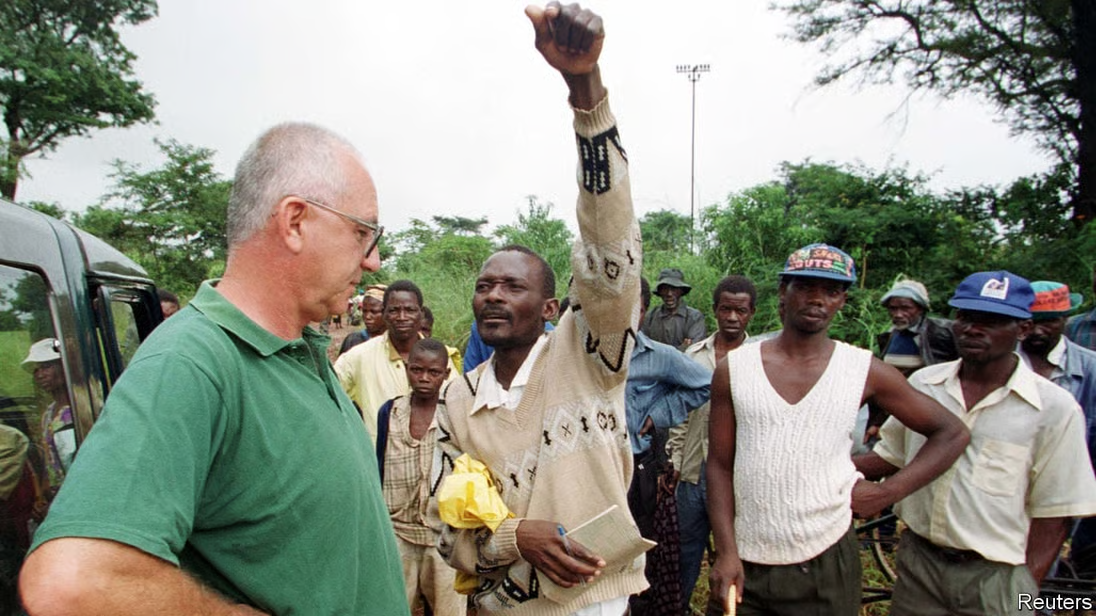
Earlier this week, reports emerged that a faction of white former farmers has hired a US lobbying firm with deep ties to Trump’s circle, asking the American president and his Republican allies to pressure Harare into paying billions of dollars in compensation for land seized decades ago under the country’s land reform programme.
Let there be no mistake: this is not about fairness or justice. It is about power, about imperial interference, and about rewriting history to serve the powerful few.
Zimbabwe’s land reform, begun in the late 1990s and early 2000s, was a radical and necessary corrective to colonial theft.
For nearly a century before independence, a white minority dominated the fertile agricultural heartlands of Zimbabwe, while the majority Black population was relegated to crowded reserves and marginal lands.
This was not an accident; it was the design of colonial conquest and racial capitalism. Redistributing that land to Black Zimbabweans was not only just, but it was essential for dignity, self-determination, and economic independence.
Yet now, more than two decades later, a clique of former landowners is trying to internationalise what was a sovereign African decision.
They have turned to Mercury Public Affairs, a US lobbying firm, to persuade Trump’s allies in Washington to intervene in Zimbabwe’s internal affairs.
Their argument is simple: they want billions of dollars in compensation for land that was taken from them. This push is deeply flawed on both moral and political grounds.
First, it ignores the most important fact: these farmers held land that was stolen from the African majority through colonial violence and legal imposition. The land redistribution was not a whim; it was a reckoning with centuries of theft.
To demand that an African nation pay huge sums on behalf of a tiny, historically privileged minority is to ignore the blood, sweat, and struggle of the millions displaced and oppressed by colonial rule.
Second, the compensation campaign is being framed through the lens of Western politics, particularly through the truncated narratives of US Republican rhetoric about “white farmer genocide” in southern Africa, a claim that has been widely debunked and exposed as an extremist fantasy.
Trump and his circle have repeatedly amplified similar claims about South Africa, and now they are seeking to cast Zimbabwe in the same light.
Here we see the danger of allowing Western geopolitical agendas to infiltrate African policy issues. This is not assistance; it is interference.
It is the old colonial project in new clothes: using financial leverage and political pressure to bend sovereign African choices to Western interests.
This is why any appeal to Trump, Congress, or US policymakers should be treated with contempt by all Africans committed to self-determination.
Third, the framing of compensation in this way trivialises the unresolved economic injustices inflicted on Black Zimbabweans under colonialism.
While the question of improvements on the land remains contested and the government has indeed budgeted sums to pay for infrastructure losses, the larger question of returning stolen land and the attendant wealth created from it remains a historical debt owed by colonial powers and settler elites to the African majority.
To accept the premise that a small group of white farmers should be compensated by a Black government at the behest of a racist Western administration undermines the very principles of justice that underpinned Zimbabwe’s struggle for independence.
It suggests that the rights of a minority settler class outweigh the collective rights of the indigenous majority whose land and resources were stolen. This is not justice. This is a replay of colonial logic.
Some critics, including within regional bodies such as the Southern African Development Community, have pointed to legal rulings that favour compensation claims under certain treaties. Yet this too must be contextualised.
The international legal order is replete with biases that favour powerful states and entrenched interests. SADC’s own Tribunal rulings, for example, have been subject to political pushback and controversy precisely because they sit at the intersection of law, sovereignty, and political power.
But no international legal technicality should be allowed to override the core principle that African nations have the right to determine how they manage their land reform and economic priorities without foreign interference.
Let’s also be clear: Zimbabwe’s land reform was not perfect. Implementation was sometimes flawed, and challenges remain in commercial agriculture productivity and rural development.
But these are problems of post-colonial reconstruction and empowerment, not excuses for Western governments and settler elites to return with demands that Zimbabwe bend to their will.
This moment calls for unity, not capitulation. Land reform in Zimbabwe was part of a broader African liberation project that sought to dismantle the economic foundations of colonialism across the continent from Ghana to Guinea, from Namibia to Mozambique.
To allow a return to colonial claims through US political pressure is to undermine the very gains that African revolutionaries fought for.
African nations and leaders, regional organisations, and civil society should stand in unison against this renewed assault on Zimbabwe’s sovereignty. This is not a local issue; it is a continental one.
It is a reminder that the battle for genuine decolonisation, economic, political, and psychological, is far from over.
In Zimbabwe, land belongs to those who reside on it, work it, and whose ancestors were dispossessed by colonial conquest. Seeking compensation from the Zimbabwean state under the influence of an external imperial power is not only unjust, but it is an affront to Africa’s liberation struggle.
Africa must reject these neo-colonial overtures and reaffirm that land reform was and remains a legitimate and necessary correction of historical wrongs.
Zimbabwe’s land reform is not negotiable. Its sovereignty is not for sale. And its liberation history must not be rewritten to serve outsiders. Rejecting this compensation campaign is not only a defence of Zimbabwe, but it is a defence of the African revolution itself.