
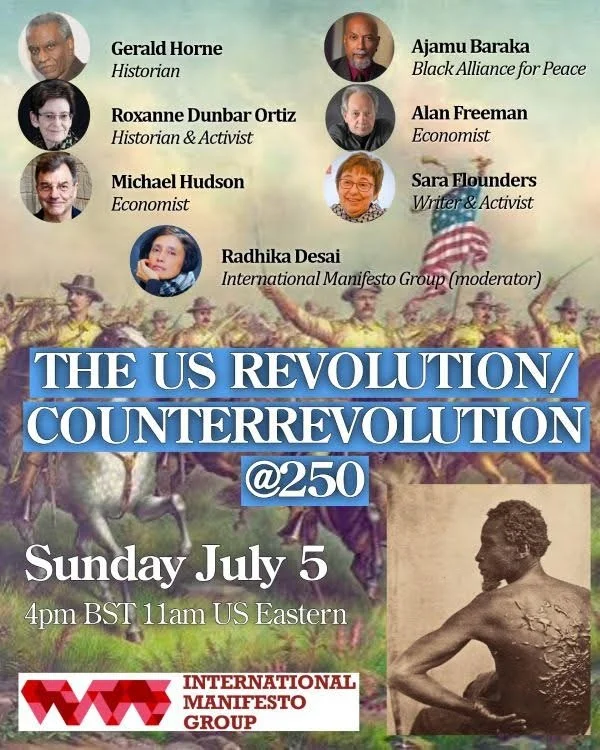
Two hundred and fifty years after the Declaration of Independence, how should we understand 1776? The familiar story celebrates a revolution for liberty and self-government. A powerful counter-tradition argues that it was in large part a counter-revolution: a bid by slaveholders and settlers to defend slavery and westward expansion against a British empire that had begun to constrain both. This webinar weighs the republic’s radical and democratic legacy – the universalist language later seized upon by abolitionists, suffragists and anti-colonial movements – against the realities of slavery, dispossession and an imperial trajectory visible from the founding.
We then trace that trajectory through its milestones: continental expansion, the Spanish–American War of 1898, the Bretton Woods settlement of 1945 and the supposedly unipolar moment of 1991 – before turning to the profound crisis we are witnessing today. We ask how the US’s domestic troubles (economic decline, debt, deindustrialisation, social division and political dysfunction) connect to signs of imperial decline abroad – military defeat by Iran, economic and technological defeat by China, and a rising multipolarity – and what might come next.
Speakers
Gerald Horne is a renouned historian who holds the John J. and Rebecca Moores Chair of History and African American Studies at the University of Houston, and is the author of more than three dozen books on race, colonialism and resistance. His work is especially apt for this anniversary: in The Counter-Revolution of 1776: Slave Resistance and the Origins of the United States of America, he argues that the American Revolution was in significant part a conservative revolt by colonists determined to protect slavery against a London increasingly inclined toward abolition.
Roxanne Dunbar-Ortiz is a historian and a longtime activist in the Indigenous movement, and winner of the 2017 Lannan Cultural Freedom Prize. Her An Indigenous Peoples’ History of the United States retells the country’s founding and expansion from the perspective of Native nations, recasting 1776 and after as a story of settler colonialism and 250 years of Indigenous resistance.
Ajamu Baraka is the national organiser and spokesperson for the Black Alliance for Peace and a longtime human-rights campaigner who founded and directed the US Human Rights Network. He was the Green Party’s vice-presidential nominee in 2016 alongside Jill Stein, and brings a Black radical, anti-imperialist lens to questions of American empire and the unfinished business of liberation.
Michael Hudson is an economist and professor at the University of Missouri–Kansas City and researcher at the Levy Economics Institute at Bard College, and a former Wall Street analyst. His landmark study Super Imperialism dissects how the US sustains global economic dominance through the dollar and institutions like the IMF and World Bank — a reading of US power well suited to assessing what 250 years of the republic has produced.
Sara Flounders is a writer and socialist activist, a co-director of the International Action Center and a leading member of the Workers World Party who has been organising against US militarism since the 1960s. She has authored or edited more than ten books on war and empire, including the anthology Sanctions: A Wrecking Ball in a Global Economy, offering a sharply anti-imperialist account of the US at home and abroad.
Alan Freeman is the co-director, with Radhika Desai, of the Geopolitical Economy Research Group (GERG) at the University of Manitoba. He was an economist at the Greater London Authority between 2000 and 2011, where he held the brief for the Creative Industries and the Living Wage. He wrote The Benn Heresy, a biography of British politician Tony Benn, and co-edited three books on value theory. He is honorary life vice-president of the UK-based Association for Heterodox Economics and a Vice-Chair of the World Association for Political Economy.
Radhika Desai is Professor at the Department of Political Studies, and Director, Geopolitical Economy Research Group, University of Manitoba, Winnipeg, Canada. Her books include Capitalism, Coronavirus and War: A Geopolitical Economy (2023), Geopolitical Economy: After US Hegemony, Globalization and Empire (2013), Slouching Towards Ayodhya: From Congress to Hindutva in Indian Politics (2nd rev ed, 2004) and Intellectuals and Socialism: ‘Social Democrats’ and the Labour Party (1994), a New Statesman and Society Book of the Month.
Organised by The International Manifesto Group