Asia-Pacific News Update #7
In this edition of the Asia/Pacific News Update, BAP’s Asia/Pacific team interviews Anthony Karefa Rogers-Wright, co-coordinator of BAP’s Climate, Environment and Militarism Working Group. In solidarity with a growing international effort to Shut Down Pax Silica, including comrades in the Philippines and other regions in the Asia/Pacific, we discuss the U.S.-led initiative, translating the State Department’s playbook, and the urgent need for organized resistance in the face of U.S. empire’s global plunder and the resultant climate crisis.
This interview has been edited for brevity.
Launched in December 2025, Pax Silica (“silicon peace”) is an international initiative coordinated by the U.S. State Department to “reduce coercive dependencies” and command global tech supply chains. As reported, through Pax Silica, the U.S. and its allies seek to “control the raw materials and systems that make AI possible.” Can you discuss the differences in how the state is defining “peace” here versus how we understand peace within the Black Radical Tradition?
I really appreciate that question. It makes me think first and foremost of the great Kwame Ture and his incredible book and opus called “Black Power and the Politics of Liberation.” He’s having a discussion about language, and he recalls a discussion between the fictional Alice in Wonderland and the Caterpillar, and basically the takeaway is “he who has the right to define is master.” So we see the co-optation and the elite capture of a word like “peace,” where what they mean by “peace” is a status quo of capitalism, a status quo of being able to maintain and expand, if you will, capital, and on their terms. So it’s really a singular, tunnel-vision view of what peace actually is. Because of course, massive extraction to serve the U.S. empire and U.S. imperialism—there’s nothing peaceful about that when you think about the people whose lands are being extracted from, the natural resources that will be impacted, including air quality and the profligate amount of water that will be utilized and poisoned. There is nothing peaceful about what essentially equates to ecocide.
At BAP (Black Alliance for Peace), when we’re talking about peace, it’s primarily through a lens of People(s)-Centered Human Rights, and Pax Silica has no concern or regard whatsoever for the People(s)-Centered Human Rights of the lands that would be extracted from. You see the list of many of the nation-states that have signed on to Pax Silica, and what you see are nation-states whose economies [for the most part] were established and maintained through colonization and imperialism. Which is to say, the extraction of natural resources in the periphery in service to the core. So it’s peace for some but not peace for all. It's really not Pax Silica, they probably should have called it Silica Belli because what it really is is a declaration of war against People(s)-Centered Human Rights and self-determination.
The U.S. State Department says that Pax Silica “secures supply chains.” Can you explain how these chains operate? Who do they serve and who do they exploit?
It certainly does secure supply chains for a vast minority of people, primarily corporations. In the case of the United States, we’re talking about probably seven major corporations, only seven. These are the seven they call, for some odd reason, the “magnificent seven” [Apple, Microsoft, Amazon, Alphabet (Google), Tesla, Nvidia, and Meta Platforms]. These corporations are right now holding close to 60%, maybe even 70%, of the total wealth of the United States of America. And what they’re using that wealth to do is to buy off entire governments, in this case the Trump Administration and his current State Department. So what we should call it is not necessarily a “securing” of supply chains as much as the capture of supply chains, the pillage of supply chains in service primarily to those corporations and the bourgeoisie that I named earlier, while maybe throwing some scraps at the periphery. But they certainly will not benefit in a coequal way at all, that’s just simply not the case because if that was the case, then Pax Silica wouldn’t be necessary. What we’re seeing is U.S. imperialism incognito and in service to the top 1%—really the 0.1% of that 1%—people who control vast amounts of capital and use that capital to capture resources and secure deals like Pax Silica.
“If the 20th century ran on oil and steel, the 21st century runs on compute and the minerals that feed it.” – Jacob Helberg, Undersecretary for Economic Affairs
When we understand this as a pattern or cycle (or the state’s “playbook”), what tactics can we expect from the U.S. as it relates to the extraction of rare earth minerals?
There’s a Mark Twain quote to that gentleman’s point, “history may not repeat itself but it often rhymes.” To that end, we’re seeing history rhyme. What the State Department and the Undersecretary is really getting at is that the U.S. and its partners will do whatever is necessary to capture those resources, in this case critical minerals. We saw this with a nearly decade-long occupation of the Middle East as it pertained to Iraq and securing oil supplies there. We’re seeing it to some extent right now with this war of aggression against the Islamic Republic of Iran. It’s not about nuclear weapons, it’s about who controls oil flow, who controls energy - essentially at a time when capital is tripling down on a technology that happens to need a ton of energy to be able to operate. So it’s not just the critical minerals, it’s also the energy to refine those critical minerals, and the machines, in this case artificial intelligence data centers that are going to need those critical minerals to be able to power their chips.
This is a declaration of imperialism. They are going to use the same tactics that were used in the late twentieth century, early twenty-first century to secure those resources. It is a major escalation against the People's Republic of China, who have the most critical mineral deposits in the world within their own nation state. So they’re secure, they don’t have to necessarily embark on a paradigm or a praxis of imperialism for their resources because it’s right there. In this case, what the Undersecretary is really saying is that the U.S. is going to do what it has to do in partnership with these other nation states that signed on to “secure” vis-à-vis “capture” those natural resources in the same way as what has been done over time. Whether it was Europeans doing the same thing on the African continent, certainly here in Turtle Island, South America, etc. It’s Colonize, Control, and Command—I call them the 3 C’s of imperialism and pretty soon it could be water. We have a dwindling water supply, so they will use those same tactics to secure water resources for this technology that centers AI. And for the sustenance of the very, very, very wealthy while the rest of us are left to fend for ourselves. So this is double speak, and it should be noted that the State Department of the United States right now is run by Marco Rubio, who is also national security adviser. And National Intelligence is basically an agency within the U.S. apparatus of war and colonization. It’s giving intelligence to the military on how to do what it needs to do to continue to sustain, and even expand, U.S. empire.
What are the material consequences of this extraction?
The material consequences of the extraction is the rendering of sacrifice zones in the periphery, whether they be here in the United States or globally. The consequences are rendering entire people and populations as surplus populations, as disposable. The consequences are massive instances of dehumanization, of no recognition whatsoever of People(s)-Centered Human Rights, no recognition whatsoever of self-determination. What we’re seeing is the consequences of increased militarism. Because this is a very toxic rendering of the idea of “by any means necessary.” They’re “elite capturing” Malcolm, they’re turning it into a paradigm of white supremacy ideology, and those are the consequences. The consequences are war, militarism, and unfortunately carnage for peoples who are not deemed, not seen as human. We’re seeing this play out with what’s happening with our comrades in Palestine, in Lebanon, in Syria, Iran, and now in South America as we’re seeing with Venezuela and Cuba. Absolute dehumanization in service to maintaining and expanding U.S. empire.
How does U.S. resource extraction globally connect to data centers domestically?
This is what the great V.I. Lenin meant by imperialism being the most sophisticated stage in late stage capitalism. We’re in a stage of monopoly capitalism now, and when you get into monopoly capitalism the only way to sustain it, its rapacious hunger, is colonization. Colonization through militarism and doing what needs to be done to secure those critical minerals, energy supplies, and water supplies to continue to feed capital—in this case, in the form of data centers.
Right now we are witnessing exactly what it will look like with the situation in Gary, Indiana. Gary gets hit by a major climate-fueled storm, power gets knocked out for a population that is majority poor, majority Black. While these people don’t have power, the data centers around them are operating at full strength. When you think about it, it’s a very sadistic picture of Black labor redundancy. Which is to say a surplus population and the prioritization of capital—in this case in the form of data centers—that are spewing out emissions on people who have no power to even ventilate their homes, to cool their homes, to preserve their food…and this is it in real time. This is a harbinger for what it will look like globally if we don't confront this very toxic scenario. Again, these Black people in Gary are not seen as human. They’re not seen as human because the data center is saying, “we will secure these resources to keep us going at your expense.” And that is to say, “we don’t even see your humanity.”
How else can you explain the prioritization of these machines over people who are just trying to live? Not live extravagantly, but basic everyday services such that they can live basic everyday lives: keep machines running for medical needs and preserve the little food that you can afford. That has been ripped away and that’s what we will see with increased mineral extraction. In places like the DRC, South America, etc., at the expense of the people. We’re talking about a technology—AI—that will be meant to make more people’s labor redundant and will make them surplus populations.
When you have a surplus population, there’s only a few things that you can do with them: 1) Mass incarceration. 2) Capture a few of them to do your bidding. Robert L. Allen reminds us in his book, “Black Awakening in Capitalist America,” you can’t have colonization without some willing elements of the indigenous population, so you capture some of them. And the third thing is you let them die, either through slow genocide or accelerated genocide, as we’re seeing in the Middle East. Gary, Indiana is showing us in real time what will happen to more and more communities globally with this data center situation. It’s a multi-pronged process of not only massive extraction but also of rendering people as not human anymore in service of maintaining the capitalist machine.
The history of the word “pax” reveals its use by falling empires (such as Pax Romana). How do we see the U.S. as a falling empire today?
I think one profound example is this war of aggression against the Islamic Republic of Iran, and the massive amount of consequences that have come with it. We see how it’s affecting global supply chains and how that, in turn, is impacting the bottom line of poor and working class people here in the U.S. Rising gas prices, small family farms not being able to purchase fertilizer to grow food for their businesses, and everyday costs going up for people. We have a situation now where the U.S. believes that it was necessary to flood the market with imported, cheaper beef, which did not benefit domestic meat producers, and a military that is spread super thin, so thin that it has no concept of how to defeat the Islamic Republic of Iran. You’re seeing the impacts of a failed war because of too much expansion and geopolitical blunder after geopolitical blunder. The U.S. is stretched thin in so many ways while back here, domestically, its society continues to break down more and more. Costs going up for everything from food, petroleum, even education in a society that continues to get sicker and sicker, both mentally and physically.
I think that we’re seeing all of the elements of a failing empire: a stretched out military, a failing economy in the sense that it’s not working for the vast majority of people, the infrastructure crumbling, and this idea that we can continue borrowing our way out of a crisis with $40 trillion in debt and that debt making up close to 80% of the GDP. This is not what a true “industrialized nation” looks like. This is the beginning of the United States going from an industrialized nation to, essentially, a banana republic. That’s also reflected in how the government is being run right now by a bunch of oligarchs and gangsters, who are literally enriching themselves and using the government to enrich themselves in ways that we’ve seen in less-developed or underdeveloped nations that we refer to as “banana republics.” The United States right now is probably the most advanced banana republic in the world and it’s only a matter of time before these material conditions experience so much entropy that the only logical outcome is full-on collapse.
What is the role of BAP’s Climate, Environment and Militarism Working Group in this fight?
The BAP Climate, Environment and Militarism group came about because we believed it was necessary to institute a series of requisite interventions in what we were observing within the more mainstream and bourgeois climate spaces, what some of us refer to as the “U.S. climate industry.” Principally, not articulating the climate crisis through a lens of People(s)-Centered Human Rights; and certainly not analyzing the role of militarism in the overarching climate crisis, not analyzing the root causes of the climate crisis, and confronting patriarchy, colonization, and white supremacy ideology. So the role of BAP’s Climate, Environment and Militarism initiative is to surface that analysis, to struggle and intervene, and make sure that we are framing this climate crisis through a lens and a foundation of People(s)-Centered Human Rights.
We are going to prosecute the role of militarism because militarism increases climate change and climate change increases militarism. We've seen this with Hurricane Katrina where the response was to militarize the city, not to provide for people, and we've seen that with other climate-fueled disasters as well. The military—whether it's the U.S. military or domestic military forces, police, National Guard, or whatever—being dispatched, in some cases, before first responders and medical aid. So understanding the role of militarism is requisite to fully understand the scale of the climate crisis and the ways to intervene and confront it.
Learn More and Take Action:
Climate, Environment and Militarism — The Black Alliance for Peace
Pax Silica and the weaponization of AI supply chains: The new front in US global economic warfare
The International League of Peoples' Struggle (ILPS) is launching a campaign to Shut Down Pax Silica. Part of the ILPS campaign to Oppose U.S.-Led War and Plunder, this is a national campaign taking action 1) against various war profiteers, including those in AI technology development and, 2) in solidarity with movements and countries that are targets of U.S.-led aggression, and campaigns fighting against U.S. militarism and war.
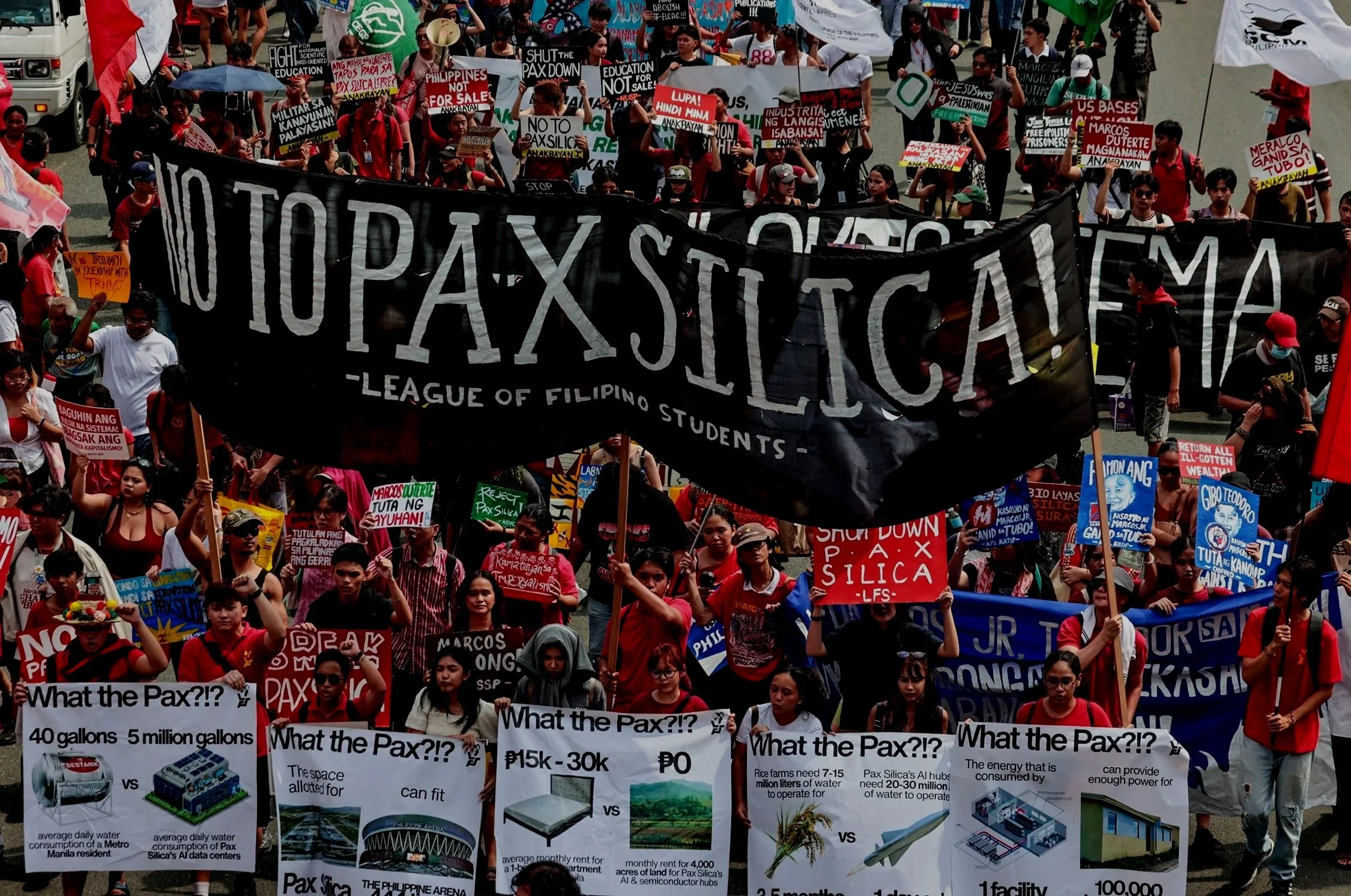
With the launch of the U.S.-based campaign and Shut Down Pax Silica network, ILPS joins BAYAN USA and organizers in the Philippines—where there is the most developed and aggressive implementation of Pax Silica—to oppose this U.S.-led initiative, which only serves to strengthen U.S. imperialism's capacity for war. The goal is to unite movements and organizations across various sectors in common action towards the goal of shutting down Pax Silica and all similar initiatives. In particular, the Shut Down Pax Silica network plans to mobilize during the ASEAN (Association of Southeast Asian Nations) Summit in the Philippines in November 2026, which Trump plans to attend and where key deals within the Pax Silica initiative are aiming to be ratified.
Get involved! Sign on to reject Pax Silica and join the campaign!