Movement News: Was Patrice Lumumba's Assassination the Most Important of the Last Century?

Movement News: Was Patrice Lumumba's Assassination the Most Important of the Last Century?

By Maurice Carney, of BAP member organization Friends of the Congo

The assassination was a disaster not only for the Democratic Republic of Congo, but for the entire African continent. More than half a century later, its shockwaves still reverberate.

The assassination of Congo's first democratically elected prime minister, Patrice Emery Lumumba on January 17, 1961 has been famously termed “the most important assassination of the 20th century”, and that is arguably true - especially for the African continent.

Should one assess the devastation and havoc wreaked on the Congo since Lumumba’s overthrow and subsequent assassination, it is unmatched anywhere else in the world.

After enduring over three decades of a US-installed and maintained dictatorship under Joseph Desire Mobutu, the Congolese people became the victims of the deadliest conflict since World War II with an estimated six million lives lost due to conflict and conflict-related causes from 1996 to 2007.

The US overthrow of Patrice Lumumba is in line with a number of other noteworthy undermining of democratically elected leaders in the 20th century, such as Iran’s Mohammad Mosaddegh in 1953; Guatemala’s Jacobo Arbenz in 1954; and Chile’s  Salvador Allende in 1973.

The United States through its Central Intelligence Agency (CIA) in cahoots with the United Nations, Belgium and local Congolese elites, did not merely overthrow a democratically elected government in the Congo; it laid the foundation for the assassination of Lumumba, his youth minister, Maurice Mpolo, and the first vice president of the Senate Joseph Okito. These actions violently uprooted and systematically dismantled any hopes for a democratic culture in the Congo.

American covert action in the Congo led by the CIA, was ranked as the largest in the agency's history at the time. Congo was the first post-independence African country in which the US intervened.

Henry Jackson in his seminal work From Congo to Soweto: US Foreign Policy Toward Africa Since 1960, noted that the United States heeded Chairman Mao’s assertion about the Congo – “If we can take the Congo: We can hold the whole of Africa.”

Congo was also the centerpiece for Kwame Nkrumah's—the man who led Ghana to independence—Pan-African project of the United States of Africa. Due to its strategic location in the heart of Africa and its spectacular wealth, it was to serve as the industrial engine to power the development of the African continent.

Frantz Fanon captured the strategic importance of Congo when he noted that Africa has the shape of a pistol and Congo is its trigger. Ludo De Witte, author of The Assassination of Lumumba rightly notes that the dismantling of the Lumumba government has had “disastrous consequences throughout Africa as a whole.” 

Africa’s and Congo’s loss has been a gain for Belgium, the United States and other Western nations.


The West’s outstanding debt

Both Belgium and the United States are morally indebted to the Congo. 

In a just world, the Congolese people would get reparations for the damage done to them by both countries. However, instead of reparations, Belgium apologised in 2002 for its role in the assassination of Lumumba and a few months ago, built a statue to commemorate Lumumba in Brussels.

As for the United States, the US Congress produced the Church Committee Reports which investigated the abuses of US intelligences services among which was the CIA’s role in the assassination of Patrice Lumumba.

Nations act based on their interests, not moral imperatives. For both the US and Belgium, keeping Congo weak, dependent and impoverished best serves their strategic interests, which includes access to precious and strategic minerals in order to fuel their military, aerospace, technology, electronics and automobile industries. 

It would be folly for the Congolese people to expect anything constructive and beneficial from the US or Belgium.

Both countries’ current pronouncements on democracy and economic development contradict their history of plunder and the stifling of democracy in the Congo. Joseph Kabila, the current strongman and authoritarian figure presiding over a tyrannical regime in the Congo could not have ascended to head of state and remain in power for the past seventeen years without the backing of the US and other Western nations.

One could quip as Malcolm X did in 1963 that the current hysteria in the United States about alleged Russian interference in US elections is a case of the chickens coming home to roost, but the comparisons are hardly equivalent.

The US intervention in the Congo that overthrew Congo's first democratically elected prime minister reverberates to this day. Stephen Weissman’s summary of US declassified documents on the CIA’s covert action in the Congo observed that its legacy of clients and techniques contributed to a long-running spiral of decline, which was characterized by corruption, political turmoil and dependence on western military intervention.

The media often report that there has not been a peaceful transition of power in the Congo. However, they often neglect to point out that it was since the CIA orchestrated the overthrow of the democratically elected Prime Minister in 1960, that there has not been a peaceful transfer of power.

Although the Belgians attempted to erase all memory of Lumumba by chopping up his corpse and dissolving the butchered pieces in acid, they have failed to extinguish his vision for a free and liberated Congo and Africa.

Lumumba’s ideas and teachings continue to have an indelible imprint on Congolese youth. The youth have perpetuated Lumumba’s legacy through art, music and activism. An entire generation of university students and young scholars are studying and learning about Lumumba as they benefit from the Lumumba Scholarship Initiative.  An increasing number of Congolese youth are striving to fulfill Lumumba’s words when he said in his last letter to his wife Pauline that the future of the Congo is beautiful and that the people will defend its independence and its liberty.

Long Live Congo! Long Live Africa!


Original article: https://www.trtworld.com/opinion/was-patrice-lumumba-s-assassination-the-most-important-of-the-last-century--19397

Movement News: NATO Is a Public Protection Racket

Movement News: NATO Is a Public Protection Racket

By Ann Garrison

Originally published on blackagendareport.com

I wish I could say I’d written that headline all by myself, but, giving credit where it’s due, I swiped it from Hungarian scholar George Szamuely’s remarks on the most recent YouTube vigil for political prisoner Julian Assange:

NATO is really kind of a public protection racket. I mean there’s no enemy that NATO’s supposedly defending anybody against. So what is it actually doing? It has to create its own crises to justify its existence. So it triggers crises and then claims to be the solution. As it moves eastward, the Russians get very upset. So then we’ve got the various Baltic states, Poland—they start getting very agitated and saying. 'Oh no no, we need more NATO, we need more NATO protection.'

“It has to create its own crises to justify its existence.”

"NATO then comes up and says, 'Well, yes, we have to move in. We’ve got this huge dangerous Russian threat looming. We need more resources for NATO.' So it becomes like a protection racket: “Well, nice place you’ve got here. Shame if anything were to happen to it.

This is how NATO operates. So now NATO’s much much bigger than it ever was in the days of the Soviet Union, and what is its purpose? What is it supposedly doing? And under Trump, who supposedly campaigned against NATO, it’s now getting even more resources. And it’s clearly creating these zones of instability.”

Szamuely says that he relies heavily on the US diplomatic cables released by Wikileaks for his research into the origins of the New Cold War. He calls them a “gold mine of information” that tell the story of what really happened, quite unlike the tale of Russian aggression told by obedient Western officialdom, think tanks, academics and media.

The New Cold War began almost immediately after the end of the First Cold War, he says, after the reunification of Germany in 1990, then the dissolution of the Warsaw Pact in 1991. Russia signed off on both and, in exchange, the Western powers reneged on everything they’d promised in return. NATO advanced eastward to Russia’s borders after reassuring Gorbachev that it wouldn’t unilaterally exploit the country’s moment of vulnerability.

“Putin undertook the defense of Syria against the US and the jihadi terrorists that the US funds.”

At the end of 1991, the US installed Boris Yeltsin as the Russian president, then ravaged the country in a neoliberal free-for-all that enriched Western oligarchs and created Russian oligarchs. Nine years later, Putin enraged the West by putting the brakes on that, refusing to let the looting continue and refusing to let the new Russian oligarchs run the country.

In recent years, Russia reacted to the way that NATO had pushed it into a corner, surrounded by US military bases and missile installations, by installing troops and missiles on its own borders, and asserting that it’s a sovereign nation, not a subject of US empire and military hegemony.

Then, in September 2015, Putin undertook the defense of Syria against the US and the jihadi terrorists that the US funds. He drew the line in eastern Ukraine and Crimea, where the populations are predominantly Russian speakers, and defended Russia’s only warm water port, Sevastopol, on Crimea’s Black Sea coast. The US reacted as though Russia had placed missiles on its Mexican borders, and again, Wikileaks was an invaluable source on what really happened.

Wikileaks and Africa

George Szamuely said he’s joined the campaign to free Julian Assange because he owes him a debt of gratitude for so much of the primary source material he’s relying on in his research into the origins of the New Cold War. There’s also a wealth of primary source material about Africa and every other corner of the world as seen through the eye of the empire and its vassals and opponents. A 2008 Wikileak diplomatic cable from an unnamed US official in Kigali, Rwanda was the basis of my last piece for the BAR: Wikileaks: Rwandan Reconciliation Is a Lie. In Rwanda: Starvation in the Shadow of a Star, I cited one of the leaked Podesta emails regarding two Rwandan districts, Kayonza and Kirehe, which the Clinton Development Initiative (CDI) boasts of helping in its publication “Anchor Farm Project: Rwanda.” They’re two of the country’s three famine stricken districts that Rwandans are fleeing to Uganda.

I’ll have more to say about that Clinton Development Initiative in Rwanda, especially in light of the 2014 Bill, Hillary, and Chelsea Clinton Foundation tax return which reveals that the foundation took in $177, 804,612.00, and made grants to charity totaling $5,160,385.00—3% of revenue. In 2005, the Clinton Foundation announced its partnership with the Hunter Foundation in the Clinton Hunter Development Initiative Commitment in Rwanda , whose value they estimated at $100 million -- $20 million a year for a five year period. How could this initiative in Rwanda be valued at $100 million, nearly 20 times the Clinton Foundation’s total grants to charity four years later? Worth $100 million to whom? I didn’t find the Clinton Foundation tax return on Wikileaks. That’s on the website of the National Center for Charitable Statistics, but Wikileaks releases contain abundant information on the African Great Lakes Region.

Wikileaks provides a wealth of primary source material about Africa and every other corner of the world as seen through the eye of the empire and its vassals and opponents.”

Speaking by Skype to editors in Tadjikistan, regarding the diplomatic cables on Central Asia, Assange said, “The most important thing to do is to read all of it. If you go searching for particular things, you will bring your prejudice to the material and you will only find what you already know. Now the other is to understand the situation in which these documents are made. That is that they are made by US diplomats, political officers, and economic officers at the US Embassies and they are reports on their own activities back to Washington.”

I haven’t yet found anything in the diplomatic cables that reversed my convictions or prejudice regarding Rwanda, Uganda, Burundi, or the Democratic Republic of the Congo, although, as Assange urged, I remain open to that possibility. I have learned a lot that I didn’t know, found a lot more detail about what I did know, and often found that US complicity in the region’s catastrophic violence and exploitation is even worse than I thought.

We’ve seen no more than the tip of the iceberg of what Wikileaks has released, but there is far more there than the DNC and Podesta emails that sent the Democratic Party on a rampage.

What are the real goals of the Democratic Party rampage?

Last week, via Twitter, the Democratic Party served Wikileaks with a lawsuit alleging that the organization collaborated with Russian spies to obtain and publish the DNC and Podesta emails during the 2016 presidential campaigns that worked out so poorly for Hillary Clinton. Wikileaks’ only terrestrial address is a post office box at Australia’s University of Melbourne, which it rents to maintain its non-profit status. The Democratic Party will have to argue that the service was legal because they’d tried and failed to serve Wikileaks at the p.o. box and that Wikileaks is demonstrably active on Twitter. There’s no doubt about that, but does the Democratic Party really want to face Wikileaks in court any more than Mueller wants to face 13 Russian spies? The Russian spies will never be tried because they’ll never be extradited to the US, so the indictment has served as a propaganda tool. US media cite it as proof even though it’s just an indictment, a list of allegations, and as Ray McGovern said, “You can indict a ham sandwich.”

Wikileaks Vault 7 release reveals that the CIA has tools that can falsify the identity of a hacker, and the CIA has never denied that. Indeed, Wikileaks has never had to retract a story and never busted a source. So the Democratic Party’s legal complaint can’t be proven any more than Mueller’s indictment. However, if Wikileaks introduces the diplomatic cables in court, they could prove that, as George Szamuely says, NATO is a public protection racket.

Ann Garrison is an independent journalist based in the San Francisco Bay Area. In 2014, she received the Victoire Ingabire Umuhoza Democracy and Peace Prize for her reporting on conflict in the African Great Lakes region. She can be reached at ann@anngarrison.com.

Movement News: Solidarity with the Popular Movements of Colombia

Movement News: Solidarity with the Popular Movements of Colombia

This is the August 6, 2018 statement by the Coalition Against U.S. Foreign Military Bases

The Coalition Against U.S. Foreign Military Bases declares our solidarity with the popular movements of Colombia who are currently the targets of a systematic operation of extermination and intimidation. On August 7, 2018, the right-wing candidate Iván Duque will take possession of the office of the presidency of Colombia, backed by every business and political interest, and every paramilitary organization that wants to undermine the country’s peace.

We denounce this right-wing violence and the efforts, whether legal or illegal, to break the peace and nullify accords that have ended more than 52 years of war between the Colombian government and the FARC-EP (Revolutionary Armed Forces of Colombia – People’s Army). As a result of this war, more than 220,000 persons have lost their lives, more than 92,000 persons have been disappeared, and more than 7.7 million have been forcibly displaced. From the beginning, the most impacted communities have been the Afro-Colombian, indigenous, and rural peoples. Also, from the beginning, the root of this conflict has been the greed of global capitalism for lands and resources that are abundant in their territories. Neither the big landowners, large agribusinesses, narco-traffickers, extractivist and transnational companies, nor the death squads who serve them, nor the militaries, business people, nor politicians linked with them, want peace. They do not want to return the displaced to their homes and farms. They do not want land reforms, nor reserves that protect oppressed communities and their access to land. They do not want peace – they want total domination and the dispossession of whatever community presents an obstacle to their excessive profits.  

The June 17, 2018 election of Iván Duque as President of Colombia was a victory for the enemies of peace. He won the vote in an electoral season marked by irregularities and a climate of threats and violent assaults against the Left and the Center-Left and their candidates. The situation was already deplorable before his election. Between January 1, 2016 and May 14, 2018, the Marcha Patriótica, a social movement for a just peace, had counted 385 victims of political violence. They were all members of popular and Left movements, ex-insurgents and ex-political prisoners and their families, unionists, human rights defenders, students, and/or ecological activists. The majority of the murders were committed by paramilitaries and other illegal groups. Many of the paramilitaries operate with impunity in places where there are located Colombian Armed Forces troops. The Armed Forces have also directly attacked popular movements and protests, and are being investigated for 14 murders of social leaders.

Of the 385 victims between January 1, 2016 and May 14, 2018, 161 came from the Marcha Patriótica and 62% were killed in rural zones. Of these, 33 belonged to just one labor organization, FENSUAGRO (the National Unified Federation of Agricultural Workers Unions). More than a third of the victims, 33.2% were indigenous (48, or almost 18%) or Afro-Colombian (41, o a little more than 15%). Since the election of Duque in June, the situation has gotten even worse, with leaders and members of social movements and ex insurgents and their families being killed at a rate of more than one person per day.

War and repression in Colombia are direct results of the policies of the United States and transnational capitalism. In 1962, the Pentagon’s Yarborough Commission pushed Colombia to unleash military and paramilitary “terror” against rural Colombians in order to achieve territorial control for national and international capitalism. Since 2000, the US has invested $11 billion through Plan Colombia. At least 70% of that funding has gone toward the Colombian Armed Forces, and  most the rest toward “security” apparatus and programs that benefit overall strategies of war and repression.

In exchange, the US military has been granted a presence on seven Colombian military bases. Colombia has not only given the US access to its military bases, it has converted into an important partner in US/NATO imperialism. Colombia has sent troops to Afghanistan and Yemen, and has patrolled Central American and West African coasts with the US military. Colombia has also given international training to more than 30,000 military, police, penitentiary, and court personnel. In an act of geographical discordance, Colombia has joined NATO, giving it a permanent presence in Latin America.

Thus, we of the Coalition Against U.S. Foreign Military Bases not only denounce the political violence in Colombia. We denounce that the Colombian state has become an agent of Empire that threatens its own people, the region, and the planet. We recognize that what happens in Colombia has global repercussions. We stand with Colombia’s popular movements and say with them that: The Peace of Colombia is the Peace of the World!

Banner photo: Twitter/TelloJhonatan

Movement News: U.S. Secret Wars in Africa Rage On

Movement News: U.S. Secret Wars in Africa Rage On

By Nick Turse

01 Aug 2018

“There is no evidence yet of massive cuts, gradual reductions, or any downsizing whatsoever.”

Last October, four U.S. soldiers -- including two commandos -- were killed in an ambush in Niger. Since then, talk of U.S. special operations in Africa has centered on missions being curtailed and troop levels cut.

Press accounts have suggested that the number of special operators on the front lines has been reduced, with the head of U.S. Special Operations forces in Africa directing his troops to take fewer risks. At the same time, a “sweeping Pentagon review” of special ops missions on the continent may result in drastic cuts in the number of commandos operating there. U.S. Africa Command has apparently been asked to consider the impact on counterterrorism operations of cutting the number of Green Berets, Navy SEALs, and other commandos by 25 percent over 18 months and 50 percent over three years.

Analysts have already stepped forward to question or criticize the proposed cuts. “Anybody that knows me knows that I would disagree with any downsizing in Africa,” Donald Bolduc, a former chief of U.S. commandos on the continent, told Voice of America.

“The number of commandos operating on the continent has barely budged since 2017.”

While the review was reportedly ordered this spring and troop reductions may be coming, there is no evidence yet of massive cuts, gradual reductions, or any downsizing whatsoever. In fact, the number of commandos operating on the continent has barely budged since 2017. Nearly 10 months after the debacle in Niger, the tally of special operators in Africa remains essentially unchanged.

According to figures provided to The Interceptby U.S. Special Operations Command, 16.5 percent of commandos overseas are deployed in Africa. This is about the same percentage of special operators sent to the continent in 2017 and represents a major increase over deployments during the first decade of the post-9/11 war on terror. In 2006, for example, just 1 percent of all U.S. commandos deployed overseas were in Africa -- fewer than in the Middle East, the Pacific, Europe, or Latin America. By 2010, the number had risen only slightly, to 3 percent.

Today, more U.S. commandos are deployed to Africa than to any other region of the world except the Middle East. Back in 2006, there were only 70 special operators deployed across Africa. Just four years ago, there were still just 700 elite troops on the continent. Given that an average of 8,300 commandos are deployed overseas in any given week, according to SOCOM spokesperson Ken McGraw, we can surmise that roughly 1,370 Green Berets, Navy SEALs, or other elite forces are currently operating in Africa.

“More U.S. commandos are deployed to Africa than to any other region of the world except the Middle East.”

The Pentagon won’t say how many commandos are still deployed in Niger, but the total number of troops operating there is roughly the same as in October 2017 when two Green Berets and two fellow soldiers were killed by Islamic State militants. There are 800 Defense Department personnel currently deployed to the West African nation, according to Maj. Sheryll Klinkel, a Pentagon spokesperson. “I can’t give a breakdown of SOF there, but it’s a fraction of the overall force,” she told The Intercept. There are now also 500 American military personnel – including Special Operations forces — in Somalia. At the beginning of last year, AFRICOM told Stars and Stripes, there were only 100.

“None of these special operations forces are intended to be engaged in direct combat operations,” said Assistant Secretary of Defense for International Security Affairs Robert S. Karem, while speaking about current troop levels in Niger during a May Pentagon press briefing on the investigation into the deadly October ambush. Despite this official policy, despite the deaths in Niger, and despite the supposed curbs on special operations in Africa, U.S. commandos there keep finding themselves in situations that are indistinguishable from combat.

In December, for example, Green Berets fighting alongside local forces in Niger reportedly killed 11 ISIS militants in a firefight. And last month in Somalia, a member of the Special Operations forces, Staff Sgt. Alexander Conrad, was killed and four other Americans were wounded in an attack by members of the Islamist militant group Shabaab. Conrad’s was the second death of a U.S. special operator in Somalia in 13 months. Last May, a Navy SEAL, Senior Chief Petty Officer Kyle Milliken, was killed, and two other American troops were wounded while carrying out a mission there with local forces.

“U.S. commandos in Africa keep finding themselves in situations that are indistinguishable from combat.”

Between 2015 and 2017, there were also at least 10 previously unreported attacks on American troops in West Africa, the New York Times revealed in March. Meanwhile, Politico recently reported that, for at least five years, Green Berets, Navy SEALs, and other commandos — operating under a little-understood budgetary authority known as Section 127e that funds classified programs — have been involved in reconnaissance and “direct action” combat raids with local forces in Cameroon, Kenya, Libya, Mali, Mauritania, Niger, Somalia, and Tunisia. Indeed, in a 2015 briefing obtained by The Intercept, Bolduc, then the special ops chief in Africa, noted that America’s commandos were not only conducting “surrogate” and “combined” “counter violent extremist operations,” but also “unilateral” missions.

While media reports have focused on the possibility of imminent reductions, the number of commandos deployed in Africa is nonetheless up 96 percent since 2014 and remains fundamentally unchanged since the deadly 2017 ambush in Niger. And as the June death of Conrad in Somalia indicates, commandos are still operating in hazardous areas. Indeed, at the May Pentagon briefing, Gen. Thomas Waldhauser, the chief of U.S. Africa Command, drew attention to special operators’ “high-risk missions” under “extreme conditions” in Africa. America’s commandos, he said, “are doing a fantastic job across the continent.”

Nick Turse is a contributing writer for The Intercept, reporting on national security and foreign policy. He is the author, most recently, of "Next Time They’ll Come to Count the Dead: War and Survival in South Sudan," as well as "Tomorrow's Battlefield: U.S. Proxy Wars and Secret Ops in Africa," and "Kill Anything That Moves: The Real American War in Vietna. Turse is a fellow at The Nation Institute and the managing editor of TomDispatch.com

This article previously appeared in The Intercept.  


Photo credit: U.S. Army

Movement News: Invoke the Leahy Amendment in Mexico!

Movement News: Invoke the Leahy Amendment in Mexico!

Los Comités de Defensa del Barrio

Human Rights Commission
PO Box 24009 Phoenix, AZ 85074

TONATIERRA


June 26, 2018

President Donald Trump

The White House
1600 Pennsylvania Avenue NW
Washington, DC 20500
 
It is with great humanitarian concern and in absolute denunciation of the complicity and collusion of the of the US government with the pogrom of violence and impunity in Mexico that we now call once again for the US State Department and Department of Defense to immediately withhold all military assistance to the government of the Republic of Mexico as a consequence of the systematic and ongoing violations human rights, collusion and impunity which is prohibited by the Section 620M of the Foreign Assistance Act of 1961 (Leahy Amendment) as follows:

(a) IN GENERAL. – No assistance shall be furnished under this Act or the Arms Export Control Act to any unit of the security forces of a foreign country if the Secretary of State has credible information that such unit has committed a gross violation of human rights.


Particulars: 

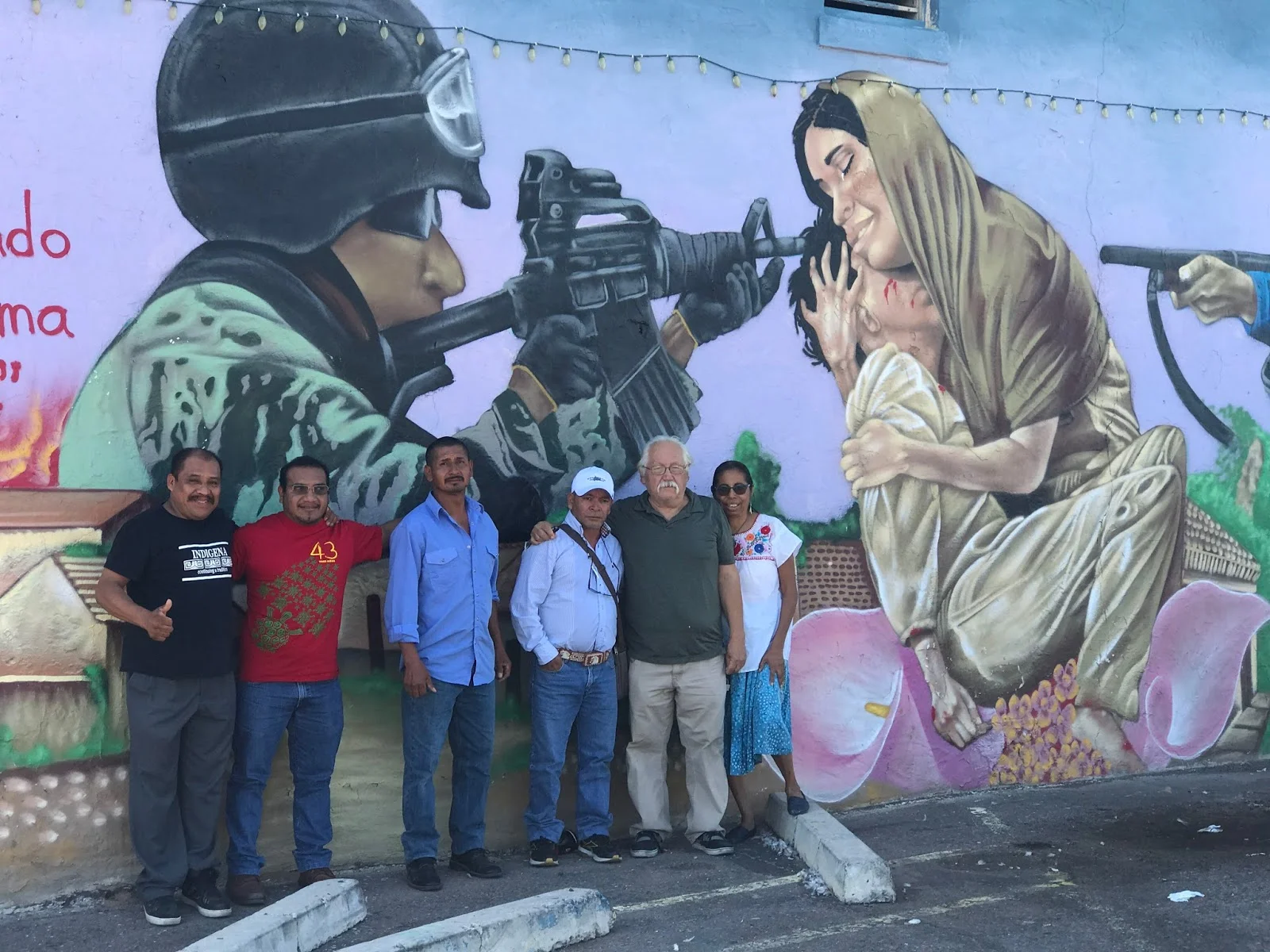
On November 20, 2014 the Human Rights Commission of the Comités de Defensa del Barrio delivered a petition to US Congressman Matt Salmon at his offices in Gilbert, Arizona requesting that Congressman Salmon provide the names and particulars of the 5 individuals trained by the US military involved in the Massacre of Tlatlaya, Mexico on June 30 where 22 youth were executed by the armed forces of the state of Mexico.  Congressman Salomon is Deputy Chief of the Western Hemisphere Sub Committee within the Foreign Relations Committee in the US Congress.  To date we have received no response.

On December 19, 2014 the Human Rights Commission of the Comités de Defensa del Barrio hand delivered a communiqué to the office of the US Attorney John S. Leonardo, District of Arizona in Phoenix, AZ calling for appropriate investigation to corroborate the now public information which details how the federal government of Mexico, from the offices of the President to the Attorney General have criminally conspired and colluded to target the 43 disappeared students of Ayotzinapa under a regime of terror financed under the US Plan Merida and the so-called War on Drugs.

In our letter to US Attorney Leonardo, we specifically call for clarification of the issues of Human Rights violations being committed by of the State of Mexico with impunity and deliberate obstruction before the Inter-American Commission on Human Rights.  We now restate this fundamental demand for respect of the Rule of Law and comprehensive transparent investigation of the events leading up to the attack on the Ayotzinapa students on September 26th, as well as subsequent actions by agents of the state and their networks of accomplices.

We have become informed that on November 18th, 2014 the Inter-American Commission on Human Rights entered into agreement with the Government of Mexico and representatives of the 43 Disappeared Students of Ayotzinapa which will allow for an Interdisciplinary Group of technical experts to work collaboratively towards the locating of the disappeared students, punishment for the responsible parties, and assistance for their families. Our understanding is that the essential aim of the agreement is to resolve the underlying structural problems in Mexico regarding forced disappearances, which are not limited to students of Iguala.

For this reason we have submitted a formal Petition for Review before the Interdisciplinary Group that the issue of Complicity and Collusion by the US government's policies, training and funding of the operatives of the narco-state in Mexico be brought to light comprehensively, and the cause of justice be served.

We call upon the US Department of State Bureau of Democracy, Human Rights, and Labor to take immediate and appropriate steps to confront the COMPLICITY and COLLUSION of the US government in the ongoing Crimes against Humanity by the State of Mexico in violation of fundamental Human Rights established under the Universal Declaration of Human Rights to which the United States is a signatory.

We call for the United Nations Human Rights Committee, and the UN Committee for the Elimination of Racial Discrimination (CERD) to review, evaluate and denounce the blatant collusion among the US and Mexican government as here presented for being an egregious systemic violation of Human Rights that merits specific consideration at the next appropriate session of the CERD in periodic review of the policies and practices of the US and Mexican governments.

We demand an end to the impunity afforded to the state of Mexico by US State Department policies and an embargo of the armaments originating from US for the bloodbath that has resulted in over 26,000 disappeared and 100,000 deaths across Mexico under the guise of the US funded War on Drugs.

Attentively,
Tupac Enrique Acosta
Los Comités de Defensa del Barrio
Human Rights Commission, Secretariat
TONATIERRA

CC.  Claudia Franco Hijuelos, Consul General Phoenix
Arizona Congresswoman, Kyrsten Sinema
Arizona Congressman Raulm Grijalva
Arizona Senator John McCain
Arizona Senator Jeff FlakeElizabeth A. Strange, Acting U. S. Attorney - District of Arizona

Secretary of State, Rex Tillerman
U.S. Department of State
2201 C Street NW
Washington, DC 20520


Link to original statement: http://cdb-tonatierra.blogspot.com/2018/06/ayotzinapa-2018-invoke-leahy-amendment.html

The Caracas Declaration

The Caracas Declaration

Between March 5 and March 7, hundreds of representatives from trade unions, grassroots peoples' organizations, youth organizations, Indigenous and African descendant organizations, women’s groups and political parties from over 100 nations gathered in Caracas, Venezuela, to express solidarity with the Venezuelan people and to support their right to self-determination and the integrity of their political process. The Black Alliance for Peace attended, represented by Ajamu Baraka, BAP’s National Organizer.

The “Caracas Declaration” was one of the products of that gathering.


Caracas Declaration: On the 5th anniversary of the Death of Hugo Chavez

We, citizens from distinct countries, social movements and organizations, political parties, women, youths, workers, creators and intellectuals, peasants, and religious leaders, gathered here in Caracas on the 5, 6 and 7th March 2018, reaffirm our solidarity and militant support of the Venezuelan people, the Bolivarian Revolution and its popular government, which is headed by Nicolas Maduro Moros.

We energetically reject the grave escalation of aggressions against Venezuela’s democracy and
sovereignty by the war-like government of Donald Trump, global corporate powers, and the
American imperialist military-industrial apparatus, which looks to overthrow the legitimate
government of Venezuela, destroy the project of Bolivarian democracy and expropriate the natural resources of the Venezuelan nation.

We denounce that this operation against Venezuela forms part of a global strategy of neo-
colonialization in Latin America and the Caribbean which seeks to impose a new era of servitude and looting through the resurrection of the shameful Monroe Doctrine, a plan which has already begun in numerous countries across the continent.

We reject the threat of Donald Trump of a potential military intervention in Venezuela and we alert that such declarations by him are not mere charlatanism. The military option against the Bolivarian Revolution forms part of the strategic and geopolitical doctrine of the U.S. for the 21st Century. The world must know that a military aggression against Venezuela would provoke a crisis in the region of historic dimensions and uncountable and unpredictable human, economic, and ecological impact.

We warn imperialism and their elites lackeys that play this game: the peoples of Latin America, the Caribbean and the world will never allow that Venezuela be touched by the ambitions of the American military boot! If, in their crazy obsession, the hawks of Washington dare attack Venezuela, the homeland of Simon Bolívar, as it was more than 200 years ago, will again be the tomb of an empire.

We denounce the blatant pressure of U.S. imperialism on the region's governments to involve them in political, diplomatic, and even military operations against the Bolivarian Republic of Venezuela.

With these actions, they seek to destroy regional integration and bring about the de-facto abolition of the principle of the founding charter of the Community of Latin America and Caribbean States, which declares the region as a zone of peace.

We reject the shameful and historical opposed attitude of governments in the region that have caved in to Washington’s politics through the creation of illegal and spurious organisms such as the so-called Group of Lima. The shameful regional elites who today lead the plundering of their peoples, hand over their sovereignty to the transnational corporations, and increase poverty, inequality and violate human rights, lack any moral and political authority to question Venezuelan democracy.

We reject the unilateral and illegal sanctions of the US Government and the European Union against the Venezuelan people, which seek to destroy its economy and break their democratic will.

Blockades and sanctions are crimes against humanity carried out by the international capitalist
system, and are severely hurting the Venezuelan people by sabotaging their productive, commercial and financial processes, preventing access to food, medicines and essential goods.

We reject the perverse U.S. sabotage of the process of dialogue developed in the Dominican
Republic and reiterate that only the absolute respect for the sovereignty of Venezuela, non-
interference in their internal affairs, sincere dialogue and electoral processes based on Venezuelan legislation can define the path to recover the political coexistence between Venezuelans. In this regard, we welcome the call for presidential, regional legislators and councilor elections for May 20, a result of a political agreement with a sector of the Venezuelan opposition.

In these absolutely constitutional and legitimate elections, the Venezuelan people in a transparent and sovereign way will decide the course of their homeland. We alert the peoples of the world to the counterproductive intentions of international governments and organizations that are directly involved in the war against Venezuela to not recognize the results of the elections on May 20, and accelerate attacks after what - no doubt - will be a real democratic expression of the Venezuelan people.

We welcome and support the declaration of the presidential summit of the Bolivarian Alliance for the Peoples of our America ALBA-TCP that categorically rejects the exclusion of Venezuela from the next Summit of the Americas, to be held in the city of Lima, Peru. Similarly, we support all diplomatic and political actions that governments, countries and peoples take to defend plurality and political diversity in the continent and to safeguard the sovereignty and self-determination of peoples.

We recognize the heroic resistance of the people of Venezuela when confronted by the ravages of economic aggression, the financial blockade and all the forms of sabotage that Venezuela is
suffering from, and support the economic, financial, political and diplomatic strategy that the
Bolivarian Government and President Nicolas Maduro are carrying out to overcome the problems and construct the humanist model of Bolivarian socialism.

We are committed to continue the battle for the truth, peace and the sovereignty of Venezuela, to expand the ties of friendship, solidarity and revolutionary commitment to the Venezuelan people.

The peoples of the world, the consciousness of all those who struggle for the just cause of mankind, accompanies at this time and always the Bolivarian revolution, its leadership and its people. We are convinced that Venezuela will be able to – through dialogue, respect for the Constitution, and the indefatigable democratic will of his people—overcome the problems that besets it, and that the Bolivarian revolution will remain a beacon of hope for the peoples of the world who search for a worthy and just destination for humanity.

In commemoration of the fifth anniversary of the physical passing of Commander Hugo Chávez,
historical leader of the Venezuelan people, from Caracas we say to the world: Venezuela is not
alone, we are all with her!

We are all Venezuela!
We will win! Caracas, March 7, 2018