Intervention Is Not Democracy: A Warning from Latin America
By Mauri Balanta Jaramillo
Afroresistance
The recent military escalation by the United States in Venezuela, far from representing the liberation of a country “submerged” in an authoritarian regime, constitutes a direct blow to the political autonomy of the Venezuelan people and a clear setback for democracy in the region.
This operation, led by President Donald Trump, can be understood as a strategic maneuver to reassert the control of U.S. corporations over the oil and hydroelectric industries, following the nationalization process initiated in the mid-1970s and culminating in de-privatization under the government of former President Hugo Chávez.
The Trump administration is not only pursuing foreign interventionist measures while bypassing its own legislative processes and international treaties, but is also encouraging the militaristic agendas of ultra-right-wing governments, justified under the guise of a more “effective” fight against drug trafficking, without questioning the historical complicity of the United States in that very phenomenon. This narrative indiscriminately assigns blame to progressive governments that have taken firm positions in defense of territorial sovereignty and greater political control over U.S. foreign policy.
Charter of the United Nations (UN)
Principle of Non-Intervention: Prohibits States from intervening directly or indirectly in the internal or external affairs of another State, including through the use of force or coercion.
Principle of Sovereignty and Territorial Integrity: Any foreign military action without the consent of the UN Security Council or outside the framework of self-defense constitutes a direct violation of Venezuela’s territorial sovereignty.
Prohibition of the Use of Force: Except in cases of legitimate self-defense or with authorization from the Security Council, the use of force is prohibited under Article 2(4) of the Charter.
Previous U.S. military interventions and the establishment of military bases in Latin America are not isolated incidents, but rather part of a historical strategy of regional control sustained by local elites. From the occupation and control of Panama between 1903 and 1979, and the invasion of 1989; the coup d’état in Guatemala in 1954 and military backing during its internal armed conflict from 1960 to 1996; the occupation of the Dominican Republic between 1916 and 1924 and the invasion of 1965; support for dictatorships and counterinsurgency operations in Bolivia during the 1960s and 1970s; to the ongoing militarization of Colombia since the 1950s, deepened through Plan Colombia (1999–2016) and the continued presence of military bases today. The United States has systematically intervened to impose a political and economic order aligned with its interests, even when this has meant mass violence, democratic rupture, and social devastation for the peoples of the region.
In light of this scenario, our position has been clear and consistent: we oppose all forms of external intervention and affirm the unconditional respect for the sovereignty of peoples and their right to decide their own political destiny. At a time when neo-nationalisms and geopolitical interests seek to undermine democratic processes, social organization, and collective self-determination, AfroResistance asserts that democracy and human rights cannot be imposed by force nor instrumentalized as a pretext for interference. Our solidarity lies with the Venezuelan people, with their collective power and people-led processes—including Black communities and all their members, reaffirming our commitment to a human rights agenda built from the ground up, rooted in justice, popular participation, and respect for the sovereign decisions of every country.
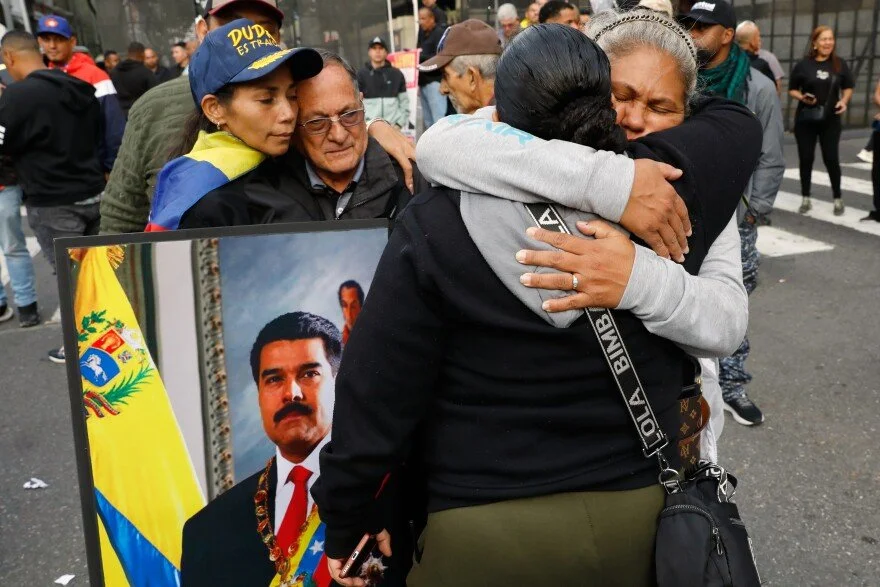
IMAGE: Supporters of Venezuelan President Nicolás Maduro embrace in downtown Caracas, Venezuela, Saturday, Jan. 3, 2026, after U.S. President Donald Trump announced that Maduro had been abducted and flown out of the country.