Viewing entries tagged
fascism

An Electoral Victory Is Not the Defeat of Fascism: A Black Radical Perspective on the Democratic Party's Midterm Victories

An Electoral Victory Is Not the Defeat of Fascism: A Black Radical Perspective on the Democratic Party's Midterm Victories

An Electoral Victory Is Not the Defeat of Fascism: A Black Radical Perspective on the Democratic Party's Midterm Victories

By: Ajamu Baraka for Black Agenda Report

Democratic victories are a setback for Trump and the Republican Party, but not a defeat of the forces driving fascism.

The Democratic victories in the November 3 elections are a setback for Donald Trump and the Republican Party. But they should not be confused with a defeat of the political forces driving the consolidation of fascism in the United States and globally. Those forces are not confined to one political party in the U.S., nor are they simply the product of Trump's personal ambitions. They are rooted in the profound structural crisis of the global colonial/capitalist system, the declining capacity of the United States to maintain its global dominance, the increasing concentration of wealth and political power and its defense, and the historical structures of racialized and colonial domination upon which the American political economy is constructed.

Democratic Party operatives and their supporters have consistently attempted to portray the current crisis as principally the product of Trump and the Republican Party. This interpretation requires a deliberate forgetting of the bipartisan character of the expansion of executive power, militarism, surveillance, and domestic repression that has characterized politics in the U.S. for most of the 21st century.

Under the banner of hope, change, and a renewed commitment to international cooperation, the Obama administration ended up being the most aggressive imperial presidency of the post-war period. It supported coups against democratically elected governments in Honduras and Egypt; along with NATO, initiated the war to overthrow the Libyan government; supported armed opposition forces in Syria; and provided military and logistical assistance to the Saudi war on Yemen.

Domestically, Obama presided over record deportations and expanded the national security state's capacity to surveil, prosecute, and punish political dissent. His administration prosecuted whistleblowers under the Espionage Act at a rate unprecedented in modern U.S. history. It also institutionalized targeted killing through drone warfare, including the extrajudicial killings of at least three U.S. citizens in Yemen in 2011: Anwar al-Awlaki, Samir Khan, and 16-year-old Abdulrahman al-Awlaki.

These were not incidental departures from an otherwise progressive administration. They demonstrated how liberal political leadership could expand the coercive powers of the state while maintaining the language of democracy, human rights, and inclusion, becoming what the late Glen Ford characterized as the “more effective evil.”

The Biden administration continued this trajectory. Its support for the militarization of the confrontation with Russia, including tens of billions of dollars in military assistance to Ukraine, reinforced the bipartisan commitment to U.S. global military dominance. Most devastatingly, Biden's administration continued supplying Israel with weapons and diplomatic protection as it carried out its genocidal assault on Gaza. The administration's conduct exposed the hollowness of its professed commitment to international law and human rights when those principles conflicted with the strategic interests of the United States. The Obama and Biden administrations provide ample evidence of this reality.

To ignore that history is to surrender political memory and make the struggle against fascism a partisan issue when both parties are committed to defending the agenda of U.S. led monopoly capital and the commitment to fascism to maintain those interests.

For African/Black and other anti-colonial peoples and forces in the U.S. and globally, the implications are clear. We cannot permit the struggle against fascism to be reduced to a campaign for the restoration of liberal Democratic governance.

Our responsibility is to help build an independent, internationalist, popular movement capable of confronting the material and ideological foundations of domination, regardless of which political party occupies the White House or controls Congress.

The struggle is not simply to defend the institutions of an existing political order. It is to establish the conditions for a genuinely democratic society and world in which sovereignty, dignity, material survival, and self-determination of peoples and nations take precedence over the interests of capital and empire.

An electoral victory in the context of neoliberal global control may slow down the consolidation of fascism, but ultimately, it is only the organized popular struggle that must defeat the social forces and material interests that sustain it.
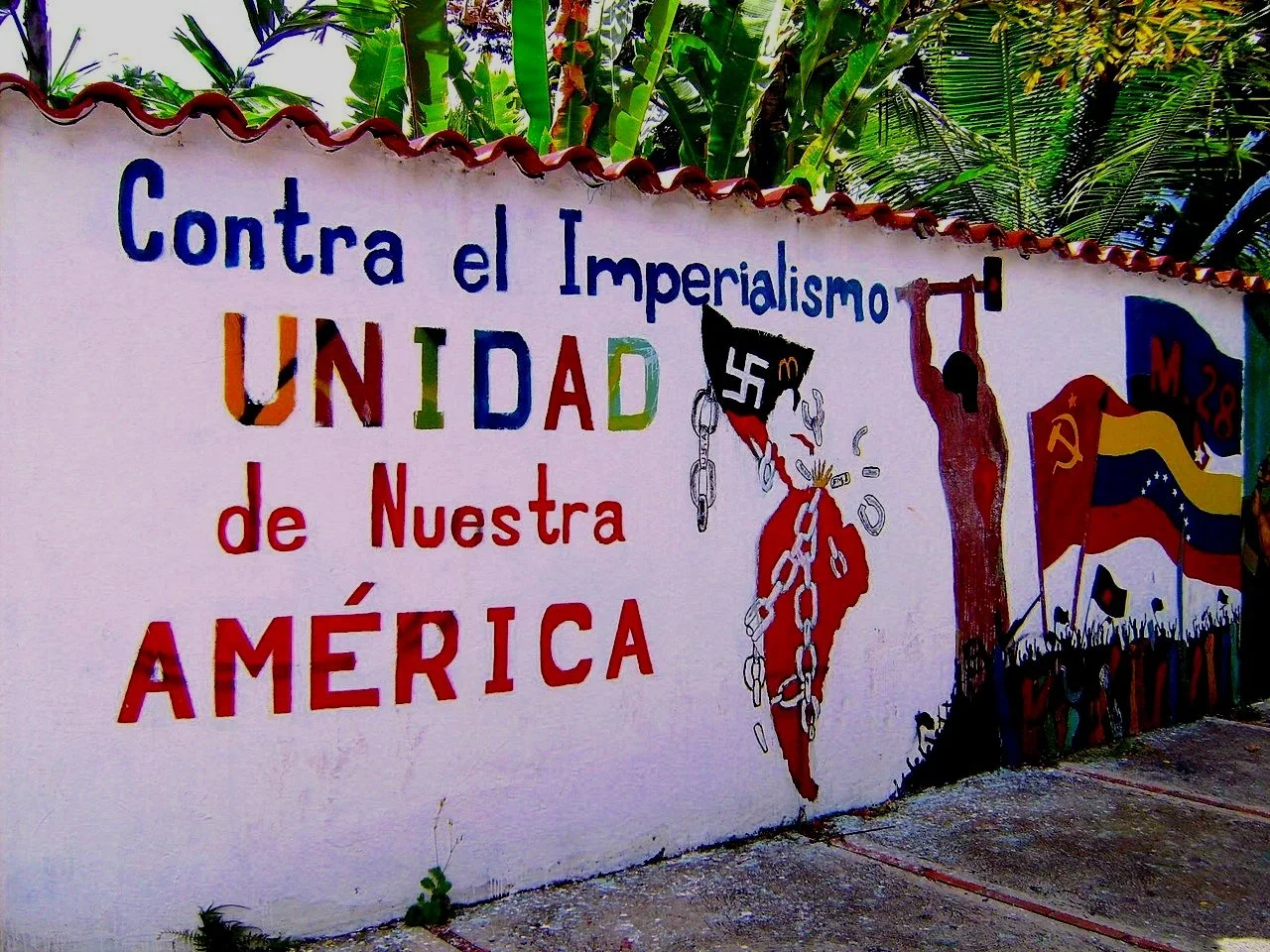
The Anti-Imperialist Imperative: Confronting Globalized Fascism

The Anti-Imperialist Imperative: Confronting Globalized Fascism

The Anti-Imperialist Imperative: Confronting Globalized Fascism

By: ​​​​​​​ Ajamu Baraka, BAR editor and columnist

Ajamu Baraka, BAR Editor and Columnist, gave this presentation at the U.S. Peace Council Webinar on Iran.

Comrades, friends, colleagues—

We are living through a decisive historical rupture.

This is not a moment of policy disagreement. It is not a moment of partisan confusion among anti-imperialists or even simply a crisis of democracy. We are in the midst of a deepening capitalist crisis so profound that capital has abandoned even the performance

of its commitment to liberal enlightenment values.

The institutions it created—

the United Nations system,

the so-called rules-based international order,

the human rights regime—

have been stripped of their moral veneer.

What remains is naked power.

The doctrine now is simple: Full spectrum dominance — by any means necessary.

And when empire adopts that posture, clarity becomes a revolutionary obligation. It is imperative—especially for those of us operating in the imperial core—that we understand something fundamental.

At moments like this,

positions that appear nuanced, balanced, moderate—

positions that seek compromise with reaction,

that dilute anti-imperialism in the name of complexity—

do not remain neutral.

They objectively amplify the forces of reaction. They legitimize the structures of domination. They align, whether consciously or not, with Western and U.S. imperialism. Intentions do not negate political effect. In periods of fascist consolidation, confusion is not accidental.

It is produced.

As one left formation in Iran and its diaspora has correctly stated:

At this stage of Western imperialist domination, the global contradiction between labor and capital is embodied in the contradiction between the masses of the world and imperialism. The main axis of struggle today is the defense of nations and peoples against imperialism’s political, economic, and military domination.

That does not erase secondary contradictions. But determining which contradiction is primary—

which contradiction must define the agenda of struggle— is a matter of political life and death. This requires dialectical clarity. It requires precision. It requires the ability to analyze the totality

and not be trapped in fragments. Because imperialism thrives on fragmentation.

Imperialism advances a fatal illusion. It tells the oppressed:

You can achieve social justice

within the framework of imperial domination.

You can secure democratic freedoms

while remaining subordinate to empire.

You can fight for human rights

without confronting the global system that negates them.

And perhaps most dangerously—

It tells us that struggle can remain purely national.

That what happens domestically is separable from the global architecture of domination. This is ideological mystification. The domestic and the global are fused.

Look at the United States.

What we are witnessing is not random authoritarianism. It is the maturation of a coherent architecture of repression. A national security state that fuses: Intelligence agencies.

Militarized policing, surveillance systems, and ideological discipline into a single integrated mechanism of control.

This system is not reactive. It is proactive. It does not wait for crisis. It anticipates it. It prepares for it. It disciplines populations in advance of rupture.

This is not about safety. It is about managing dissent. It is about stabilizing imperial order

in a moment when consent is no longer sufficient. Because a system built on exploitation, extraction, and endless expansion cannot govern through consent when its contradictions sharpen, it must govern through coercion.

Consider immigration enforcement in the United States.

ICE raids in cities, mass arrests, workplace sweeps, collaboration between federal agents and local police. This is not merely about deportation. It is about terror. It is about deterrence. It is about instilling fear so pervasive that communities retreat into silence.

Migrant communities become laboratories of repression. Spaces where techniques are tested. Where methods of fragmentation are refined. And once perfected— those techniques do not remain confined, they are generalized, expanded, normalized.

Now consider the training relationships between U.S. police forces and Israeli security forces.

This is not symbolic. Israeli policing is shaped by occupation. By counterinsurgency, by the management of a population defined as a permanent threat. It is not designed to serve a public. It is designed to dominate an enemy.

When U.S. police import these models, they import more than tactics. They import a political logic, a logic that declares:

Certain populations are not citizens.

They are risks.

They are problems.

They are enemies to be contained.

This is the fusion of foreign and domestic repression.

The techniques used to occupy abroad are now fully integrated into governance at home. Sanctions logic becomes economic discipline, counterinsurgency logic becomes urban policing and military doctrine becomes domestic policy.

The empire has come home. Not because it prefers to— But because it must.

And this is what we must understand. We are not facing isolated authoritarian tendencies. We are confronting the consolidation of globalized fascism. A system in which:

International gangsterism is normalized.

State terror is justified.

Genocide is rationalized.

Sanctions are weaponized starvation.

And all of it is framed as defense of democracy.

When barbarism becomes normalized at the global level, it will not remain external. It returns inward. It reshapes the domestic terrain. It produces a Hobbesian international order— where the most powerful impose medieval forms of domination to preserve their interests. And once that normalization is complete— The descent accelerates.

Beyond Iran we have Venezuela, we have Cuba, occupation in Haiti, continued colonization in Puerto Rico, and increasing domestic terror within the imperialist core of the U.S.

So what is the task before us?

It is not reform within this globalized architecture of repression. It is not pleading with multilateral institutions that have already revealed their impotence or complicity. It is not technocratic adjustment. The task is confrontation - political confrontation, ideological confrontation and organizational confrontation.

Because only organized resistance can disrupt a system that has abandoned pretense. Anti-imperialism is not optional in this moment. It is not one tendency among many. It is the central organizing principle of the conjuncture. To misidentify the primary contradiction

is to disarm the masses. To equivocate in the face of imperial consolidation

is to assist its stabilization.

We must say clearly:

There can be no authentic struggle for human rights

that does not confront imperial domination. There can be no democratic renewal

that leaves the imperial war machine intact. There can be no social justice

inside a global order structured by extraction and control.

The choice before us is stark. Either we align our analysis with the realities of global power, or we retreat into comforting illusions.

History will not reward ambiguity. It will not excuse hesitation. The imperative is clear:

Confront imperialism.

Expose the unity of global and domestic repression.

Build movements that understand

that the fight for national liberation,

the fight against sanctions and militarization, the fight against racialized policing and migrant terror— Are not separate fights. They are one struggle. And only by confronting the totality

can we begin to dismantle it.

And for this programmatic imperative at this historical moment - there must be:

No Compromise, No Retreat!

All Power to the people!

Thank you.


WATCH HIS PRESENTATION HERE

The Crisis of Liberalism

The Crisis of Liberalism

EACH strand of political praxis is informed by a political philosophy which analyses the world around us, especially, in modern times, its economic characteristics. On the basis of this analysis, the particular political philosophy sets out the objectives which have to be struggled for, and the political praxis informed by it carries out this struggle. The objective may be difficult to achieve, more difficult in certain contexts than in others, and this difficulty may act as a hurdle for political praxis; but this does not constitute a crisis for that political philosophy. The sheer difficulty of achieving an objective does not constitute a crisis. A crisis of a political philosophy arises when it has an internal contradiction, when the objective it puts forward is logically in conflict with some other feature in which it believes… FULL ARTICLE CONT’D