Viewing entries in
Cuba

Castro, Cuba, and Pan-African Commitments

Castro, Cuba, and Pan-African Commitments

Castro, Cuba, and Pan-African Commitments

by D. Musa Springer in Hood Communist

The first section of this essay looks at the military aid Castro’s Cuba provided to several African movements on the continent, in the Caribbean, and in Latin America. The second section focuses on the broader Cuban commitments to equipping the Global South with tools of development that often go overlooked, specifically medical diplomacy and mass education and literacy initiatives.

While this specific article does not go into it, an entire additional section could be written focusing specifically on the asylum Cuba gave to dozens of Black revolutionaries — from Assata Shakur and Robert F. Williams, to Walter Rodney and Puerto Rican revolutionary William Morales. Comrade Ahjamu Umi does a great job covering this in his article. Another section could highlight the multitude of ways that Castro specifically supported Africans in Cuba, from affirmative action reforms in healthcare, housing, labor, education, and political representation.

Military Aid As Material Commitment To Solidarity
Fidel Castro was a man ahead of his time, not only leading the Cuban Revolution and bringing about sweeping revolutionary changes across his island, but also playing a significant role in several African liberation movements. His contributions to these movements were multifaceted and demonstrated his commitment to improving the lives of Afrodescendent people and helping us achieve self-determination, a commitment which would evolve into a core principle of the Cuban Revolution itself.

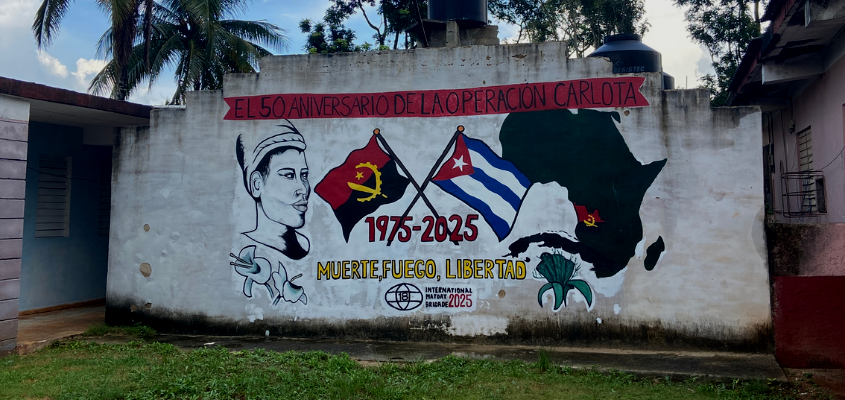
Possibly most important is the military aid which Castro’s administration provided to various African countries during their struggles for independence. In 1975, he famously sent at least 35,000 Cuban troops to Angola to help the MPLA (People’s Movement for the Liberation of Angola) in their fight against South African colonial forces attempting to maintain control over the country. The Cuban intervention was pivotal in preventing the Apartheid-backed and armed FNLA and UNITA foces from defeating the MPLA and seizing power, the prevention of South African annexation.

Castro also provided support to a number of other African countries, including Mozambique and Guinea-Bissau, helping them fend off invasions or rebellions backed by Western colonial powers. In this regard Castro’s fiery words about African solidarity, Cuba being an ‘African island’, and an internationalist politic were not just rhetoric: they were mandates, commitments of the highest order. This includes the complicated, perhaps controversial, intervention in Ethiopia as well.

In Ethiopia, Castro provided military advisors and at least 11,000 Cuban troops to support the government of Mengistu Haile Mariam in repelling a US-backed Somali invasion of the Ogaden region in 1977. By the time of the conflict, Haile Selassie had already been deposed in a 1974 military coup, and it was the new Ethiopian government that received Cuban and Soviet backing. This intervention was a significant factor in Ethiopia’s ability to resist the invasion and maintain territorial integrity, while at the same time it divided many among the Pan-African left. The conflict emerged from longstanding border disputes over the Ogaden region. But the involvement of outside powers, with the Soviet Union and Cuba supporting Ethiopia while the U.S. backed Somalia, gave it broader implications for the shifting alignments of the Cold War and the emerging struggle for a multipolar world. Other socialist nations, including the DPRK and South Yemen, also contributed military and technical support to Ethiopia during the conflict.

In Guinea-Bissau, following the legendary 1966 Tricontinental Conference, Castro provided military support to the PAIGC (African Party for the Independence of Guinea and Cape Verde) as they fought against Portuguese colonial forces in the 1960s and 1970s. This support included the deployment of Cuban military advisors and the provision of weapons and other military assistance. This also crucially included providing training from Cuban guerilla fighters to PAIGC combatants, which proved decisive in battle. The PAIGC ultimately gained independence from Portuguese colonizers in September 1974, and Castro’s support was a significant factor in their success.

In addition to his support for African liberation struggles on the continent, Fidel Castro also provided support to Africans in the Caribbean during their struggles for independence and liberation. One notable example of this support was in Grenada, where Castro provided military and logistical support to the socialist government of Maurice Bishop in the 1980s. This support was a key factor in the government’s ability to develop socialist social service institutions, including a robust healthcare system that alleviated longstanding class and gender-differences on the island, which is documented greatly in Dr. Patricia Rodney’s “The Carribean State: Healthcare and Women.”

Cuban support also helped Grenada resist a bloody US-led invasion of the tiny island nation in 1983, though the U.S. forces would ultimately succeed. Dozens of Cubans were viciously murdered by the U.S. during the invasion, including many Grenadans who the U.S. “suspected were Cuban.” In her essay “Grenada Revisited”, Grenadian-American writer Audre Lorde illustrates the immediate impact of this violent invasion of the island, stating:

“Unemployment in Grenada dropped 26 percent in four years. On October 25, 1983 American Corsair missiles and naval shells and mortars pounded into the hills behind Grenville, St. Georges, Gouyave. American marines tore through homes and hotels searching for “Cubans.” Now the Ministries are silent. The state farms are at a standstill. The cooperatives are suspended. The cannery plant in True Blue is a shambles, shelled to silence. On the day after the invasion, unemployment was back up to 35 percent. A cheap, acquiescent labor pool is the delight of supply side economics. One month later, the U.S. Agency for International Development visits Grenada. They report upon the role of the private sector in Grenada’s future, recommending the revision of tax codes to favor private enterprise (usually foreign), the development of a labor code that will ensure a compliant labor movement, and the selling off of public sector enterprises to private interests. How soon will it be Grenadian women who are going blind from assembling microcomputer chips at $.80 an hour for international industrial corporations? “I used to work at the radio station,” says a young woman on the beach, shrugging. “But that ended in the war.””

Castro’s support for Grenada was part of a wider effort to promote socialist revolution in the Caribbean and Latin America, especially among the masses of working class African and Indigenous peoples throughout the Americas. He saw the struggles for independence and liberation in these regions as part of the global struggle against colonialism, imperialism, and capitalism, and made a commitment to support the right of self-determination against the whims of imperialist capital.

In addition to his support for Grenada, Castro also provided military and logistical support to other Caribbean and Latin American countries during various liberation struggles. This included Nicaragua and Venezuela, where he supported socialist governments and movements that were staunchly opposed by the U.S. and other Western powers. Cuba supported the Sandinista Revolution in Nicaragua in 1979, which resulted in the overthrow of the brutal U.S.-backed Somoza dictatorship and the establishment of a socialist people’s-government led by the Sandinista National Liberation Front (FSLN). The Bolivarian Revolution in Venezuela, led by Hugo Chávez, took place in the 1990s through the early 2000s and also received support from Castro. This resulted in the establishment of Bolivarian socialism and the adoption of a number of progressive social and economic reforms, with Cuba specifically providing funding and technical assistance to help the Chávez government establish a network of community clinics and other healthcare facilities, similar to Cuba’s own successful neighborhood polyclinic system, as well as to support the development of the country’s education system.

In a speech to the UN General Assembly in 1979, Castro stated:

“It was indispensable to stress that the colonialist and imperialist powers were continuing their aggressive policies for the purpose of perpetuating, recovering or expanding their domination and exploitation of African nations. The dramatic situation in Africa is none other than that. The non-aligned countries could not avoid condemning the attacks on Mozambique, Zambia, Angola, Botswana, the threats against Lesotho, the attempts at permanent destabilization in that region, and the role of the racist regimes of Rhodesia and South Africa. […] To condemn South Africa without mentioning those who make its criminal policy possible would have been incomprehensible. From the sixth summit there emerged with more strength and urgency the need to end a situation which involves the rights of the people of Zimbabwe and Namibia to their independence and the unpostponable need for the black men and women of South Africa to achieve a status in which they are considered equal and respected human beings, as well as that the conditions of respect and peace for all countries of the region be insured.”

This quote is one of many that demonstrates Castro’s belief in the importance of fighting against colonialism, racism, and imperialism; immersed in supporting liberation struggles across the continent, he shook the UN with unshakeable ideological clarity and material solidarity. His support for the global African liberation movement was a crucial factor, during an extremely complex and contentious historical period, in the eventual independence of these countries and a testament to his commitment to the well-being of people of African descent around the world.

Fidel Castro and the Cuban revolutionary state’s military support for African liberation struggles on the continent, in the Caribbean, and across Latin America demonstrate his material commitment to the global anti-colonialism and anti-imperialism struggles, and that commitment in itself presented the contradictions of the West — with all their development, so-called power, and money — and the difference between their rhetoric and actions.

Beyond Military Aid: The Fundamental Tools for Development

Castro’s support for African liberation movements extended far beyond just military aid, leaving a lasting and expansive imprint on the cuban state to this day. He also recognized the importance of access to education and healthcare in the development of independent, self-determined African states. Cuba’s revolutionary support for African and Caribbean nations in the areas of education and healthcare are key parts of Cuba’s commitments, and to that end, Castro sent thousands of Cuban doctors, medical professionals, educators, education professionals, and social scientists to African countries to provide support in a multitude of ways.

He also funded scholarships for African students globally to study in Cuba free of charge, giving them the opportunity to receive a world-class education. By providing access to education and healthcare, he sought to give these countries the tools they needed to build strong, self-sufficient societies which could eventually break away from Western-dependence for self-development. A seemingly impossible, but not unimaginable, task.

One of the most significant ways in which Castro supported African and Caribbean nations in the area of education was through the provision of scholarships for students to study in Cuba for free, particularly in fields most relevant to development: medicine, engineering, and agriculture. Havana’s Latin American School of Medicine (Escuela Latinoamericana de Medicina) has trained over 20,000 doctors from 120+ countries since 1999, prioritizing students from underdeveloped regions, including many from over 36 African nations.

The scholarship program was highly competitive and attracted top students from across the African and Caribbean diaspora, but was also designed to be inclusive, with a particular emphasis on providing opportunities to women, indigenous people, and Africans. This was designed to model Cuba’s domestic affirmative action policies, which attempted to reverse centuries of African slavery and colonialism by giving specific focus to specific groups in the education sector, such as Afro-Cubans.

In addition to helping Africans study in Cuba, the Cuban government also established programs to send Cuban educators and educational professionals to various countries to provide training and support to native workers. These programs focused on improving the quality of education in areas such as teacher training, curriculum development, and school infrastructure.

In How Europe Underdeveloped Africa, Guyanese historian Walter Rodney explains how education itself can act as a tool of colonial domination across Africa and its diaspora, stating that education can either be for the purpose of subjugation and underdevelopment or, conversely, progressive development. Castro’s orientation towards ‘education for development’ internationally is in part inspired by Cuba’s own revolutionary literacy campaigns, launched in 1960 immediately after the Cuban Revolution’s triumph in 1959. A key part of the Cuban Revolution’s efforts to promote education and improve the lives of the Cuban people, Castro sought to eliminate illiteracy in Cuba and provide universal access to education for all Cubans, ideals which had been long denied by former colonial regimes.

[Image: the famous photo by photographer Liborio Noval shows the final march closing out the highly successful Cuban literacy campaign in December 1961; the campaign was famously supported by thousands of teenage girls and women.]

To achieve this goal, the Cuban government mobilized tens of thousands of volunteers, including teachers, students, and medical professionals, to go out into previously excluded rural and majority African neighborhoods to teach literacy to those previously denied the opportunity to go to school. The campaigns were highly successful, and by the end of the 1960s, Cuba had achieved a literacy rate of nearly 100%. This made it the first country in Latin America to eliminate illiteracy and one of the first countries in the world to do so.

Medical professionals, including doctors and nurses, played a significant role in the revolutionary literacy campaigns in Cuba. In addition to teaching literacy, they also provided healthcare services to those living in rural and underserved areas where access to healthcare was very limited. The role of medical professionals in the literacy campaigns was part of a broader trend in the Cuban Revolution, which prioritized the integration of healthcare, social and natural sciences, and education as part of its efforts to improve the lives of the Cuban people. By bringing healthcare and education together, the Cuban government sought to create a more holistic approach to development that would address the needs of the population in a more comprehensive and integrated way. This approach was highly effective, and it helped to make the Cuban Revolution one of the most successful social and economic experiments of the 20th century.

Cuban psychiatrist Norma Guillard was a young nursing student when she volunteered in 1960 to join the literacy campaigns, and she has worked extensively to document the importance of these campaigns in all future public health endeavors on the island; the ideal of medicine being accompanied by social services and education is in fact the bedrock of Cuban public health. As she informs, a large percentage of those who received medicine and literacy training during these campaigns were Afrodescendant Cubans and, conversely, many of those who volunteered in the programs (who themselves received medical training to lead careers in medicine) were also Afrodescendant Cubans, both representing groups that had previously been disallowed from Cuban universities.

The revolutionary literacy campaigns were not just praised by underdeveloped countries around the world, but also inspired similar efforts in many newly liberated states. One country that was particularly inspired by Cuba’s literacy campaigns was Nicaragua, which launched its own literacy campaign in 1979 after the success of the Sandinista Revolution. The Nicaraguan literacy campaign, known as the “Battle of the Alphabet,” was led by a coalition of educators, students, and other volunteers, and was modeled on the Cuban literacy campaign, with the intention of collapsing lines between medicine and social services and social sciences. It was highly successful, and within a year, Nicaragua had achieved a literacy rate of more than 90%.

Ghana and Angola were also both deeply inspired by Cuba’s revolutionary literacy campaigns and sought to emulate their successes. In the case of Ghana, the government launched mass literacy campaign in the late 1960s, shortly after the success of the Cuban literacy campaigns, and then again in the 1980s. The Ghanaian campaigns were based on the flexible Cuban model developed by Cuban brigadista Leonela Relys, led by a coalitions of educators, students, and other volunteers. They were highly successful, and within a few years, Ghana had achieved a literacy rate of over 80%.

Angola’s post-independence education system was heavily influenced by its allies, particularly Cuba and the Soviet Union. Following independence, Angola re-founded its ‘University of Luanda’ as the Universidade de Angola, and while seeking to decolonize remnants of colonialism in their education system, invited hundreds of Cuban and Soviet teachers to Angola to teach; at the same time, thousands of Angolan students studied in Cuba and the Soviet Union. Ongoing external-backed insurgencies and internal issues disrupted the development of a complete, new education system in Angola and caused school enrollment to decline. In 2009 Angola’s Education Minister called for a ‘Cuban system of education’ in the nation, and formally invited dozens of Cuban educators to work with the African nation to re-develop its education system.

As Mark Abendroth details in his 2009 book ‘Rebel Literacy’, the UNESCO (United Nations Educational, Scientific and Cultural Organization) awarded a King Sejong Literacy Prize to Cuba’s Latin American and Caribbean Pedagogical Institute (IPLAC) for its innovative work in literacy campaigns of over 15 countries. Despite imperialist lies and distortions emanating from the U.S. and other Western capitalist forces, Cuba’s contributions to global education initiatives, started at the direction of Fidel Castro, represent a vital line of support for formerly colonized nations. Even the West’s own institutions like the United Nations have been forced to recognize this.

Despite prevailing myths and misreadings of history, Fidel Castro’s support for Africa did not end in the 1970s, and in fact continues to this day through Cuba’s medical diplomacy and medical brigades. These programs send Cuban doctors and medical professionals to countries across the African diaspora to provide healthcare services and improve public health systems.

Cuba’s medical diplomacy and medical brigades have their roots in the country’s support for the African liberation movement in the 1970s, especially its previously mentioned support of Angola against Portuguese and South African forces. In addition to military aid, Castro also recognized the importance of access to healthcare in the development of self-determined African states, and sent medical professionals to Angola, beginning what would eventually be established as programs to send thousands of Cuban doctors and other medical professionals to African countries, providing critical healthcare services and improving public health.

These early efforts to provide healthcare assistance to African countries were just the beginning of Cuba’s commitment to medical diplomacy. In the following decades, Cuba has continued to expand its medical aid programs, and the medical brigades became a key component of the island’s foreign policy and international relations. The early days of the medical brigades were characterized by a strong sense of international solidarity, and an anti-colonial commitment to improving the lives of people in need. Cuban medical professionals were motivated by a desire to make a difference and to help those in need, and they worked tirelessly to provide quality healthcare services to Africans and others. They faced many documented challenges, including limited resources, difficult living conditions, and separation from their families and home country; many locations were grappling with conflict, poverty, and other challenges of development, and Cuban doctors had to adapt to these conditions in order to provide the best care. Despite these challenges, the medical brigades worked tirelessly to help people in need and to improve the health of the communities they served.

Cuba’s medical diplomacy has been particularly effective in addressing health crises and disasters across the African continent in particular, such as the 2014 Ebola outbreak in West Africa. One of the most significant examples of Cuba’s medical diplomacy in action, the island’s response to the 2014 Ebola outbreak in West Africa saw over 250 Cuban medical professionals sent to West Africa at the height of the crisis, effectively making it the largest medical mission in the country’s history. These professionals worked tirelessly to provide quality healthcare services and to help contain the spread of the virus, an act which public health professionals praise for halting what may have become a global health pandemic of similar proportions to 2020’s COVID-19 outbreak.

The Ebola response was just one example of Cuba’s commitment to global health and international solidarity. Over the past few decades, Cuba has also been a leader in sending medical professionals to countries affected by HIV/AIDS. Since the early 2000s, over 50,000 Cuban doctors have served in 66 countries, providing critical healthcare services and improving the lives of people living with HIV/AIDS.

Cuba’s response to the HIV/AIDS epidemic has been particularly notable due to the country’s own history with the disease. In the 1980s, Cuba was hit hard by the HIV/AIDS epidemic, and the Castro administration was forced to implement a number of innovative measures in order to curb the spread of the disease: widespread testing and counseling, the establishment of a national treatment program, the implementation of sex education programs in schools, and widespread education initiatives to deal with homophobic stigmas surrounding HIV/AIDS. As a result of these efforts, Cuba was able to effectively control the spread of HIV/AIDS and provide care and support to those affected by the disease.

This experience with HIV/AIDS made Cuba uniquely qualified to help other countries facing similar epidemics. In the early 2000s, Cuba began sending medical professionals to countries in Africa, Latin America, and the Caribbean to help address the HIV/AIDS epidemic. These doctors were able to provide much-needed healthcare services, including testing, counseling, and treatment, and they also worked to build capacity in local healthcare systems. In addition to providing direct care, the Cuban doctors also worked to educate communities about HIV/AIDS prevention, helping to reduce the stigma surrounding the disease and encouraging people to get tested and seek treatment.

In addition to responding to emergencies, Cuba’s medical brigades also work to improve the overall health of African populations; they provide primary care in rural areas, as well as specialized care in fields such as ophthalmology and pediatrics. They also train local healthcare professionals, helping to build capacity in African countries to improve the overall health systems of the populations they serve.

Cuba’s medical diplomacy and medical brigades are a testament to the country’s commitment to global health and international solidarity. They have had a significant impact on the health of Afrodescendent people globally, and have helped to build strong relationships between Cuba and the countries it has assisted. Demonstrating the importance of international South-South cooperation, they are a transformative part of Cuba’s history and identity, a key component of Fidel Castro’s legacy, and a source of pride for the country and its people.

Socialist conceptions of material solidarity, in theory, are mutually beneficial where possible, and Cuban medical diplomacy in practice exudes this ideal: Cuba’s international medical diplomacy has brought numerous benefits to the country, both domestically and internationally. Cuba’s medical brigades have helped to improve the country’s reputation and standing on the global stage, directly combatting decades of imperialist propaganda and slander by the most powerful empire in human history, the U.S.. By providing medical assistance to countries in need, Cuba has demonstrated its commitment to global health and international solidarity, maintaining a positive reputation for the island internationally.

Cuba’s medical brigades have also brought economic benefits to the country, as the Cuban government has received payments for the services provided by its medical professionals, who are often sent by request of the needing country, which has helped to generate revenue for the country. In addition, the sale of Cuban-developed pharmaceuticals to other countries has also contributed to the country’s economy. In their socialist system, the majority of funding from medical diplomacy goes directly into the country’s own socialist healthcare system, which in turn is able to provide medicine to its citizens free of cost.

The medical brigades have had an obvious and significant humanitarian impact as well, improving the health and well-being of people in the countries where they have served, helping to improve healthcare systems and address health crises in these countries. Lastly, the medical brigades provide extensive opportunities for professional development for Cuban medical professionals themselves. By working in different countries and exposing themselves to different cultures and healthcare systems, Cuban doctors and other medical professionals have been able to expand their knowledge and skills, incorporate relevant advancements into their domestic practices, and improve the Cuban healthcare system to remain one of the best in the world, even despite a decades-long blockade harshly straining their economy. Therefore, Cuba’s African commitments through medical diplomacy have helped to improve the quality of healthcare in Cuba as well.

Castro’s material solidarity with African and African diaspora liberation movements remains one of the most concrete examples of internationalism in the 20th century. At a time when words of support were plentiful but boots on the ground were rare, Cuba put both resources and lives on the line for the cause of self-determination. And this commitment to self-determination, solidarity, and sovereignty has remained unwavering to this day.

Today as the United States tightens its blockade, imposes destabilizing oil embargoes, and works tirelessly and systematically to strangle the Cuban people into submission, we are called to remember what Cuba gave to Africans when it did not have to give. The same internationalist spirit that sent Cuban troops to Angola and doctors to the Congo, Jamaica, and Venezuela demands that we meet this moment with equal resolve. Solidarity is not a sentiment. It is a practice, and Cuba practiced it for decades at enormous cost. The least we can do is raise our voices, organize our communities, and struggle for an end to the blockade now.

The blockade is not policy. It is punishment for Cubans having the audacity of self-determination. Those who claim the legacy of anti-imperialism cannot be silent. Now is the time to stand with the people of Cuba as fiercely as possible.

The Caribbean People’s Debt to Cuba

The Caribbean People’s Debt to Cuba

The Caribbean People’s Debt to Cuba

By: Tamanisha J. John and Kevin Edmonds for Black Agenda Report.

Caribbean governments are betraying Cuba through silence and compliance with U.S. empire. The only way to challenge this failure of leadership is for the people to build an anti-imperialist movement.

Introduction

What we are seeing across the Caribbean in 2025-2026 is a total absence of political and moral leadership, specifically in regards to the failure of elected officials and prominent regional organizations like the Caribbean Community (CARICOM), to speak out against the criminal blockade and embargo of Cuba, and the imperialist attacks against Venezuela – which includes the violation of Venezuela’s sovereignty that resulted in the kidnapping of the Venezuelan President, Nicolás Maduro, and First Lady, Cilia Flores by the United States (US). 

We heed Tennyson Joseph’s (2025) warning:

Given the apparent weaknesses of Caribbean leaders in the face of US power, it is necessary for the Caribbean people, academia, civil society organizations to put pressure on their governments to resist the isolation of Cuba, or to themselves directly amplify their voices and their actions in direct support of Cuba and its people. The Caribbean simply cannot allow Cuba to fall. If Cuba fails, Caribbean sovereignty will come to an end.[1] 

We also echo Norman Girvan’s (2008) statement that the debt owed to Cuba is unpayable (“la deuda es impagable”)[2] and, as Horace Campbell (2025) writes, this debt is “not quantified in monetary terms.”[3] Instead, the debt owed to Cuba – by Caribbean people especially – is in real solidaristic terms. It is our duty to uplift regional unity against imperialist visions for domination in our region, given the sacrifices and solidarity of Cuba and its people to us. Cuba’s solidarity to the Caribbean region has brought progressive developments – including independence. Without the Cuban Revolution of 1959, the colonial pretense that island states could not be self governing – unless neocolonial governors were installed – was shattered. While anti-colonial movements shifted to neocolonial governments in the Caribbean, which garnered many of them US support (such as the US-supported dictatorship of François “Papa Doc” Duvalier), Cuba’s Revolution rejected that shift. 

The US imperialist vision for our region includes the denial of state sovereignties, and directing our external and internal policies so that foreign capital and the global capitalist system continue to sustain our underdevelopment. The US imperialist attacks on Cuba have only been emboldened by the lack of regional response to the imperialist attacks against Haiti and  Venezuela. Going beyond the issue of solidarity, as we will explain, the Cuban and Venezuelan Revolution have arguably been the biggest contributors of progressive development to the region – in terms of material support – for the past 60 and 20 years respectively. The silence amidst the imperialist attacks on Haiti and Venezuela cannot be allowed against Cuba. On this question of the unpayable debt of real solidarity, it “belongs to those who have benefited from Cuban solidarity and have yet to respond in kind” (Pambuzaka News Editors, 2025). While our focus here is on Caribbean states that have benefitted from Cuban (and Venezuelan) solidarity, Cuban internationalism has been global.

Though imperial narratives often frame Cuban aid and development assistance in a negative light, convincing large swaths of people internationally that Cuba’s extension of development assistance is “harmful,” we provide facts to correct this record. The new articulation of the “Monroe Doctrine,” which includes the “Trump corollary,” demonstrates the continuation of US imperialist strategy in the Western Hemisphere that directly forces compliance from the states in the region.

A Brief Note on the Importance of Revolution for the Caribbean

As far as the Caribbean is concerned, there are three countries that notably structurally transformed the region and regional dynamics in the 18th and 19th centuries. Those countries are Haiti, Cuba, and Grenada – in that order. The Haitian Revolution (1791-1804) rendered slavery structurally untenable in the Caribbean – forcing the first permanent abolition of slavery and rendered direct colonial control untenable.[4] The Cuban Revolution (1953-1959) continued the project of making US direct colonial (and legal) control structurally untenable, and asserted the Caribbean region's anti-imperialist right to sovereignty and self- determination. In real terms, the Cuban Revolution’s example provided Caribbean independence fighters and leaders with a model, or a small state being able to self-govern without territorial status or “association” designation, which had almost been “pre-determined” for the Caribbean, based on colonial histories.”[5] Nevertheless, numerous US regimes (and their proxies) denied Cuba’s revolutionary transformation, claiming instead that the island was simply a geopolitical proxy of the Union of Soviet Socialist Republics (USSR). 

The same could not be said for Grenada. The Grenada Revolution (1979-1983), picking up on this understanding of the Caribbean state’s anti-imperialist right to sovereignty and self- determination successfully took popular power. The Cuban example and its revolutionary aid to Grenada created the first regional project not tied to – or seriously supported by – the USSR, which was always a longstanding critique against the Cuban model. Previously led by dictator Eric Gairy, who was regarded as “democratic” given his ability to please the foreign capitalists and Western imperialists,[6]  revolutionary Grenada was able to pursue a Caribbean oriented, non-aligned path of development that challenged foreign control over a Caribbean economy. For the first time in the Caribbean region, an English-speaking Caribbean state was able to advocate ideas of ideological and developmental paths that did not align with imperialism, worker exploitation, or foreign ownership and exploitation of one’s economy and resources.[7] 

The World Bank was even forced to admit in its 1982 report that despite inheriting a deteriorating economy from the former dictator Eric Gairy, the policies and platform of the PRG were turning Grenada’s economy around. Grenada was one of the few countries in the Western hemisphere to see sustained, multi-year growth during a global economic downturn.[8] By 1983, 37% of the national budget was being spent on education and health, unemployment dropped to 14%, and the percentage of food imports dropped from over 40% to 28% at a time when market prices for agricultural products were collapsing worldwide. The short lived example of the Grenada Revolution proves that the people of the Caribbean have a material interest in being anti-imperialists. 

Cuban Internationalism, Net Benefit to the Caribbean (and The World)

On January 29th, 2026 the US President, Donald Trump, issued Executive Order 14380  escalating US imperialist strategy and economic warfare against Cuba and those that trade with the island –  by threatening  to tariff all of Cuba’s trading partners that directly or indirectly provide the island with oil.[9] The executive order (EO) went on to state that the US President had the power to modify the order in the event that Cuba and its trading partners found ways to sidestep US “national security and foreign policy objectives,”[10] directly signaling the intent of the EO to control states behavior and external relations. Paired alongside statements made by the US President that the US had effectively “taken control of Venezuelan oil”[11] and now had the power to “starve Cuba of oil”[12] – while threatening Mexico for sending oil to Cuba[13] – the new US attempt to destabilize Cuba for the purpose of eradicating the political institutions in Cuba and further undermining the Cuban government – to destroy the Revolution – was (and is) in full effect. The outcry against the EO by organizations and civil society in the Caribbean, and globally, was swift – even as many of the governments in the region, and abroad, that have benefitted from Cuban internationalism and anti-imperialist politics, were quiet. 

Many argue that leaders of Caribbean states are afraid of the overwhelming strength of the US military and the threats by the US Trump regime, to enact unilateral sanctions and tariffs. Nevertheless, this is no excuse for cowardice and complicity. We need only point to its unilateral actions against Cuba for 60+ years or the 1915 occupation of Haiti. And yet still, history shows courage – not cowardice – at opposing this US bully intent on directing the internal and external affairs of our Caribbean states. This is true even during the founding of the CARICOM by the leading independent states – Barbados, Guyana, Jamaica, and Trinidad and Tobago – in 1972, who opposed imperialist attempts to isolate Cuba in the Caribbean region. CARICOM rejected the isolation of Cuba by establishing formal diplomatic ties with the nation, paving the way for solidarity projects in technical cooperation, health, and education.[14]

Across the Caribbean today, various states' current and former Prime Ministers and Presidents partially owe their political successes to the infrastructure, social services and programs that directly come from, or received assistance from, states like Cuba. For instance, Venezuela’s PetroCaribe initiative and program – which provided discounted oil to the region to aid regional economic development – kept the Caribbean region afloat during a time of massive debt and declined investments. We need only see the dire consequences of the forced ending of projects such as PetroCaribe – through US sanctions and insistence – wherein it led to the fall in the standards of living for Caribbean people and increased regional debt and dependence. It is not a big leap, therefore, to suggest that abolishing medical and educational programs that Caribbean governments have with Cuba – again given US pressures and threats of sanctions or tariffs – will also have dire consequences for Caribbean peoples.

These destabilization campaigns by the US are not new to the Caribbean region. For instance, unable to paint the Grenada Revolution as a USSR proxy, US destabilization propaganda painted all positive developments in Grenada as nefariously planned “Cuban expansionism” into the country. Given that the Grenada Revolution highlighted that Caribbean people had a material interest in being anti-imperialists, public opinion was consistently constructed through US and Western propaganda with two purposes: (1) garner Caribbean support for Western models of development, and/or  (2) make populations more amenable via fear – through the prospect of use of force or sanction – to support Western imperialism and development models. 

This, the Grenada Revolutionaries themselves pointed out, was a successful strategy, given:

the substantial influence, and in some cases, control, which US imperialism and its allies in the industrial developed world, still exercise[d] over events in the Caribbean and in particular over some of the region's leaders.” [This was buttressed] “by threats of naval blockades, US military maneuvers in Caribbean waters, increased US military presence in Florida, Guantanamo Bay [, today in Puerto Rico and Haiti as well], the involvement of American ships in murderous plots to overthrow [revolutionary and/or progressive leaders], and the refusal of [US allied] countries” to sell revolutionary/progressive governments necessary military equipments to defend their sovereignty. Though these same countries sell to “fascist governments in South Africa [today, Israel and the UAE] to kill [Palestinian and African] black people.”[15]

Today, we see these same tactics in play: imperialist propaganda framing Cuban aid and development assistance to countries – in the form of education and or medical aid – as “terroristic” and “human trafficking,” alongside wider condemnations, by leaders, of communism. This is supported, however implicitly– by a wider turn of cowardice and complicity by Caribbean governments. This is why it is imperative that we correct the record on Cuban internationalism.

Cuban Medical and Education Support in the Caribbean

Today, imperialist counter-narratives are working hard to obscure Cuban internationalism. For us, it is important that we not assume that these counter-narratives by US imperialism will be outright rejected – given the current climate of cowardice and fear. The truth is, that since the 1970s, Cuba has offered life changing opportunities in the form of scholarships to train tens of thousands of Caribbean nationals to be doctors, nurses, technicians, engineers, agronomists, teachers and other professions, at no cost. For example, a total of 14 Cuban doctors, nurses and technicians came to Jamaica in 1976 to support the staff and community served by the Savannah-la-Mar Public General Hospital.[16] This was extremely important at the time, given structural adjustment policies in the Caribbean, including Jamaica, which cut the social services that could be accessed by Caribbean populations. Fast forward 30+ years later, and in 2025, the Jamaican government announced that 88 Cuban doctors, 199 nurses and another 100 technicians were working across the country in the Cuban Medical Cooperation Program.[17] For countries across the region still grappling with the consequences of IMF structural adjustment and a host of underdeveloped public service sectors that it produced, we cannot underestimate how important Cuban assistance has been to Caribbean health and education sectors. 

Jamaica as an example is instructive, because it has one of the harshest austerity budgets in the world – mandated to run a budget surplus of 7.5%.[18] This program necessitated drastic cuts to government spending in order to pay down debt, resulting from following US/IMF led budgets over the past 40+ years. It is within this context, where Cuban medical assistance has acted as a safety valve, helping to offset personnel shortages and service gaps that are magnified by the systemic brain drain as underpaid and overworked healthcare workers have been under a wage freeze and thus seek higher salaries elsewhere, often in the US. This is why during the initial push for states to rid themselves of medical cooperation with Cuba, Caribbean leaders had such a strong reaction towards the US efforts to undermine these programs and label them as human trafficking. On top of the personnel, Cuba has also helped to establish long running programs to refurbish medical equipment, and the Jamaica/Cuba Eye Care Programme has undertaken thousands of sight-saving surgeries across Jamaica for free.[19] In fact, between 2004 and 2019 the Cuba-Venezuela program, Operación Milagro, restored the vision of 4 million people across 34 countries in the Caribbean and Latin America, for free, by providing eye surgeries to low-income communities and people.[20] 

Though the economic contribution of Cuba’s medical assistance to the Caribbean has not been broken down by individual countries, it can be reliably valued in the billions of dollars. Contrast this with the fact that a country like Jamaica has paid more than $19 billion to the IMF and World Bank during the decades of structural adjustment, money that could have gone to help build and maintain a public healthcare system, Cuba’s medical solidarity is truly unmatched.[21] Cuba’s internationalism is only threatened by US and Western imperialism, seeking to cut communities off from healthcare given their vision of Caribbean lives as disposable. Jamaica, like other Caribbean governments, must reject this from happening. 

PetroCaribe

PetroCaribe was a preferential energy alliance started by Venezuela in 2005 with Cuba also a founding member of the oil initiative. It offered countries in the region the ability to purchase oil at preferential terms, paid for below market rates (of 1 - 2 percent), with due dates ranging between 15 - 20 years. This stood in stark contrast to traditional oil purchases which required full payments in 90 days, and typically required states in the Caribbean and Latin America to borrow money (at 5 -15 percent) to pay the oil companies directly. The preferential terms of PetroCaribe allowed cash strapped governments from across the Caribbean to redirect money that would have otherwise gone towards oil related debt payments, into infrastructure and social service provisions. It has been estimated that PetroCaribe cost the Venezuelan government between 6 - 8 billion USD per year until it ended in 2019. 

For Caribbean countries like Guyana that benefitted from PetroCaribe, it paid up to $3 billion of its oil debt in the form of goods – like rice exports to Venezuela.[22] This is important to highlight given that PetroCaribe repayments by Caribbean countries did not necessarily happen on monetary terms, but in this spirit of regional solidarity. Through separate agreements with embargoed Cuba, Venezuela – again in this spirit of solidarity – sent Cuba about 100,000 barrels of oil per day.[23] 

What this means is that Cuba and Venezuela were, at the VERY LEAST, larger donors to the Caribbean over the past 20 years far surpassing that of the US and its Western allies. Yet, today, both Cuba and Venezuela are being discarded in favor of the US who engages with the region through threats of military intervention, economic blackmail, and travel bans. This is important, as it turns the argument that Caribbean governments must maintain – not just friendly relations with the US, but to take a downright subservient position vis a vis the US given development and monetary ties, all the more ludicrous. It is true that the US is the richest country on the planet, and it is also true that the US has instead been the biggest saboteur of Caribbean development projects and progressive programming – given its ideological disdain of solidarity, whether it be from Cuba, Venezuela, (and today, China).

To put Cuban and Venezuelan support in context, reports from the Congressional Research Service, USAID and ForeignAssistance.gov have highlighted that from 2010 to 2024, the US has contributed between $7.5 - 9 billion to the Caribbean IN TOTAL, with the majority of that funding going to the ongoing occupation and failed “reconstruction” of Haiti – enriching US institutions, NGOs, and military contractors.[24] This is also not conjecture. Forensic reporting by the Centre for Economic and Policy Research (CEPR) broke this down further, revealing that Haitian reconstruction efforts were largely a money laundering exercise, with 92 percent of USAID funding going to DC area firms, and less than 1 percent to Haitians and the government.[25] In contrast to US thievery, after the 2010 earthquake, Venezuela cancelled Haiti’s outstanding PetroCaribe debt, with Hugo Chavez stating “Haiti has no debt with Venezuela…on the contrary, it is Venezuela that is historically indebted to that nation.”[26] 

At the same time as Venezuela announced the debt forgiveness, the puppet government of Michel Martelly would be installed by Hillary Clinton in a rigged election, and would eventually be accused of stealing an estimated $3.8 billion in PetroCaribe funds. Because that stolen money came from Venezuela, and not US oil companies, Martelly was able to live the high life in Florida, rather than face justice for his crimes which led to ongoing collapse of both the Haitian state and later assisted in the bankrupting of the PetroCaribe program given large losses amidst US sanctions on Venezuela.

None of this had to happen, but was made to happen. Dumbfoundedly, Caribbean leaders are consistent in their position that they cannot afford to alienate the US government – who they claim is their largest patron, customer, investor and supporter. We must be clear that US foreign investment has yet to build a hospital or train doctors – but has fractured regional unity while siphoning billions out of the region through the treadmill of debt repayment and economic policies which discriminate against domestic production and regional trade. 

“Donroe Doctrine,” Down with Sovereignty: An Imperialist Tool of Forced Compliance

Only anti-imperialist solidarity can push back US bullyism in our region. After invading, bombing, and violating Venezuela's sovereignty – Trump proclaimed US “dominance in the Western Hemisphere will never be questioned again,” noting that “they call this the “Donroe Doctrine.””[27] 

Under US President Trump’s tenure, the “Donroe Doctrine” is only the recent iteration of US imperialist strategy to downplay state sovereignty through economic warfare, psychological warfare, and violent military violations of sovereignty via bombings, invasions, kidnappings, assassinations, extrajudicial murders, and weapons testing. 

The forced policy compliance of states thus far, in this new “Donroe Doctrine,” have been specifically done in ways that help to enrich individual members of the Trump regime, his friends, and the US military industrial complex seeking new ways to accrue profit outside of West Asia (commonly referred to as the “Middle East”). These blatant violations and conflicts of interests, while manifested through the Trump regime, is tolerated amongst a large swath of US government officials and the US state apparatus given an overall agreement with the Trump regime’s attempt to (re)assert US hegemony in the Western Hemisphere amidst perceived challenges posed by China, Russia, Iran, Hezbollah, and Hamas (all states and names that the administration has thrown around). 

As various Prime Ministers talk about pressures from the US government to cut medical and educational ties with Cuba, as well as pressures from the US government to install various kinds of military equipment to surveil states like Cuba and Venezuela, as well as US threats of sanctions and travel and visa bans for not complying with US policy – we must be very clear about US imperialism being the primary contradiction and the destabilizing force in the region.

It is not by accident that the US has extrajudicially murdered 140+ Caribbean and Latin American nationals in our countries territorial waters. It is not by accident that after kidnapping the President and First Lady of Venezuela, the US claimed to own and control Venezuelan oil and land. It is not by accident that the US has threatened to sanction Mexico, Cuba’s largest oil trading partner as of 2024 given the sanctions against Venezuela, if it sends oil to Cuba. It is not by accident that Cambridge Analytica helped to usher in, in Trinidad and Tobago one of the most hostile Prime Ministers seeking to actively undermine Caribbean unity in favor of US Trumpism. It is not by accident that US President Trump talked about new technologies used to invade and bomb Venezuela, resulting in the deaths and injuries of hundreds, only to then brag about similar technologies being used in Gaza. It is not by accident that US mercenaries are now freely operating drones in Haiti, yet again contributing to the overwhelming death toll by US weapons in the region. 

In 2025, three out of four of the leading CARICOM states  – Guyana, Jamaica, and Trinidad and Tobago – refused to align with the Community of Latin American and Caribbean States (CELAC) to oppose growing US militarism in the region.[28] These states consented and complied with US militarism, and have been notably silent on US war crimes committed in the region and against Caribbean people – except for Trinidad and Tobago, which has done nothing but extol and grant numerous praises on the US capacity, intent, ability, and actions of killing Caribbean and Latin America people.[29] Amidst this fact, Guyana’s silence has been accompanied by increased security collaborations with the US[30]; Jamaica’s silence has been accompanied by quiet dismissals of Cuba’s medical programs[31] – it does not take a genius to surmise where those two governments also stand in relation to the “Donroe Doctrine.”

Conclusion 

The collapse of the Grenada Revolution and the role that Caribbean leaders played in undermining it continues to traumatize the region to this day. Given these facts, the concern regarding Caribbean collaborators enabling the destruction of the Bolivarian Revolution in Venezuela, and the Cuban Revolution in Cuba, is concerning for all Caribbean people who care about justice, fairness, progressive development, and the sovereignty of our sisters and brothers in the region. 

Today, Cuba’s humanitarian crisis is sparked by direct imperialist aggression against it and its revolution faces a critical point given US military might amassed in the region – that has already been deployed against Venezuela. US imperial hubris has long targeted Cuba via assassination attempts, biological, chemical, commercial, financial, medical and agricultural warfare – as well as the wider Caribbean region by committing one of the deadliest terrorist attacks in 1976 against Cubana Airlines Flight 455.[32] This is only surpassed by the ongoing US terror campaign of extrajudicial murder in our region targeting boats of fisherpeople – whose death toll of 145+ has yet to stop, and at the time of this writing, rises weekly. The January 3rd, 2026 attack on Venezuela has only emboldened US violence in our Caribbean region, and Isaac Saney (2026) provides us with some insight, as to what an attack on Cuba and its Revolution would mean:

The crushing of the Cuban Revolution would embolden imperial aggression everywhere. It would reinforce the doctrine that no country, however principled its aspirations, can defy the dictates of global capital and survive. It would deepen cynicism and despair among oppressed peoples and movements struggling for emancipation, sending a chilling message that resistance is futile and alternatives are illusions.”[33] 

In other words, just as we have yet to address where the Grenadian Revolution left off – that is building up anti-imperialist movements and states that can weaken the dictatorship of foreign capital in our region not determined, or capped, by US and Western foreign interests – a blow to the Cuban Revolution would mean erasing those gains that it made for us, namely: making US direct colonial and legal control of Caribbean states untenable. If we acknowledge that the “Donroe Doctrine” seeks to undermine sovereignty in favor of states being forced to comply with the policy interests of the US in ways that enrich the Trump regime, its allies, and the US military industrial complex – then not engaging in struggle with Cuba against US imperialist aggression means throwing out the red carpet for US direct control over Caribbean people and resources.

We believe that it is our duty to be in real solidarity with Cuba by opposing imperialism in our region and fighting alongside them in their struggle against continued US imperialist aggression in the Caribbean and elsewhere. It is our duty to remind the world that the Caribbean people have a material interest in being anti-imperialist and it is for this reason that the US has targeted Cuba for decades, as they shine as a bright beacon reminding us of that fact.


[1] Tennyson S.D., Joseph. ”Cuba and Caribbean Sovereignty: An Unpayable Debt.” February 20, 2026, Pambuzakahttps://www.pambazuka.org/Cuba-and-Caribbean-Sovereignty

[2] Norman, Girvan. 2008. ”The Debt is Unpayable, La Deuda es Impagable.” February 20, 2026, Pambuzaka, https://www.pambazuka.org/Debt-is-Unpayable

[3] Campbell, Horace. ”Quito Cuanavale and the break from Western Capitalist and Racist Domination: Africa’s Debt to Cuba” February 20, 2026, Pambuzaka, https://www.pambazuka.org/Cuito-Cuanavale-Africa-Debt-to-Cuba

[4] Knox, Robert. 2016. ”Valuing Race? Stretched Marxism and the Logic of Imperialism.” London Review of International Law 4(1), 81-126

https://law.unimelb.edu.au/__data/assets/pdf_file/0007/2356018/Knox,-Valuing-Race-Stretched-Marxism-and-the-logic-of-imperialism.pdf

[5] Ibid.

[6] Bishop, Maurice. [post humous]. “Appendix 1: Fascism: A Caribbean Reality?” in In Nobody's Backyard: Maurice Bishop's Speeches, 1979–1983. Pgs. 243-250, https://static1.squarespace.com/static/5c48e799d274cb651051c404/t/698b90a208a1855ff6424e8d/1770754210401/In+Nobodys+Backyard.pdf

[7] Bishop, Maurice. [post humous]. “Appendix 2: We have the Right to Build Our Own Country in Our Own Likeness ” in In Nobody's Backyard: Maurice Bishop's Speeches, 1979–1983. Pgs. 243-250, https://static1.squarespace.com/static/5c48e799d274cb651051c404/t/698b90a208a1855ff6424e8d/1770754210401/In+Nobodys+Backyard.pdf

[8] World Bank Country Study. 1985. Grenada Economic Report https://documents1.worldbank.org/curated/en/771531468030608851/text/759380PUB0Box30nada0Economic0Report.txt

[9] White House. “Addressing Threats to the United States by the Government of Cuba.” January 29, 2026 https://www.whitehouse.gov/presidential-actions/2026/01/addressing-threats-to-the-united-states-by-the-government-of-cuba/

[10] Ibid

[11] Donald J. Trump. “I am pleased to announce that…” January 6, 2026, Truth Social

https://truthsocial.com/@realDonaldTrump/posts/115850817778602689

[12] Donald J. Trump. “Cuba lived, for many years, on large amounts of OIL and MONEY from Venezuela…” January 11, 2026, Truth Social

https://truthsocial.com/@realDonaldTrump/posts/115876460615555838

[13] Barrera, Jorge and Tania Miranda Perez. “”Trump Blindsided Mexico with Cuba Oil Export Tariff Threat, says Mexican President.” January 30, 2026 CBC News https://www.cbc.ca/news/world/mexico-cuba-trump-oil-tariff-9.7069046

[14] Antillean Media Group. “1972: How Four Caribbean Countries Led the Collapse of the Cuban Embargo in the Americas.” AMG, https://www.antillean.org/1972-caribbean-leaders-led-collapse-cuban-embargo-americas/#:~:text=The%20decision%20these%20leaders%20took,diplomatic%20relations%20with%20160%20countries%E2%80%9D.

[15] Free WestIndian Editorial. “Of Yard Fowls, Uncle Toms and Political Crapouds of Hypocrisy, Spite and Intimidation.” December 8, 1979.

[16] Lewis, Anthony. “Cuba Marks 60 Years of Medical Mission — 47 Years Service to Jamaica.” May 28, 2023, Jamaica Observer https://www.jamaicaobserver.com/2023/05/28/cuba-marks-60-years-of-medical-mission-47-years-service-to-jamaica/

[17] Linton, Latonya. “Partnership with Cuba Will Continue — Health Minister.” June 11, 2025, Jamaica Information Service (JIS) https://jis.gov.jm/partnership-with-cuba-will-continue-health-minister/

[18] Johnston, Jake. Partners in austerity: Jamaica, the United States and the international monetary fund. No. 2015-09. Center for Economic and Policy Research (CEPR), 2015. https://cepr.net/publications/partners-in-austerity-jamaica-the-united-states-and-the-international-monetary-fund/

[19] Ministry of Health and Wellness. “The Jamaica-Cuba Eye Care Programme.” October 22, 2023, Jamaica Information Service (JIS)  https://jis.gov.jm/information/get-the-facts/the-jamaica-cuba-eye-care-programme/

[20] Gorry, Conner. 2019. “Six Decades of Cuban Global Health Cooperation.” MEDICC Review 21 (4): 83-92

https://mediccreview.org/wp-content/uploads/2019/09/MediccReview-October2019.pdf

[21] Johnston, Jake, and Juan A. Montecino. 2012. Update on the Jamaican economy. Washington DC: Center for Economic and Policy Research. https://cepr.net/publications/update-on-the-jamaican-economy/

[22] Thomas, Clive. “PetroCaribe and the Affliction of ‘Pathological Altruism’.” March 15, 2015, Stabroek News https://www.stabroeknews.com/2015/03/15/features/petrocaribe-and-the-affliction-of-pathological-altruism/#google_vignette

[23] Ibid.

[24] Meyer, Peter J. 2023. U.S. Foreign Assistance to Latin America and the Caribbean: FY2023 Appropriations. CRS Report No. R47344. Washington, DC: Congressional Research Service. https://www.congress.gov/crs-product/R47331;

U.S. Agency for International Development and U.S. Department of State. "Foreign Assistance Data Dashboard: Caribbean Region (2010–2025)." ForeignAssistance.gov.;

U.S. Agency for International Development. "U.S. Overseas Loans and Grants: Greenbook." USAID Explorer. https://explorer.usaid.gov/aid-trends.

[25] Johnson, Jake. 2018. “Where Does the Money Go? Eight Years of USAID Funding in Haiti.” Center for Economic and Policy Research (CEPR), https://cepr.net/publications/where-does-the-money-go-eight-years-of-usaid-funding-in-haiti/

[26] Schepers, Emile. 2010. “Venezuela Cancels Haiti’s Debt.” People’s World, https://www.peoplesworld.org/article/venezuela-cancels-haiti-s-debt/

[27] Este, Johnathan. 2026. “Greenland, Venezuela and the ‘Donroe Doctrine’.” The Conversation, https://theconversation.com/greenland-venezuela-and-the-donroe-doctrine-273041

[28] Watts, Jay. “CELAC Unity Shattered by Minority Siding with US Imperialism.” Mexico Solidarity Media September 4, 2025, https://mexicosolidarity.com/celac-unity-shattered-by-minority-siding-with-us-imperialism/

[29] Associated Press. “Trinidad and Tobago Leader Praises Strike and Says US Should Kill All Drug Traffickers ‘Violently’.” CNN, September 3, 2025, https://www.cnn.com/2025/09/03/americas/trinidad-tobago-caribbean-us-venezuela-strike-intl-latam

[30] News Room Guyana. “”Guyana Supports Democratic Transition in Venezuela and Maintenance of Region as Zone of Peace - President Ali.” NewsRoomGY, January 3, 2026, https://newsroom.gy/2026/01/03/guyana-supports-democratic-transition-in-venezuela-and-maintenance-of-region-as-zone-of-peace-president-ali/

[31] Ciber Cuba Editorial Team. “Jamaica’s Minister says they are Renegotiating the Medical Program with Cuba under Pressure from the United States.” February 17, 2026, CiberCuba, https://en.cibercuba.com/noticias/2026-02-17-u1-e208933-s27061-nid321094-ministro-jamaica-dice-renegocian-programa-medico#google_vignette

[32] Pambuzaka News Editors. 2026.  “The Debt is Ours: Cuba, Solidarity, and the Obligation of the World.” Pambuzakahttps://www.pambazuka.org/Debt-is-Ours-Cuba-Solidarity 

[33] Saney, I. “Cuba Must Not Fall - Its Revolution Matters to the Whole World.” Morning Star February 13, 2026. https://www.morningstaronline.co.uk/article/cuba-must-not-fall-its-revolution-matters-whole-world

Tamanisha John is an Assistant Professor at York University. She is a member of the Black Alliance for Peace (BAP), Caribbean Solidarity Network (CSN), and the Anti-Imperialist Scholars Collective (AISC). @tamanishajohn (Twitter and Instagram)

Kevin Edmonds (@kevin_edmonds) is a member of the Toronto-based Caribbean Solidarity Network  (CSN), an organization committed to the principles of Caribbean Liberation and Unity across the region as well as throughout the Diaspora. He is also an assistant professor in the Caribbean Studies Program at the University of Toronto.
The Anti-Imperialist Imperative: Confronting Globalized Fascism

The Anti-Imperialist Imperative: Confronting Globalized Fascism

The Anti-Imperialist Imperative: Confronting Globalized Fascism

By: ​​​​​​​ Ajamu Baraka, BAR editor and columnist

Ajamu Baraka, BAR Editor and Columnist, gave this presentation at the U.S. Peace Council Webinar on Iran.

Comrades, friends, colleagues—

We are living through a decisive historical rupture.

This is not a moment of policy disagreement. It is not a moment of partisan confusion among anti-imperialists or even simply a crisis of democracy. We are in the midst of a deepening capitalist crisis so profound that capital has abandoned even the performance

of its commitment to liberal enlightenment values.

The institutions it created—

the United Nations system,

the so-called rules-based international order,

the human rights regime—

have been stripped of their moral veneer.

What remains is naked power.

The doctrine now is simple: Full spectrum dominance — by any means necessary.

And when empire adopts that posture, clarity becomes a revolutionary obligation. It is imperative—especially for those of us operating in the imperial core—that we understand something fundamental.

At moments like this,

positions that appear nuanced, balanced, moderate—

positions that seek compromise with reaction,

that dilute anti-imperialism in the name of complexity—

do not remain neutral.

They objectively amplify the forces of reaction. They legitimize the structures of domination. They align, whether consciously or not, with Western and U.S. imperialism. Intentions do not negate political effect. In periods of fascist consolidation, confusion is not accidental.

It is produced.

As one left formation in Iran and its diaspora has correctly stated:

At this stage of Western imperialist domination, the global contradiction between labor and capital is embodied in the contradiction between the masses of the world and imperialism. The main axis of struggle today is the defense of nations and peoples against imperialism’s political, economic, and military domination.

That does not erase secondary contradictions. But determining which contradiction is primary—

which contradiction must define the agenda of struggle— is a matter of political life and death. This requires dialectical clarity. It requires precision. It requires the ability to analyze the totality

and not be trapped in fragments. Because imperialism thrives on fragmentation.

Imperialism advances a fatal illusion. It tells the oppressed:

You can achieve social justice

within the framework of imperial domination.

You can secure democratic freedoms

while remaining subordinate to empire.

You can fight for human rights

without confronting the global system that negates them.

And perhaps most dangerously—

It tells us that struggle can remain purely national.

That what happens domestically is separable from the global architecture of domination. This is ideological mystification. The domestic and the global are fused.

Look at the United States.

What we are witnessing is not random authoritarianism. It is the maturation of a coherent architecture of repression. A national security state that fuses: Intelligence agencies.

Militarized policing, surveillance systems, and ideological discipline into a single integrated mechanism of control.

This system is not reactive. It is proactive. It does not wait for crisis. It anticipates it. It prepares for it. It disciplines populations in advance of rupture.

This is not about safety. It is about managing dissent. It is about stabilizing imperial order

in a moment when consent is no longer sufficient. Because a system built on exploitation, extraction, and endless expansion cannot govern through consent when its contradictions sharpen, it must govern through coercion.

Consider immigration enforcement in the United States.

ICE raids in cities, mass arrests, workplace sweeps, collaboration between federal agents and local police. This is not merely about deportation. It is about terror. It is about deterrence. It is about instilling fear so pervasive that communities retreat into silence.

Migrant communities become laboratories of repression. Spaces where techniques are tested. Where methods of fragmentation are refined. And once perfected— those techniques do not remain confined, they are generalized, expanded, normalized.

Now consider the training relationships between U.S. police forces and Israeli security forces.

This is not symbolic. Israeli policing is shaped by occupation. By counterinsurgency, by the management of a population defined as a permanent threat. It is not designed to serve a public. It is designed to dominate an enemy.

When U.S. police import these models, they import more than tactics. They import a political logic, a logic that declares:

Certain populations are not citizens.

They are risks.

They are problems.

They are enemies to be contained.

This is the fusion of foreign and domestic repression.

The techniques used to occupy abroad are now fully integrated into governance at home. Sanctions logic becomes economic discipline, counterinsurgency logic becomes urban policing and military doctrine becomes domestic policy.

The empire has come home. Not because it prefers to— But because it must.

And this is what we must understand. We are not facing isolated authoritarian tendencies. We are confronting the consolidation of globalized fascism. A system in which:

International gangsterism is normalized.

State terror is justified.

Genocide is rationalized.

Sanctions are weaponized starvation.

And all of it is framed as defense of democracy.

When barbarism becomes normalized at the global level, it will not remain external. It returns inward. It reshapes the domestic terrain. It produces a Hobbesian international order— where the most powerful impose medieval forms of domination to preserve their interests. And once that normalization is complete— The descent accelerates.

Beyond Iran we have Venezuela, we have Cuba, occupation in Haiti, continued colonization in Puerto Rico, and increasing domestic terror within the imperialist core of the U.S.

So what is the task before us?

It is not reform within this globalized architecture of repression. It is not pleading with multilateral institutions that have already revealed their impotence or complicity. It is not technocratic adjustment. The task is confrontation - political confrontation, ideological confrontation and organizational confrontation.

Because only organized resistance can disrupt a system that has abandoned pretense. Anti-imperialism is not optional in this moment. It is not one tendency among many. It is the central organizing principle of the conjuncture. To misidentify the primary contradiction

is to disarm the masses. To equivocate in the face of imperial consolidation

is to assist its stabilization.

We must say clearly:

There can be no authentic struggle for human rights

that does not confront imperial domination. There can be no democratic renewal

that leaves the imperial war machine intact. There can be no social justice

inside a global order structured by extraction and control.

The choice before us is stark. Either we align our analysis with the realities of global power, or we retreat into comforting illusions.

History will not reward ambiguity. It will not excuse hesitation. The imperative is clear:

Confront imperialism.

Expose the unity of global and domestic repression.

Build movements that understand

that the fight for national liberation,

the fight against sanctions and militarization, the fight against racialized policing and migrant terror— Are not separate fights. They are one struggle. And only by confronting the totality

can we begin to dismantle it.

And for this programmatic imperative at this historical moment - there must be:

No Compromise, No Retreat!

All Power to the people!

Thank you.


WATCH HIS PRESENTATION HERE

Letter from the President of the ACNU to the Secretary-General of the UN 

Letter from the President of the ACNU to the Secretary-General of the UN 

Letter from the President of the ACNU to the Secretary-General of the UN 

January 23, 2026

I am writing to you with urgency, indignation, and deep concern in light of the growing and blatant threats made by US President Donald Trump to peace in the region and the world, reflecting his total contempt and disrespect for multilateralism and the current international order.

In another display of disrespect for the principles of sovereign equality of States, self-determination of peoples, and peaceful settlement of disputes, the US president has crudely and specifically threatened to “wipe out Cuba,” a founding member of the United Nations and defender of multilateralism, the UN Charter, and international law.

We strongly condemn the state terrorism practiced by the United States against Venezuela, which constitutes an act of imperial arrogance and high-handedness, barbarism, and contempt for humanity.

We strongly reject the U.S. administration's disregard for its statutory obligations as a permanent member of this principal organ of the United Nations, as well as its selective use of the veto to cover up its actions as a pariah state in the international community.

The actions of the US administration seriously violate international law and the Charter of the United Nations, while also violating the primary responsibility to maintain international peace and security that this legal instrument confers on the UN Security Council.

The names of individuals and legal entities, networks, movements, and other actors associated with and/or collaborating with ACNU, we ask that, pursuant to Article 2.4 of the Charter, you unequivocally and without delay urge President Donald Trump and his administration to refrain from resorting to the threat or use of force against the territorial integrity and political independence of the Cuban State.

In conveying our hope for your determined efforts in favor of peace for Cuba, as well as for the US administration to refrain from using force against the territorial integrity and independence of our homeland, I take this opportunity to reiterate, Mr. Secretary General, the assurances of our highest consideration and respect.

Cuba is a peaceful, resilient, resistant nation that respects international law and the United Nations Charter. We therefore demand reciprocal treatment from all signatory states of the United Nations Charter. We hope to count on your resolute support to ensure that, as stated in the preamble to the Charter, future generations, in this case our population, are spared the scourge of war.

The Cuban civil society that I represent supports the commitment of the national authorities and their actions in favor of the well-being of the entire population, which is reflected in the public policies adopted, in whose design, implementation, and supervision we play a fundamental role.


Carta de la Presidenta de la ACNU al Secretario General de la ONU 

23 de enero de 2026

Le escribo con urgencia, indignación y profunda preocupación ante las crecientes y burdas amenazas del presidente de los Estados Unidos Donald Trump a la paz de la región y del mundo, reflejo de su total desprecio e irrespeto al multilateralismo y al orden internacional vigente.

En otra muestra de irrespeto a los principios de igualdad soberana de los Estados, la libre determinación de los pueblos y la solución de controversias por medios pacíficos, el presidente estadounidense ha amenazado grosera y específicamente con "arrasar a Cuba," Estado fundador de las Naciones Unidas, defensor del multilateralismo, de la Carta de las Naciones Unidas y del derecho internacional.

Condenamos energicamente el terrorismo de Estado practicado por los Estados Unidos contra Venezuela, que constituye un acto de prepotencia y arrogancia imperial, de barbarie y desprecio a la humanidad.

Rechazamos enfáticamente el desacato de la administración estadounidense de sus obligaciones estatutarias como miembro permanente de este órgano principal de las Naciones Unidas, así como el uso selectivo del veto para cubrir su actuación como Estado paria de la comunidad internacional.

El accionar de la administración estadounidense quebranta seriamente el Derecho Internacional y la Carta de las Naciones Unidas, a la vez que viola la responsabilidad primordial de mantener la paz y la seguridad internacionales que dicho instrumento jurídico confiere al Consejo de Seguridad de la ONU.

El nombre de las personas naturales y jurídicas, redes, movimientos y otros actores asociados y/o colaboradores de la ACNU, le pedimos que, en virtud del artículo 2.4 de la Carta, inste inequívocamente y sin dilación, al presidente Donald Trump y su administración, a abstenerse de recurrir a la amenaza o al uso de la fuerza contra la integridad territorial y la independencia política del Estado cubano.

Al trasladar la esperanza en su decidida gestión a favor de la paz para Cuba, así como de la abstención del uso de la fuerza por parte de la administración estadounidense contra de la integridad territorial e independencia de nuestra Patria, aprovechó la ocasión para reiterarle, Señor secretario general, las seguridades de nuestra mayor consideración y respeto.

Cuba es una nación pacífica, resiliente, resistente y respetuosa del derecho internacional y de la Carta de las Naciones Unidas. Exigimos, por tanto, un trato recíproco de todos los Estados firmantes de la Carta de las Naciones Unidas. Esperamos contar con su resuelto apoyo para lograr que, como señala el preámbulo de la Carta, se preserve a las generaciones, en este caso a nuestra población, del flagelo de la guerra.

La sociedad civil cubana que representó, apoya el compromiso de las autoridades nacionales y su accionar a favor del bienestar de toda la población, lo que se refleja en las políticas públicas adoptadas, en cuyo diseño, implementación y supervisión desempeñamos un papel fundamental.

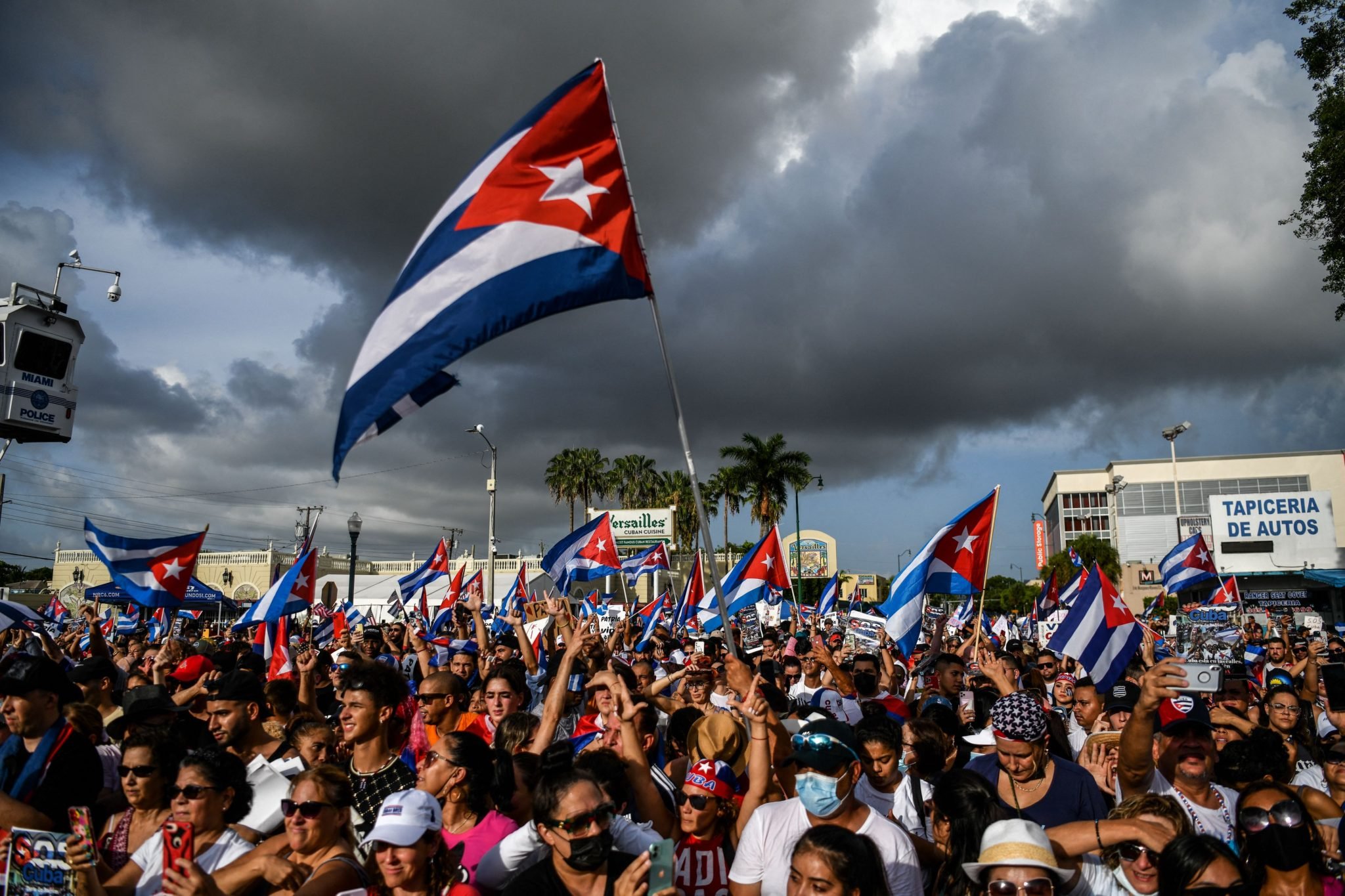
Image: Cuban Americans hold a rally in Miami to support dissidents on the island, July 2021. Flickr.