AFRICOM Watch Bulletin #58
As we reflect on the actions and demands of the 5th International Month of Action against AFRICOM, we are reminded that our struggle is not a new one. It is a direct continuation of the resistance that began the moment foreign powers decided that our land, labor and lives were theirs for the taking. The term “Scramble for Africa” remains a reality on the African continent today. The players may have changed, with new flags joining the old, but the objective remains the same. In this critical interview, we delve into the core mechanisms of this modern-day scramble. We tie in the comprador class with the presence of the U.S. Africa Command (AFRICOM) as a military enforcer of the broader neocolonial project. We also analyze the shifting dynamics of power, as seen in the revolutionary AES (Alliance of Sahel States). Ultimately, this issue seeks to remind readers that our liberation is inextricably linked from the continent to the diaspora, demanding a unified and unwavering resistance against all forms of imperialist control.
U.S. Out of Africa: Voices from the Struggle
AFRICOM Watch Bulletin spoke with Djibo Sobukwe, a long time Revolutionary PanAfrican Internationalist and a retired educator based in the US. A former AAPRP member who worked with Kwame Ture on the Political Education committee, he is currently a member of the Black Alliance for Peace working on the Africa and Political Education/ programs teams as well as the US out of Africa steering committee. Djibo has also written various articles, many of which are published on Black Agenda Report.
AWB: We’ve recently had our 5th International Month of Action Against AFRICOM this October. This year’s theme is “21st Century Neocolonialism: Capitalism, Compradors, and the Ongoing Scramble for Africa.” The first demand of the “ShutDown AFRICOM” campaign is “The Complete Withdrawal of U.S. forces from Africa. For those of us who are just becoming aware of what is taking place on the continent, what is meant by the “Scramble for Africa,” and how are U.S. forces being utilized to maintain these conditions across the continent?
DS: Well the “scramble for Africa” is not new, in fact it goes back at least to the Berlin conference which was a conference held in Berlin in 1884 – 1885 when the European colonial powers that had taken various territory in Africa came together to peacefully decide which European country would get which piece of Africa and they parceled Africa as if it was a piece of cake. Even though the US was not represented at that conference, the US had already colonized Liberia in 1820 using the American Colonization Society and formerly enslaved Africans in the US as its instrument. The wealth of Africa was so vast in natural resources and human labor that As WEB DuBois points out that the two imperialist wars (World Wars) were both fought for the spoils of Africa. This scramble is still going on today where there are in addition to the old colonizing powers such as France, the UK, Portugal, Belgium etc. there are some new players that have joined ‘the scramble’ contending for influence for example, China, the UAE, Saudi Arabia, Qatar, Turkiye, Israel and the Russian Federation.
AWB: This year’s theme makes mention of compradors. A term with Portuguese origins, comprador describes, in the context of neocolonialism, one—native to a colonized people—who facilitates the economic and political exploitation of their people by the colonizer-foreign ruling class. How do we identify those we might consider members of the comprador class, and how do we understand their role in maintaining the exploitation of our land, labor, and people?
DS: A typical comprador is an indigenous elite who serves as a conduit to foreign banks (like the IMF/WB) and other multi-national companies where they procure loans and facilitate the exploitation and economic looting of their own country via tax evasion, invoice manipulation and other corrupt means. The compradors facilitate what is known as ‘capital flight’ including ‘illicit financial flows’ which is embezzled money that ends up in foreign banks outside of Africa. Compradors manipulate foreign loans for illegitimate private gains which also puts them in position to leverage government policies to their advantage at the expense of the poor masses. Just to understand the magnitude of the problem, the African Development Bank recently determined that Africa’s yearly capital flight amounts to $587 Billion of which at least $ 90 billion comprises Illicit Financial Flows (IFF’s). This is money that could go towards education, health care, food security, infrastructure development and other necessities. A perfect example of a comprador is the former president of Zaire (now DRC) Mobutu Sese Seko who served as a local proxy for the US and Belgian governments in the governmental overthrow and murder of the great Pan-African nationalist Patrice Lumumba in 1961. After Mobutu led another coup to become the country’s military dictator in 1965 he remained self-appointed president until his ouster and subsequent death in 1997. During that time Mobutu murdered all of his opposition and amassed great wealth, all looted from the country’s economy and stashed in foreign banks. He had an extravagant palace and a big private airport. He was said to have established a kleptocracy to end all kleptocracies, and his net worth at the time of his death was reported to be $5 billion in a country where the average income was 60 cents per day.
AWB: We understand AFRICOM to exist in the context of a broader U.S. imperialist strategy for domination. What are some connections we might draw to help us understand the significance of AFRICOM to Haiti and Our Americas, to our communities, here, in the belly of the beast?
DS: The United States Africa command (AFRICOM) is one of 11 of the US Department of War’s combatant commands with a geographic function and mission that provides command and control of military forces around the world. AFRICOM is responsible for all US Department of war operations, exercises, and security operations on the African continent. AFRICOM initially began in 2007 and became operational on October 1, 2008. Its stated role is to support and work in tandem with US foreign policy in Africa to support US national interests. What is important to understand is that although AFRICOM is only one of eleven US command centers that cover the world, they work in complete cooperation with other command centers including SOUTHCOM and NATO to ensure seamless coverage of Haiti and all of the Americas. AFRICOM also has coordinated direct partnerships between the national guard of 14 states in the U.S. and 16 African countries. The partnerships also include interoperability in areas such as health care, education, disaster preparedness, infrastructure development, cyber security and counter-terrorism to name a few.
AWB: AFRICOM—being the U.S. military command in Africa—operates to facilitate the violent capitalist exploitation of Africa. To get a fuller picture of what this looks like, we must also understand some of the other institutions and mechanisms at play in that process of exploitation (the United Nations, the IMF and World Bank, ECOWAS, NGOs, today’s African Union, etc.). What are some institutions and mechanisms that play a role in this exploitation and how does AFRICOM serve to enable them in that process?
DS: In his book, "Neo-colonialism: The Last Stage of Imperialism", Kwame Nkrumah describes the mechanisms of neo-colonialism which include not only the economic field but a wide array of fields such as the political, religious, ideological and cultural fields as well. I would add to some of the institutions you have already named, NATO, which works closely with AFRICOM and the African Union where NATO even has an office. The National Endowment for Democracy (NED) which essentially serves to insure a capitalist ‘US business friendly’ development of local neo-colonial governments. Of course we cannot forget the CIA of which Nkrumah said is at the heart of the “invisible government” and is covertly involved in all of the organizations named and also in some that may seem benign or even humanistic like the AFL/CIO, Peace Corps, Christian evangelism, US Information Agency (USIA) etc.
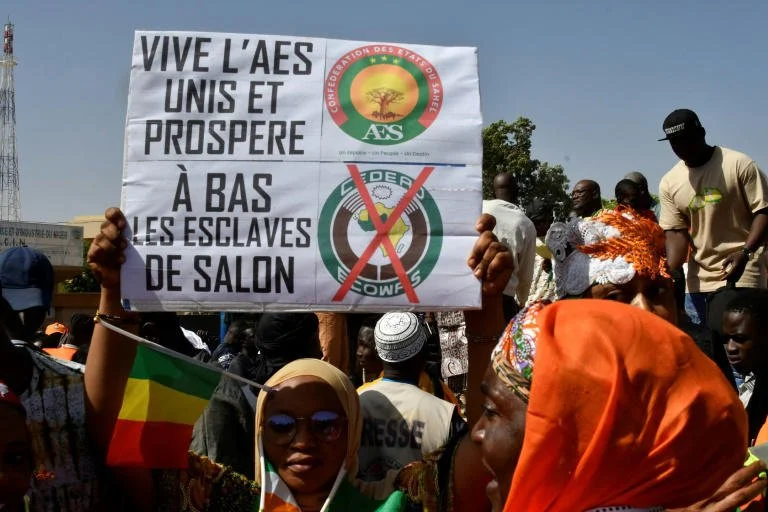
AWB: In 2023, ECOWAS threatened military intervention and imposed sweeping sanctions on Niger shortly after the popular military uprising, including the closure of land and air borders, the freezing of all financial transactions and assistance, and the suspension of utility services that disrupted over half of Niger’s electricity supply. ECOWAS also suspended all three member states of the AES shortly after it was formed. When the AES member states responded by permanently withdrawing from ECOWAS, the tone quickly changed and ECOWAS started urging negotiations and reconciliation. How should we understand this shift in ECOWAS’s strategy toward the AES?
DS: Well, ECOWAS and specifically Nigeria (which is the leading country in ECOWAS) and its president Tinubu understands that its threatened military invasion of Niger and sanctions were highly unpopular not only in the AES countries but also especially in Nigeria which shares a border with Niger. This colonial border, as is often the case, divides a large ethnic group on each side of the border, the Hausa which are the largest ethnic group in northern Nigeria and have many of their kin living in Niger as well. Add to this that Nigeria is the largest military force in ECOWAS (ECOMOG) and the largest ethnic group that comprises Nigeria’s military are Hausa from the North of Nigeria. Therefore there was no appetite for Nigeria’s military to militarily invade their brethren in Niger. It was understandable also that ECOWAS withdrew its sanctions based on humanitarian grounds.
News and Analysis
Sudan: Africa's Regional Neo-Colonial War
November 5th, 2025 by Black Agenda Report
Macron, Madagascar, and the Return of France’s Old Colonial Ghosts
November 9, 2025 by Raïs Neza Boneza
Mali defends sovereignty against a Western-backed “proxy war” by terror groups
November 19, 2025 by Peoples Dispatch
Sudan Internal Conflict Continues Despite Pledges to End Fighting by Imperialism and its Allies
November 23, 2025 by Abayomi Azikiwe
PAIGC/A-APRP Statement -Urgent Message: Military Attempting To Stop Electoral Process In Guinea Bissau,
November 26, 2025 by PAIGC and the AAPRP
Don’t Believe The Simulated Coup d’État in Guinea-Bissau
December 1, 2025 by BAP’s U.S. Out of African Network & Africa Team
Tanzania crisis: ICC filing, regional isolation mount pressure on President Hassan
November 26, 2025 by The African Mirror
100th Somalia strike of year shows AFRICOM mission that outpaces even US action in Caribbean
November 24, 2025 by Stars and Stripes